Big wooden boxes filled with all kinds of pumpkins and gourds lined the parking lot. Some were green, some orange, some white, some flesh colored, some big, some small, some shaped like gnome hats, some with big hideous warts, some squishy looking, some fat, some for cooking, some for decoration. When I walked through the opened door of apple house, a waft of sweet-smelling fried pies, pastries and breads tickled my nose. From the long line of customers, it seems they must have been enticed by the pleasing aromas too, as they waited somewhat patiently to make their purchases.
I made our selection of apples to be made into applesauce, pies and other tasty treats, and let my husband pay for them while I went outside to wait. As I sat on a bench people watching, I saw an elderly gentleman come my way. He pushed one of those small half carts, with his cane riding inside the little buggy. Carefully, he sat down on another bench. He had a slight smile on his face that looked like it could be permanent fixture. He looked toward another gentleman and said, “It sure is a pretty day, isn’t it?” There was no response. I watched him closely, then his eyes met mine and I smiled and nodded in agreement. When I got up to leave, I told him to enjoy this pretty day. His whole face lit up.
Little did the elderly man realize that seeing him stirred many memories for me. For several years in the fall of the year, another elderly gentleman, my father, and I took a trip to the Apple Capital of Georgia to get apples. We would make a day of it visiting one of the many orchards in the area and going out for lunch. Our adventures always included a scenic drive while Daddy told tales of his childhood and family history.
Autumn memories somehow make an already pretty day with family even sweeter.
I know a guy who doesn’t get out much other than for work and an occasional visit to a family member. He might be just a little bit hermitish (though I don’t think that’s a word).
One day he and another fellow went to a neighboring town to get items for work. They decided to stop and get some lunch at a Chinese restaurant. After eating their meal, the guy opened his funny little cookie. He thought it was nice that they gave him a cookie, and quickly put the whole thing in his mouth. As he chewed, he knew something wasn’t quite right. He pulled a narrow piece of paper out of his mouth and was surprised to see a prophetic message that read, “You will get a surprise!”
Wow! That was quick. I guess fortune cookies really do work!
Many old towns were built around the town square. Businesses, cafés, benches, and friendly folks were a welcome sight to residents as well as passersby. Some of you probably remember those days and were even among the number of those who “cruised the square” or sat on a park bench licking an ice cream cone or sipping on a cherry coke or shake purchased at the local soda fountain.
One small community in which we lived had a town square but there were very few businesses lined along the street. The square was more like a square with rounded corners. This town square had a fountain in the center. Some days, that was the talk of the town. Well, those were the days that followed the nights when some of the teenaged kids soaped the fountain, sometimes even in color. This small patch of greenspace was donated to the community in the mid-1800’s by a lady from one of the prominent families of the town. For being such a small plot, it sure was a popular spot.
On one side of the square was a small store. You could buy a candy bar and coke for about 15 cents. That’s when cokes really were the “real thing”. Candy displayed in racks included candy cigarettes much to my mother’s disapproval. The store was a short walk from our house, so if change rattled in my pocket, I would go to the store for a treat. My first choice was a Milky Way bar, but if I bought candy cigarettes, I hid them away.
The Post Office was on another side of the square where people came for more than mail. There was a lot of chatter as neighbors met and got caught up on the town gossip and the goings-on of family members, sometimes one and the same.
Across from the store on the other side of the square stood the United Methodist Church as a beacon to the community. Of course, we spent quite a bit of time there since my dad was the preacher. The land for the church building was given by the same benefactor as the parcel given for the square. The local churches were vital to the community. They provided a place to worship and a place for the community to come together and serve one another in time of need, sickness, or tragedy.
In the summer, there was a Marigold Festival complete with parade, and an occasional celebrity in the mix. Vendors, train rides, ball games, food, square dancing, and bands made the festival an attraction for residents as well as tourists. My sister was even a candidate for Miss Marigold one year. The whole city was planted in marigolds of various kinds. Everything was groomed and pretty with marigolds blooming in bright colors. There was a downside however – it didn’t smell too good. Marigolds are not the sweetest smelling blooms! The festival was an annual event from 1971 to 2002. However, the buzz is that the festival will return in 2022.
Though all of these were inviting characteristics of small-town living, there was another favorite of mine – the Bookmobile. We knew ahead of time when it would be parked at the town square in our little community. I loved going into the Bookmobile and rummaging through all the book titles and making my selection. It was almost magical to me. Books I might have overlooked in a library had a special appeal in the Bookmobile.
As I look back through the years, I feel richer and greatly appreciative of having the privilege to live in small towns with a big sense of community. Those are good places to call home.
That September day one hundred twenty-five years ago, Doctor Bezalell Bell Andrews arrived to make a special delivery. The next morning the Knapps welcomed another baby boy into the family. Dr. Andrews handed the baby boy to his mother and said, “Bee Bell. That’s his name, named after me. When he gets bigger, I’ll give him my silver watch.” The baby’s father wanted to name him Jack, but his mother said, “The doctor has already named him. He’s Bee Bell!” The Knapp family moved from Nebraska before little Bee was old enough to carry the promised watch, but he did carry the name with him all of his life. That in itself was a tremendous gift and extraordinary honor.
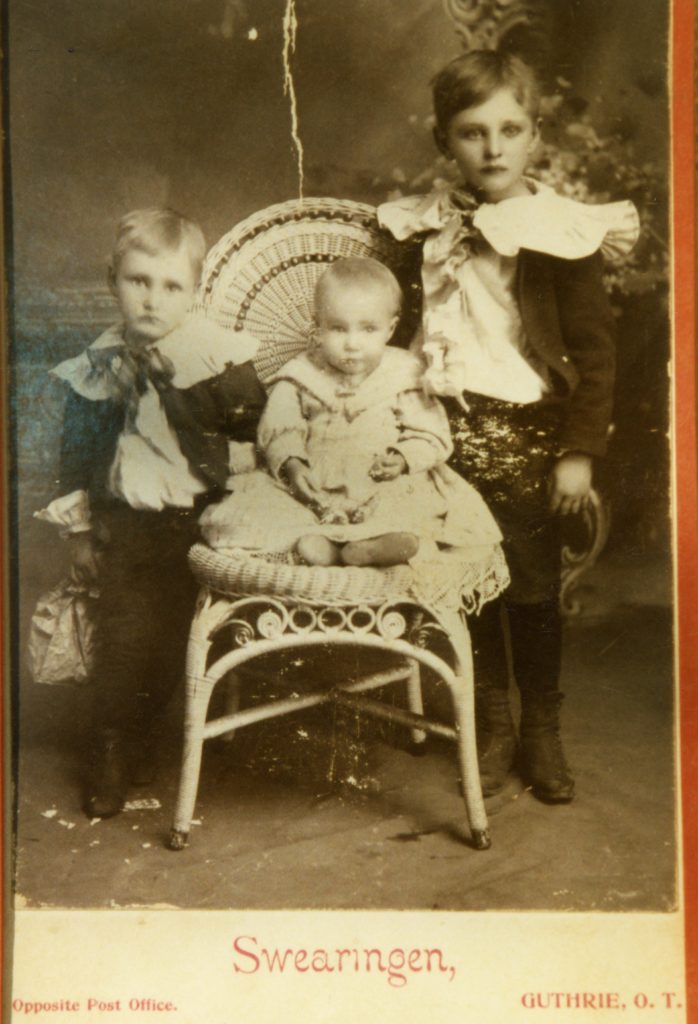
Bee Bell Knapp with sister Leone and brother Fred
Bezalell Bell Andrews, commonly known as B. Bell Andrews, was no ordinary man. His patients and community knew him as a respected physician and surgeon. He practiced medicine, which included homeopathy, in Stella, Nebraska for a number of years. His wife was also a doctor. But there was more to Dr. B. Bell Andrews. More than thirty years before the delivery of a baby boy on that 29th day of September, 1896, Bezalell Bell Andrews was a prisoner of war.
While serving with Co L 17th Illinois Cavalry, Andrews was captured at Jonesville, Virginia on January 3, 1864, and sent to Belle Isle, Richmond, Virginia. In February, the prisoners on Belle Isle were moved to Andersonville, Georgia. It is said, “The men who left Belle Isle were dirty, poorly clothed, and almost all of them weighed less than 100 pounds.”
Upon arrival at Andersonville, Andrews (aka Lale) was taken into a building where his chum, John McElroy (aka Mc), saw him. That may well have been the salvation of both of the teenage boys who were thrown into manhood in one fell swoop. McElroy, who became a journalist and author, later wrote of their experiences at Andersonville as well as the other camps to which they were moved before being released.
McElroy told of his initial arrival at Andersonville, “Five hundred weary men moved along slowly through double lines of guards. Five hundred men marched silently towards the gates that were to shut out life and hope from most of them forever. A quarter of a mile from the railroad we came to a massive palisade of great squared logs standing upright in the ground. The fires blazed up and showed us a section of these, and two massive wooden gates, with heavy iron hinges and bolts. They swung open as we stood there and we passed through into the space beyond. We were in Andersonville.”
The two friends stayed together and managed to gather a few items including a couple of tin pans, a few pieces of lumber to construct a shelter, a few onions and collards from a garden on the side of the road, and a few garments stripped from the dead. They shared a coat and a blanket, huddling together for warmth.
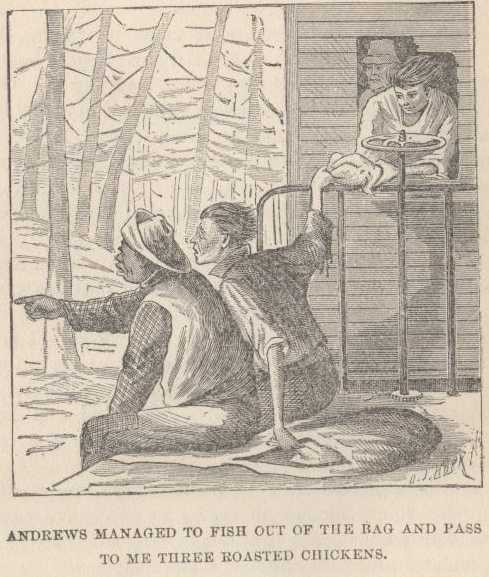
illustration taken from Andersonville : A Story of Rebel Military Prisons by John McElroy, 1879
One of their prized possessions was a crudely made chess set. Here is McElvoy’s account, “My chum, Andrews, and I constructed a set of chessmen with an infinite deal of trouble. We found a soft, white root in the swamp which answered our purpose. A boy near us had a tolerably sharp pocket-knife, for the use of which a couple of hours each day, we gave a few spoonfuls of meal. The knife was the only one among a large number of prisoners, as the Rebel guards had an affection for that style of cutlery, which led them to search incoming prisoners, very closely. The fortunate owner of this derived quite a little income of meal by shrewdly loaning it to his knifeless comrades. The shapes that we made for pieces and pawns were necessarily very rude, but they were sufficiently distinct for identification. We blackened one set with pitch pine soot, found a piece of plank that would answer for a board and purchased it from its possessor for part of a ration of meal, and so were fitted out with what served until our release to distract our attention from much of the surrounding misery.”
Whenever they were moved, they would gather up their crudely carved primitive chess pieces and board and wrap it up in a holey blanket as if it was the grandest and only possession in the world, pushing their way to the forefront. They wanted to be the first load of prisoners to be moved, hoping with the hope of a futile promise of being exchanged for Southern prisoners. They were human pawns in their own game of chess, using their honed wits and strategy to survive.
It is said that “War is Hell.” In this hell, teenage boys were forged into men. Here, a name was made, but Bezalell Bell Andrews was more than a mere name, it spoke of character, endurance, and determination.
Not only does history touch each of us in some way, but it is in our history that names are made and character is fashioned. The little boy named Bee Bell, born that fall day in September 1896, became my grandfather. He carried his name well, for he too was a man of honorable character with a heart of compassion.
Having been on my own journey, I was returning to the home I have known for many years. I flew on wings of blue and white as the eagle soars through the sky.
As the day faded, I pulled a book from a bag and began to read. It was the story of a boy who grew to be a revered Indian Chief – the chief of the Crows.
My eyes became heavy. I set the book aside and drifted off to sleep, wandering in another land and place. Somehow the words I had read were played out before my eyes. Indian boys clothed in wolf skins stepped into manhood , approaching a buffalo ready to charge. One young boy began his own journey to find the path of his destiny as leader of his people. I saw a glimpse into the life of a great warrior and chief.
As quickly as my eyes closed into slumber, my mind was roused back to reality. The dream, though brief, faded into the darkness.
And yet, the thought came to mind in an inaudible whisper, “Your father would be proud.” Of where the thought came, I did not know. Was the voice because of my own journey? Was it the cry of the voices of a people in search of a land? Of that, I cannot tell.
The plane landed and we made our way to the baggage claim area. As we waited, I looked, and above the baggage carousel was a sign, “There are road trips. And then there are pilgrimages.”
My Guest Author is Ed Brannin who tells about a true life incident
In the mid 70’s I was working for the Sweetgrass County Sheriffs Office. There had been a theft of saddles and tack in Fergus County. A suspect in the theft allegedly lived in Sweetgrass County and the investigation lead to a search warrant. When the search warrant was executed none of the stolen saddles were found. This resulted in the Sheriff’s office being accused of fabricating the story about the theft.
About this time Uncle Sid had been visiting with his sister Anita. During his visit he had picked up an old saddle that he was going to take home to Washington. The night he was leaving I was working patrol. I saw Sid standing outside the bus depot getting ready to leave. He had the old saddle with him. I decided to stop and say goodbye. When I got out of the patrol car, Sid threw his hands in the air and hollered that he gives up. After this the word spread that the investigation into the saddle thefts must have been legit since the Sheriff’s office had spoken to a suspect with a saddle.
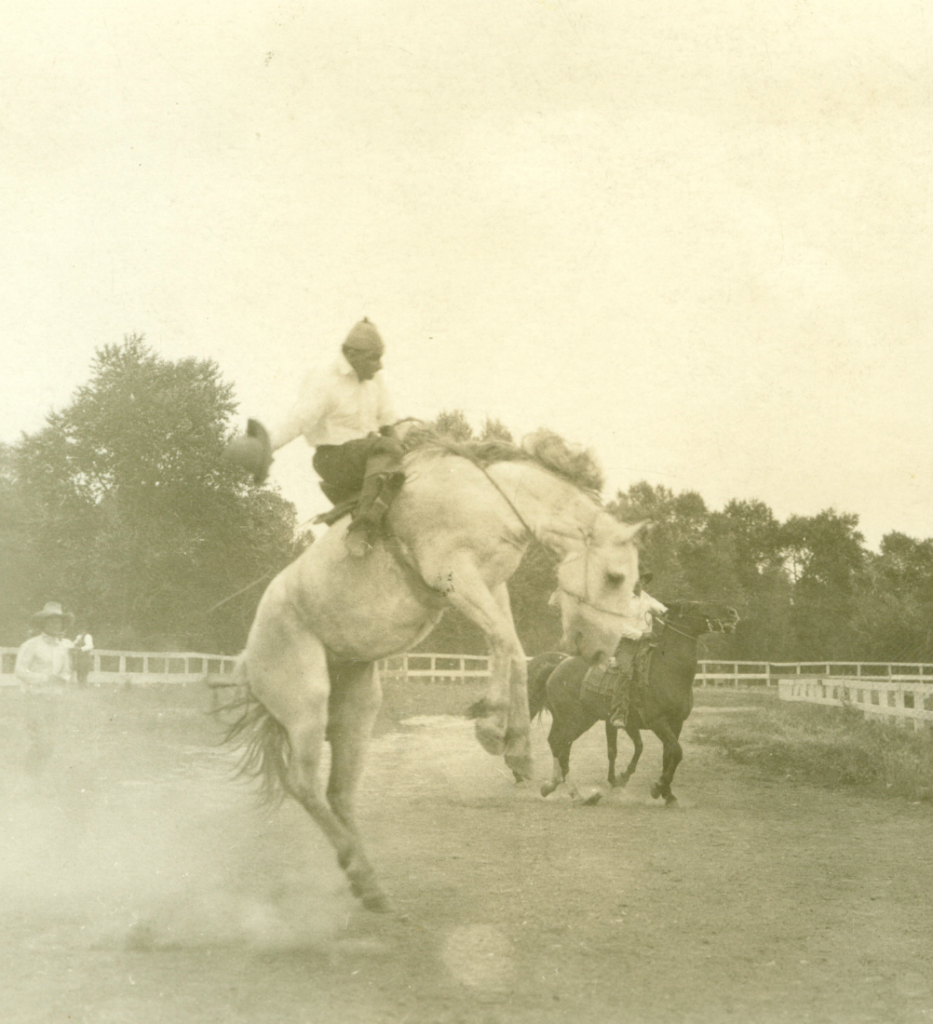
Uncle Sid at the rodeo at Big Timber, MontanaUncle Sid with JugheadUncle Sid on Butterfly at Harlo rodeo 1924
Note: I’m sure Uncle Sid got a big kick out of that! He was such a jokester! Come to think of it, he did have a large collection of saddles…….
We pulled into the gas station to fill up the truck. Parked at the pump beside us was a green F250 that was hard pressed to be considered green. It was covered with mud, dust, and very likely other ranch excrement. The diesel was running, and it was evident the engine had been revved a time or two.
But that wasn’t what caught my eye. There was a guy, I assumed the owner, in the back of the truck along with a four-wheeler. When he had pumped gas into the four-wheeler, he took rags and wiped off the gas cap and the seat. He took the squeegee and cleaned off the mirror, then wiped the whole thing clean. When it was to his liking, he hopped in the dirty truck and drove off into the sunset.
I thought the scene a bit amusing. As I pondered it, the modern cowboy came to mind. When I was a kid, we drove into western towns and were rewarded with seeing real cowboys – you know, the ones who wore cowboy boots with jingling spurs, cowboy hats, western pearl snap shirts, walked bowlegged, and rode the range on horseback. Their horses were well cared for – fed, brushed, and rubbed down. They not only bore their rider across the range to drive cattle, mend fences, check livestock, etc., but they were also the cowboys’ companion.
Nowadays, four-wheelers ride the range. The guy who carried his four-wheeled horse powered steed in the back of the truck was just taking care of his ride.
That was the response from the little man whenever something strange happened or something was missing.
One day I opened the microwave oven. I said, “Daddy, why is there a cup of cold coffee in the microwave?”
His reply? “The old man did it. He must have gotten it warm and forgot to take it out. I’ll drink it in the morning.”
“Daddy, your t-shirt is ripped.”
“The old man did it.”
The old man moved papers, left trails of spilled coffee on the floor, left burners on, set off the smoke alarm, hid things, and did other antics.
One morning Daddy came out of his bathroom and said, “I looked in the mirror and there was an old man staring back at me.”
That old man in the mirror hung around for a while. I guess that was good because he was company for my dad.
Note: Sometimes when I look in the mirror, I see one of my sisters in the blink of an eye, but the other day, for one split second, I thought I saw an old man in the mirror (that looked like my dad) looking back at me.
This is a remembrance of my guest author (my dad) about one of his uncles
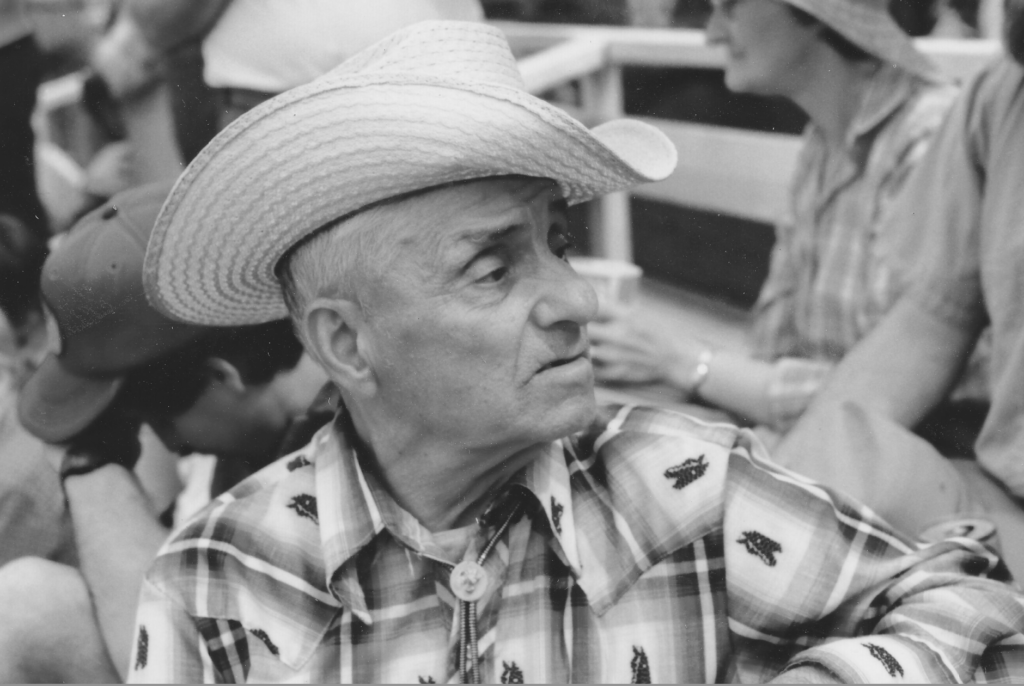
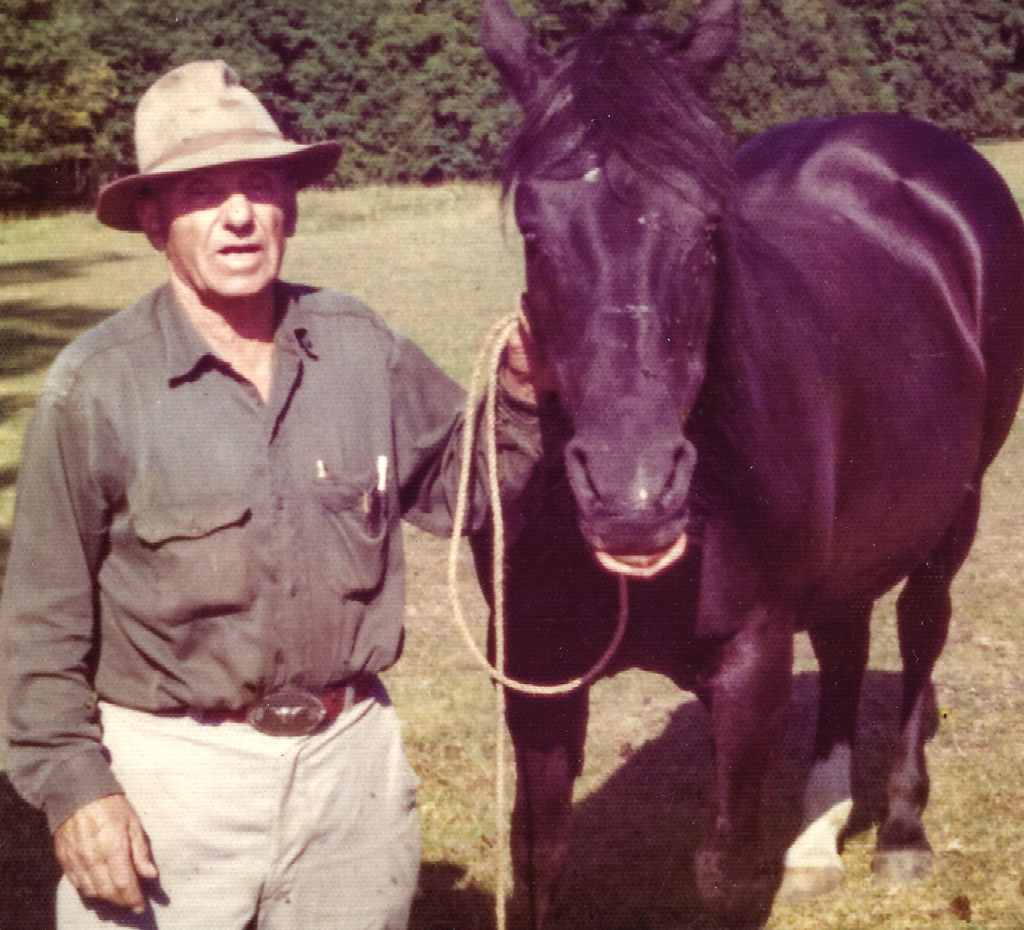
Charles Crawford Brannin had many nicknames. Some of the neighbors called him Crawford. Dick Brannin called him Diney. Several nieces and nephews knew him as Sparky. Father and Uncle Ed called him Tommy. However, to my sisters and me he was Rube.
A load of names was bound to slow anyone down. Fortunately this didn’t go against Rube’s nature. It wasn’t that he had anything against hurry in principal; if people wanted to do a day’s work in an hour’s time that was their problem. Anybody with a lick of sense ought to know that rushing about was best reserved for memorable occasions. The three or four times we saw Rube in a rush were memorable occasions.
The winter of 1942-43 Uncle Ed and Aunt Dora stayed with us. The first week in January, Rube came steaming up the road. He busted into the shop where the stormy weather had driven us. He didn’t even bother to brush the snowballs off the bottom of his tattered trousers but went straight over to his older brother.
Rube and sister Babe
“Gu-guess wh-what?” he said, waving a chopper mitt in Ed Brannin’s face.
“What?”
Rube burst into a grin. His week’s growth of whiskers grinned with him. “B-B-Barney just married the long legged school marm.”
That was news! Barney Brannin was fifty four years old and Nella Francis was in her early twenties. “B-b-bet they have some l-l-long legged kids.”
Barney and Nella didn’t produce any children, but the marriage did change things at the Brannin Hunting Lodge. About the end of January, Rube came hobbling up the road with a sack on his back. He was mumbling to himself all the way. When he reached the barnyard, he sat the sack on a bare place on the snow spotted ground. He took a short breather, and then, wagging his finger, he began talking to whatever was in the sack. “D-don’t worry. I’ll be back after while.”
“What you got in the sack?” Dad asked as Rube came into the yard.
“It’s B-B-Bones,” Rube answered.
He untied the gunny sack and dumped a red rooster on the ground.
“Brought him up for vacation,” he explained. Then a scowl crossed his face. “I-It’s on account of N-Nella,” he said. “She’s got a h-h-hungry look in her eye.”
Bones was in charge of the Brannin hen house. Every so often the cook would crave a chicken for dinner and Rube would bring Bones up for a vacation. The rooster spent Thanksgiving and Christmas with us. Those were critical days. Luckily Bones was old and tough or he’d have never made it through the Fourth of July. That’s when the Brannin cook would poach some of the spring hatch for chicken dinner. But here it was – January.
“Wh-when B-B-Barney gets to town, maybe he’ll buy Nella some w-wieners.”
It was cold weather and Barney didn’t get any wieners until the end of February. By then things were in a desperate condition. Rube was getting homesick for his pet rooster and so were the hens. In fact, Rube’s pullets were on strike. They hadn’t laid an egg since the end of the year and the first of March is egg laying season.
“D-danged hens fergot how to lay,” Rube announced when he came after his rooster. Hopefully old Bones would stir the hens to action. Rube hobbled down the road with a sack of live chicken over his back. A week later he came back. This time he was traveling in the express lane, coming in a dead run, which for him was twenty yards without stopping to see how far he had come.
When Rube reached the house he didn’t even go for Dad’s tobacco can. You could tell there was something important on his mind. It came pouring out in a conglomeration of words. It seemed that Bones had gone right to work getting the hen house in order. Two or three days after the rooster returned, Rube found him scratching the straw in a nest box. Later that afternoon there was an egg in the box.
“B-B-Bones laid it,” Rube boasted. “B-b-best rooster I ever had.” He shook his head in amazement.
“Whoopee” he shouted. “B-b-ones L-l-laid an egg. Wha-what a r-r-rooster. Wh-whoopee!”
He pulled his ragged jacket off, unzipped an empty tobacco pouch and headed into the middle room for Dad’s can of Prince Albert tobacco.
We played cards, but then, we were Methodists! The Baptists down the road wouldn’t be caught doing that and truth be known, Mama and Daddy didn’t want us caught at it either.
They weren’t opposed to us playing, we just couldn’t do it in view of passersby with the possibility of being the topic of conversation around someone’s dinner table that night. We had to maintain a certain appearance you know – especially since we were the preacher’s kids and were often held to a higher standard than the neighborhood kids.
One day my sister and I headed out to the front steps to play a friendly game of poker. We were quickly told that we could play in the back yard or in the house where no one could see us. I didn’t see a problem, nor did I think it was anyone’s business. Some folks even frowned on solitaire or pinocle or rummy.
Our poker playing was quite harmless. After all, we used candy corn for poker chips. If someone happened by, we could easily destroy the evidence by ingesting the sweet nuggets. Surely using candy corn ante couldn’t be considered gambling. Well, I guess it was quite a gamble for the winner who took the ante pot that had been handled by everyone at the table. You can bet that made the win not quite so sweet.