While talking with a cousin the other day, he said, “We aren’t good neighbors anymore.” I thought, “He is exactly right.” Often, we don’t even know our neighbors. An age old question is, “Who is my neighbor?” Well, it can be anyone.
Once upon a time, neighbors needed one another. Neighbors weren’t necessarily close in distance but were essential. They would stop what they were doing to help others.
A neighbor might make a five-mile trip in the middle of the night to deliver a birth announcement or rescue an expectant couple when the bridge was out. Neighbors gathered to help raise a barn, fight fires, help in the fields, brand cattle, sew and quilt, or make home repairs. They were there for funerals, weddings, tragedies, in time of sickness, and times of great joy. They pooled their resources, worshipped and fellowshipped together, and made time for each other even in the busiest of times. Neighbors were a necessity. They became friends and valuable treasures.
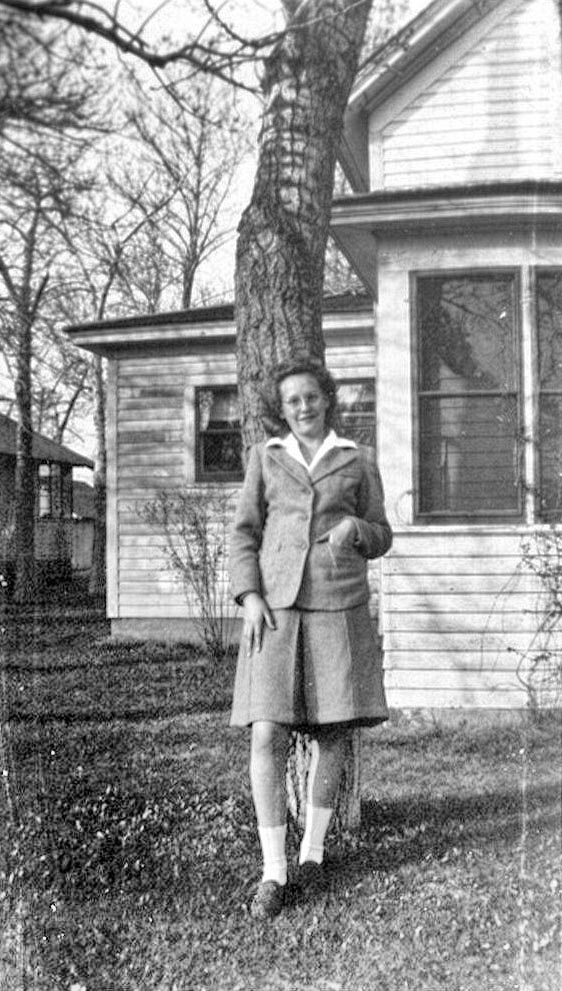
My great grandmother was such a friend. She was midwife to expectant mothers, doctored neighbors with her herbal remedies, and considered the matriarch of the community as well as her own family. They knew what it meant to be a neighbor and a friend.
William Butler Keats said, “There are no strangers here; only friends you haven’t met yet.”
Daddy’s instructions were to pack for our trip. I gave him a list of restrictions for carry-on baggage in order to be TSA approved. Containers of liquids could only hold 3 ounces, no sharp items allowed, no ammunition, etc. We were up early, loaded our luggage in the car and headed to the airport. The line through security was short and we went through with no problem.
Our visit with family and friends passed all too quickly. Soon, it was time to take the flight back home. Once again, we had to go through security. Daddy was in different line than me. I got through, grabbed my carry-on bag and waited.
Where was that little man? I turned around and scanned every line. There he was! The TSA agents had pulled him aside. I walked over to get a closer view. The agents pulled items out of his bag. What was that? A huge bottle of hair gel! That was definitely TSA Unapproved! They confiscated his big bottle of gel and sent him on his way. I couldn’t figure out how he got through security the first time.
Now why does one little man with a little bit of hair need a great big bottle of hair gel?
I don’t know either.
The next time we took a flight, I checked his bag before we left home. He made it through security without any alarms going off – TSA Approved.
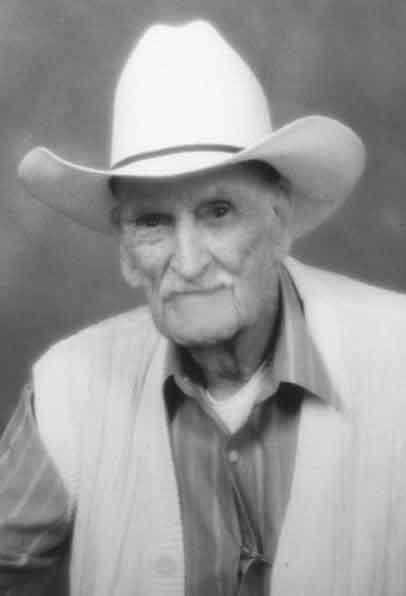
My granddad loved to take a ride through the countryside. (So do I.) We would load him up in the car or truck and drive down country back roads. He was as happy as a lark. Leather gloves in hand, he ran them through his big hands, cowboy hat on his head, and a big smile on his face. He spoke of the “good grass” he saw and told us how many head of cattle could be raised on such a spread as opposed to how many horses could graze that same land. Whether it was North Georgia hills, or Montana prairies, the child-like wonder in his eyes never faded.
We crossed over a creek and his memories were stirred. His tale took us back to a time when horse and wagon were the mode of transportation. He and his batchin’ partner, John, saw a storm coming up. They unhitched the wagon, grabbed their gear and set up their tent. Just as the storm hit, a man, his wife and new baby came flying up in their wagon. My granddad rolled back the tarp and invited the travelers inside out of the storm. As he told the story, he pointed to a grassy place near the creek and said, “Right there is where we camped.” Of course, it wasn’t “right there” where they camped, but in his mind, he was transported to a different time and place. In his eyes, it was “right there.”
Passing a field, we heard of his days on Sun Prairie Flats and working the harvests all the way into Canada. Grazing horses evoked remembrances of working on the Long X Ranch. Stories flowed of the mountains around Calgary and celebrating the Queen’s birthday. Tale after tale followed.
As he reminisced, he marveled at the land around him. His eyes twinkled with every recollection.
Oh, that we could see the world around us through such eyes.
Knew horses and cows before she knew people other than family Knew the meaning of hard work Weathered by time Gracious, down to earth
Artist
Woke early, stayed up late to care for her household
No drippy words of love but displayed it in every action
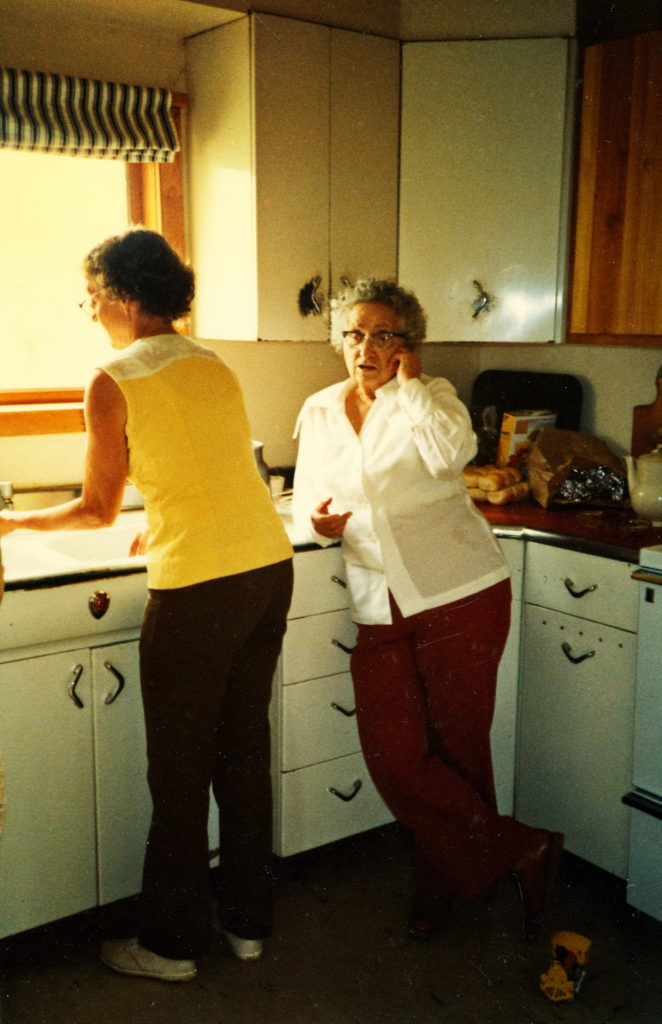
Cared for bum lambs as well as children, nieces, nephews, and grandchildren
When someone came to visit, she set another plate on the table Fresh bread, real cream, Cream puffs with raspberries Roast beef, potatoes and gravy for weary hikers
Spoke of old days but did not linger on the past
Even when she was injured, nothing slowed her down
She could ride a horse or four-wheeler with best of them Cattledriver
She was a faithful partner of her rancher husband Always had a fuzzy companion or two
Though her brother did not live close, she adored him
The long trek from New Mexico to Montana had not been without hardship and loss for the Brannin family. Their bout with typhoid had lifelong effects, rendering the youngest son handicapped. Heading north from Annabella, Utah, where they had wintered, they were caught in a snowstorm that took about half of their goat herd.
Almost a year after their departure from their ranch along the Sapillo in New Mexico, they arrived at their Montana destination where two more children were added to the family. However, that was not the journey’s end.
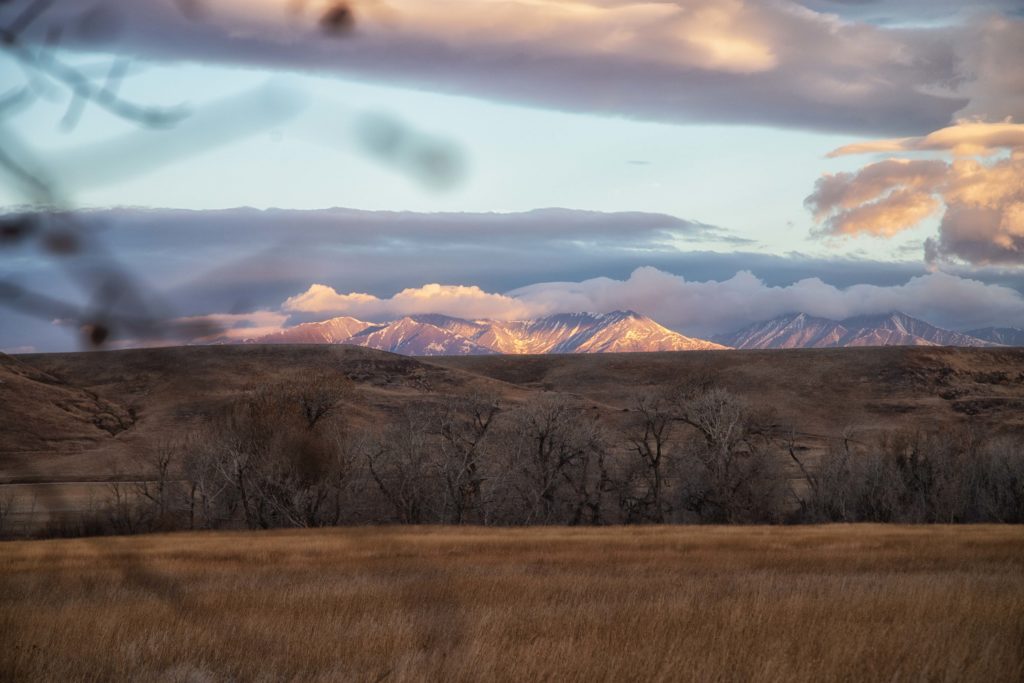
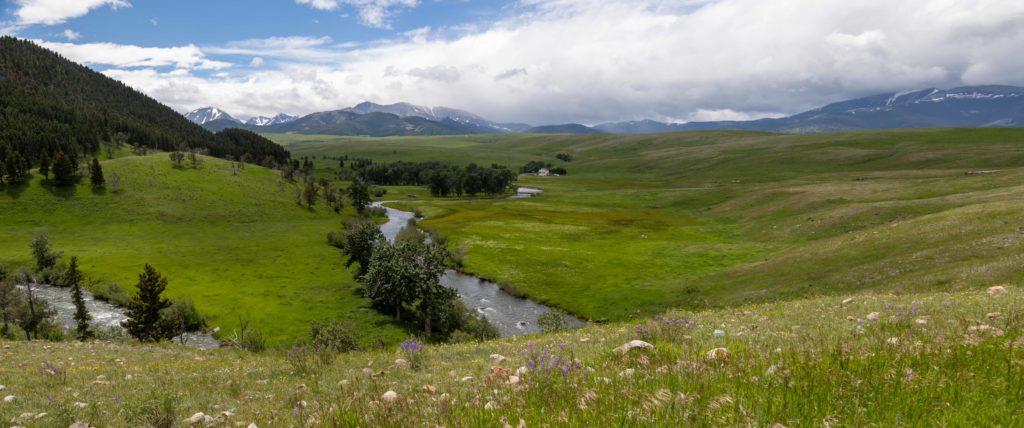
One of the boys, Ed, and a friend rode into Sweet Grass Canyon in 1898 after checking out mining possibilities in Fergus County. The two young men on horseback followed the trail that led into the Crazy Mountains. As the trail began to descend, they rounded a hill, and it seemed as if a secret doorway opened in front of their very eyes. In the valley below, the river danced and sang a tune as it made its way from the mountains through the horseshoe bend and beyond. They had never seen such a view. Before them lay Sweet Grass Canyon. Immediately Ed knew that his family had to move to the heart of the mountains.
They crossed the river, and stopped to talk with C. M. Rein, a Norwegian man who had made his home there in 1893. The Reins became valuable neighbors and friends of the family for years to come. They also visited the Tucker family who lived on the Sweet Grass near Melville. The Tuckers, who they had known from Marysville, were more than friends, they became family as well.
After spending the winter in the Crazy Mountains of 1898-99, Ed made his way back to Silver City, Montana, to tell the family of the paradise he had seen. Upon his return, he encouraged the family to move to that paradise. Grandfather Brannin went to look it over, pulled up stakes in 1904, and made the move. Joe had his misgivings because it was too far from a school. Had the matriarch of the family known of future events, she might have had misgivings as well.
The youngest girl, Babe, remembered the trip, “Papa and Joe came to get us and take us to the Sweet Grass and the Crazy Mountains. Papa drove the spring wagon with Mamma, Sid, Bess, Crawford and me in it. Joe drove the lumber wagon and Will Smedley went along to help. I think Gus must have been with Dick over at the new place.” According to Sid, they camped the first night on the Missouri near Helena. The second night they camped along the trail and the third night near White Sulphur Springs. They traveled by way of Deep Creek Canyon and spent the fourth night in Martinsdale. The fifth night was on the Little Elk near Two Dot. When they passed the American Fork Ranch, they knew their destination was within reach.
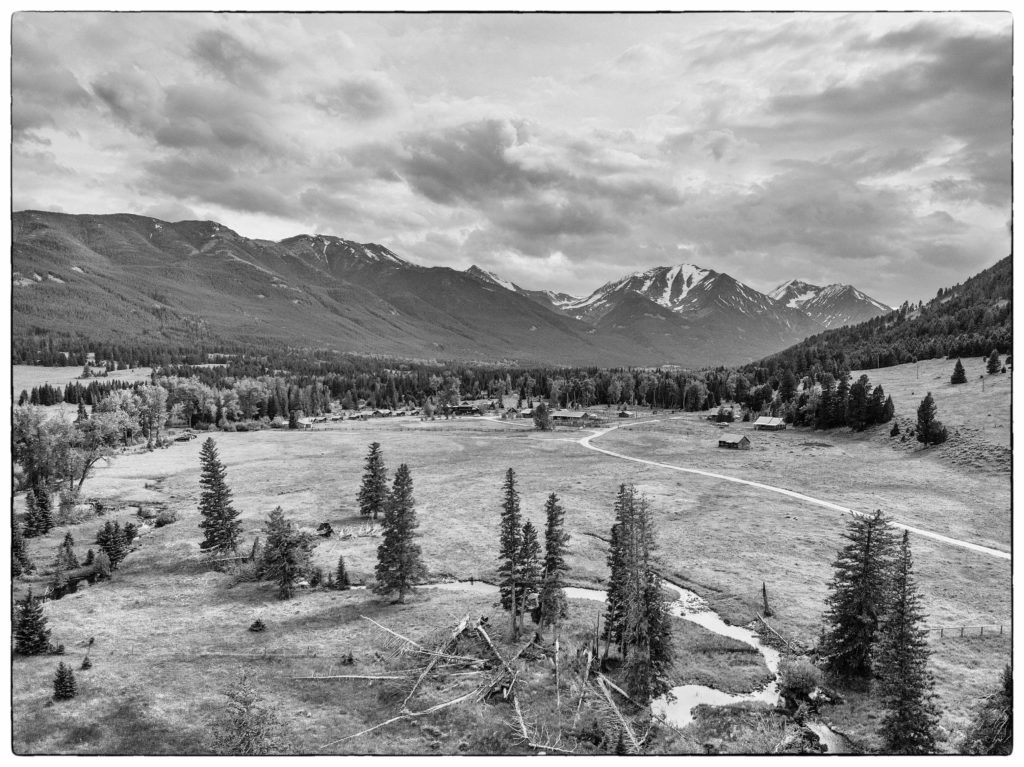
As the wagons topped the rise and followed the trail into the valley, they saw the horseshoe bend of the Sweet Grass River. Looking into the canyon in front of them, they knew this was home. For the first time in her life, the matriarch felt safe and was no longer afraid to be alone. The mountains called her name, and she answered the call. With her back to the mountains and the valley before her, she found her place of refuge there in the heart of the mountains. She was finally home – a place of safety, surrounded by her family, and neighbors who needed one another.
Years later, Babe, the young one who rode in the spring wagon at five years old, said every time she came to that place at the horseshoe bend, she thought the same thing, “This is home.”
The simplest of things can often bring the most comfort. It might be a silky pillowcase. It could be in just a couple of words or a tune of a song. It might be found in the corner of a blanket or a small worn-out stuffed animal. It could be in a smile or a quiet hug. Those little things, seemingly insignificant, carry big medicine.
Daddy and Brownie, the bear
You’ve heard the story of my daddy’s teddy bear, Brownie. I know just how he felt about his bear because I feel the same way about the bear my mama made for me when I was about four or five years old. He is made out of brown corduroy, with off-white velvety paws and ears, and embroidered eyes, nose and mouth. His corduroy is worn thin, his neck has been restuffed and stitched together a few times, and he has flannel patches on his tattered body. He might not look like much, but to me, he is more than special. Having him close by is comforting especially if I don’t feel good or have had a bad day. He is good medicine.
That’s not the only medicine I have. When I was quite small, my Montana grandmother came to visit. That was a treat! I never got to see her as often as I would have liked, but it never failed that when I did, it was just like we had never been apart. On that particular visit, she made a special treasure for me – a quilt. The pieced side is made from scraps of flannel. It is soft, warm, and cuddly just like my grandmother was. I didn’t use it a lot, but rather tucked it away for special times when I needed an extra dose of comfort.
My quilt has a few worn places just like my bear and me. Even though I am a grandmother, there are still times I carefully pull the quilt over me and hold my bear close.
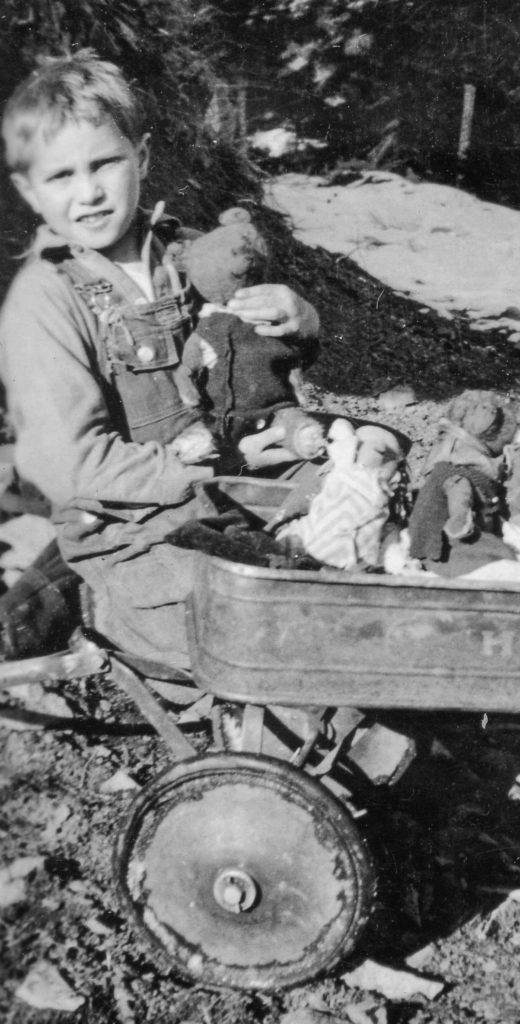
On the day of Jack’s funeral, a man gave the kids’ mother a dollar to get something special forJack’s younger brother and sisters. They found their treasures at the Big Timber Golden Rule – three fuzzy stuffed bears – a gold one, brown one and green one at 35 cents each. Even the store clerk’s heart was pricked, and he sold the three bears for a dollar. Even though Brownie the bear offered some comfort to Jack’s little brother, loneliness still crept into his world.
To little brother Buck, that bear was special. In his young mind, that was all he had left of Jack. For a year after his brother’s death, little Buck thought they were all doomed. One night tears slid from his eyes when he said his prayers, “God, let my Teddy Bear be buried with me when I die.”
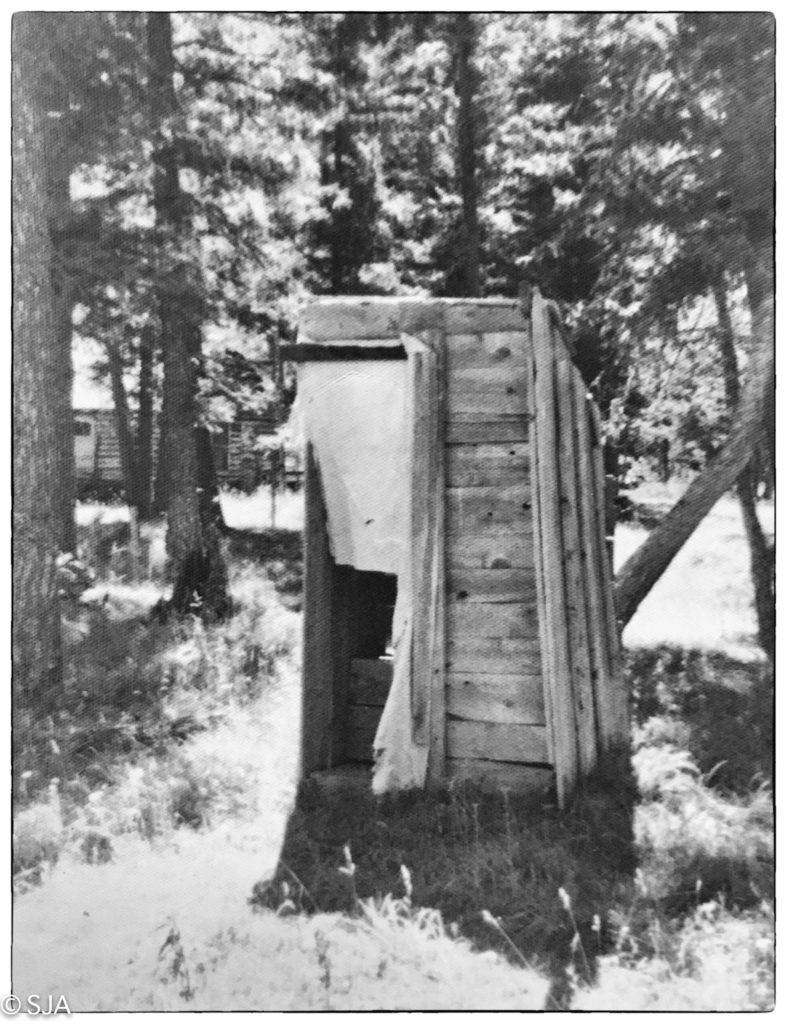
The Privy
The little boy carried his bear with him everywhere. One day when he took the bear with him to the outhouse, he set the bear beside him very carefully, but the bear toppled over and fell into the deep pit out of the boy’s reach. Indian Charlie heard him cry and scream all the way up at the sawmill. His mama heard him probably before he even screamed because mamas have premonitions and know things before they actually happen. She ran to the outhouse thinking something terrible had happened. It had.
Little Buck’s mama was a hero. He thought she was an angel. She assessed the situation, got the garden rake, and rescued Brownie, the brown fuzzy bear, out of the dark murky hole. Immediately, she tossed the bear into the horse trough. When the bear came up for air, little Buck grabbed him from his watery grave. His mama brought his teddy bear back from the dead. It was too bad she could not have done the same for his brother Jack. It took years for the little boy to get over the loss of his brother. In fact, it took all of eighty-seven.
Brownie almost lost his life again when Sister Ellen wanted to give her doll funeral rites. Not wanting the doll to be buried alone, she convinced Buck that the bear should be buried, too. It’s a good thing the bear was buried with his ear sticking out. He was soon rescued when he was pulled from the sawdust pile by his ear at the hand of a little boy.
At the old homeplace way back in the heart of the mountains, the outhouse, known to some as the privy, though it was the smallest “house”, may have been the most important building of all.
It was a place to read the “Monkey Ward” magazine, which was also used for other things. It was a place to think or make up a song. It ranked high as a place of necessity. Someone could sit and rest and hear the water piped from the spring splash into the horse trough and spill over the sides. Little kids learned how to run fast from imaginary bears that lurked behind the privy ready to pounce. In the wintertime it wasn’t much fun having to make the trek to the little house even though grown-ups cut a trail for such emergencies.
Sometimes privies were used for pranks. On one such occasion Sister Ellen sent sister BJ on a mission to run to the privy and open the door. Little did BJ know the outhouse was occupied. The door flung open and there sat Effie Bowlegs reading Monkey Ward. He didn’t get rescued! I guess he didn’t have an angel watching out for him.
When I was a kid, I liked to eat frog eggs. They were really yummy. I liked them warm right out of the pan. I liked them cold, too.
I watched my mommy put dried frog eggs in milk with some sugar, a pinch of salt and the big yellow eyes of a few chicken eggs.
Eating frog eggs didn’t scare me. My brothers thought it would. That’s just because if I was afraid, they could eat the frog eggs in my bowl.
You might ask how I knew they were really frog eggs. That’s simple! My brothers told me so. They would never try to trick a little sister, would they?
When my husband was little, he ate Pop Cereal. His mama made that just like my mommy made frog eggs, only his mama left the dried frog eggs out.
I don’t eat frog eggs now, (I can’t find them in any of the stores), but I do eat Tapioca Pudding. Did you know it’s cooked the same way my mommy made frog eggs for us?
Story inspired by an old, abandoned Michigan homestead
Faded curtains flapped in the breeze through broken panes of glass. I saw no other movement in the big old house. It stood empty except for the memories that lingered there. My mind wandered as I envisioned another time when laughter tickled the rafters and sweet aromas drifted from the cook stove, a time when hopes and dreams were alive.
The old shed that stood nearby was shy a few boards while others just barely hung on by rusty nails. Rotting shingles hung precariously from the edge of the roof. Other outbuildings threatened to lean all the way to ground as they rotted into the soil. Stones lined the opening to the cellar, now forgotten as a larder for the family that once lived in the big house. Fields, long since plowed and seeded, produced a yield of briars and weeds among patches of broom straw waving in the breeze. Snow lay in dark recesses protected from the warming sun. A thin layer of translucent clouds hung like sheer curtains beneath billowing gray clouds drifting slowly across the sky. A gust of wind parted the clouds briefly to reveal a canopy of blue before closing tight again.
As the wind blew across the open fields, I heard a door slam. The sounds of hurried footsteps echoed on the floor of the porch. The door creaked as it opened and slammed again. Voices mingled with sounds of running feet. Children’s laughter floated on the breeze. The humming engine of a tractor making its round in the field joined the sounds of the family. Little ones played in the yard as the lady of the house took towels and freshly laundered bedsheets from the clothesline. She folded them, placed them in a basket that she hoisted on her hip, and walked back to the house. Some children headed to the chicken house to gather eggs. The door of the coop slammed and the hens bawked in protest as their nests were disturbed. Two older boys strolled to the barn to do the evening milking. Metallic cow bells clanked as the milk cows headed toward their stanchions to be relieved of their excess baggage. The evening sun faded and cast long golden rays on the house. Dark shadows from scattered trees loomed large across the countryside.
The sound of a bell on the back porch clanged as the clapper on the string was jerked back and forth. Kids ran to the back of the house and up the steps. Boys emerged from the barn with full buckets of milk that sloshed and threatened to spill over the sides. The tractor spit and sputtered and came to a stop with one last lingering groan. Soon the sound of work boots could be heard on the wooden planks of the porch.
Light streamed from the kitchen window. Everything got quiet just briefly before the sounds of laughter, light bantering, and clanging forks escaped the walls. Fried chicken, mashed potatoes, gravy, canned beans and biscuits with homemade butter and jam were placed on the table among all the plates. Egg custard sat cooling on the windowsill. There was lots of chatter. Kids talked about their day of adventure and told on their siblings for their misdeeds. The father talked with the older boys and gave instructions concerning the farm equipment, fields and the cows. The mother talked of the garden spot that needed to be plowed so it would be ready for the seeds as soon as the soil warmed up a bit more.
Though I had envisioned life on the old farm, the abandoned homestead lay eerily quiet with an occasional creak and crack from the forsaken walls and floors of the old house. I took in the scene before me and wondered what had happened to this family. What had driven them from their home? The dad didn’t come in from the fields one day. He left his widow with all those kids. At least the bigger kids were able to continue to take care of the crops and livestock for a while. It wasn’t long before the kids had grown. They left one by one and found a new life in the big city. The mom could no longer care for the place nor did she have the heart to do so. She ended up in town in a home for the elderly. Now she was gone, too. The old homestead only lived in the memories of the kids who had grown up there. An old neighbor would reminisce from time to time and mention the family that had once lived down the road.
As we turned around the bend, I heard a door slam one last time. I turned back for a final look. Through the dust I saw a fleeting shadow. A light flickered in the window just briefly – and then it was gone.