I am a dreamer. I dream every night. Some are pure nonsense, some are vivid with bright colors and sounds. I have solved many problems through my dreams, written poems and songs that I scribbled on a notepad in the dark. Some dreams I choose not to remember. Other dreams I cling to hoping it will come again. Such was the dream the other night.
The other night we had a family gathering at our house.
Margaret & Hank blew in late – obviously having stopped at a farmer’s market or two along the way. Boxes and bags of fruits and veggies (and yes, plenty of watermelons) were scattered around the kitchen. I stepped over a box of lettuce that still had water droplets on the leaves (evidently fresh from the market) and decided for sanity’s sake to make my exit. I glanced out the window and saw Matthew come up the walkway with his handsome family.
Kids, siblings, nieces, nephews, and grandkids crowded the rooms. When Keri and her troops came in, I said “Oh, your dad said you weren’t coming. He said Jonathan was the only one coming!” She said, “We are ALL coming,” which meant ALL the nieces and nephews, kids and grandkids. Kellie had to take me for a ride around the block while she and Kayli laughed about an old boyfriend Kellie had seen. Karis and I walked out the back of the house and climbed down a cliff and peered into caves looking for extra bedrooms for all those gathered. Michael sat by the door. His face was beet red from some sort of malady. He laughed as he asked other family members if they had experienced a similar condition that could be genetically connected.
How was I going to feed all these folks when I had only a meager dinner in the oven to feed just a few mouths? Concern fleeted quickly as I knew it would all come together.
Amid all the commotion, I saw the side door open. All the preparations could wait, for coming through the door was my daddy. Before anyone else could see him, I led him to the front room. I grabbed my knitting out of the blanket on the sofa and as we sat down, I took his hand in mine. Oh, what a feeling! We just sat and chatted as we watched the comings and goings of family.
When I awoke from my dream, my heart was full, though it ended too quickly. Not only had I spent an evening with the warmth of family all around, but I got to spend some time with daddy. After five years of being separated from him, I relish those moments – even the dreams that bring us together again.
I stood transfixed in front of the refrigerator, door opened, and pondered the scene before me. Now understand that my refrigerator is often dangerous territory while searching for the unknown or for some science project. But on this particular day, I was looking for something else. I had started a pot of soup with a chicken broth base and a few potatoes, tomatoes and meat tossed in the mix. Surely there was something in the fridge I could add to the pot. Soon my refrigerator was roomier as I emptied containers of left over veggies, gravy, tomato sauce, and even a few mashed potatoes. I took the “taste test” and the soup passed with at least a 9. It was ready to take to the church Family Night Supper. One of the ladies declared the soup was delicious, asked what kind it was, and wanted the recipe. Hmmmm. “Well,” I said, “I don’t have a recipe, but I call it refrigerator soup. It’s different every time depending on what’s in the ice box. Just start with a broth base and you never know what you might end up with.”
That is just a prelude to my new soup recipe I recently fixed a couple of weeks ago. It actually started a couple of days prior. One night I made burgers and wanted baked beans to go with them. The cupboard did not give me any pork ‘n beans, but I did find a can of mild chili beans. How would that taste all doctored up like baked beans? There was only one way to find out. I dumped the beans in a pan, stirred in some ketchup, a little squirt of mustard, garlic, brown sugar, a shake of Worcestershire Sauce, homemade sweet pickle juice, and various spices. The beans turned out acceptable. The few leftovers joined the other containers stashed away in the fridge.
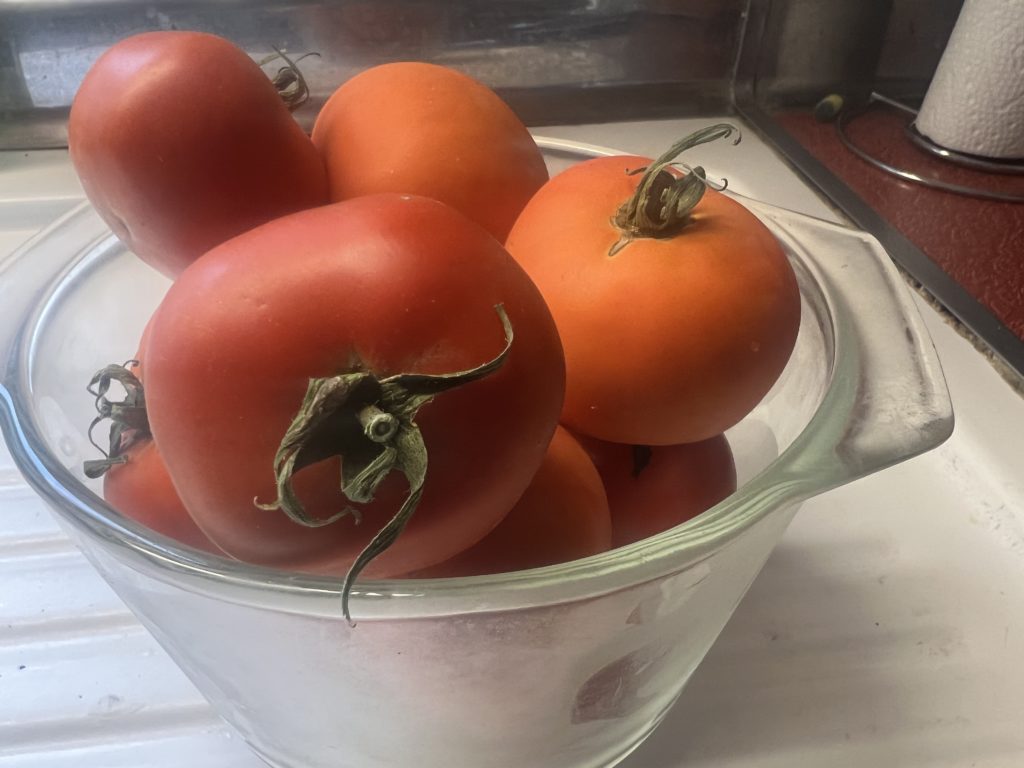
A few days later, my oldest granddaughter came to visit. In preparation for more company, she was helping in the kitchen. I had her cut and seed tomatoes to roast them in the oven with garlic, basil, and olive oil. After they were roasted, she chopped them up and placed them in covered dish in the fridge.
The next day, the menu was Creamy Tomato Basil Soup and grilled cheese sandwiches. Yum! Garlic sauteed in oil to which juice was added along with fresh basil and other ingredients. All I lacked was the roasted tomatoes and cream. I grabbed the container out of the refrigerator, dropped it into the mixture, and poured in some cream.
I served the soup with freshly made croutons. My daughter took a few bites and said, “this tastes a bit sweet.” Well, I had not added any sweetener. My grandson said, “Does this have beans in it?” How ridiculous is that? Someone else dipped into their bowl and presented the spoon on which was a bean. “How did that get there,” I proclaimed with innocence. It was truly a mystery.
Later that evening I opened the fridge and stood quietly eyeing its contents. How did beans get in the soup? I shifted and rearranged the containers. There in the back on the top shelf was a dish holding a red substance. I opened the lid and took a sniff. Ahh Haa! It was chopped roasted tomatoes! So, what did I put in the tomato soup? Then it came to me! You guessed it – baked mild chili beans sweetened with brown sugar. To redeem myself, a few days later, the roasted tomatoes went into meatloaf.
End of the mystery of the Creamy Tomato Basil Baked Chili Bean Soup!
The yips and yowls of the coyotes sent shivers down my spine. My imagination took over as I thought about our missing dog facing the relentless scavengers that called from just over the hill. If that wasn’t enough, the evening storms caused another surge of fear as I visualized our furry friend shaking uncontrollably with every clap of thunder and gust of wind. Where could she find refuge? As the days went by the prospect of her return seemed to fade, yet every time we turned into the driveway, we anticipated her running to greet us, her tail wagging with excitement.
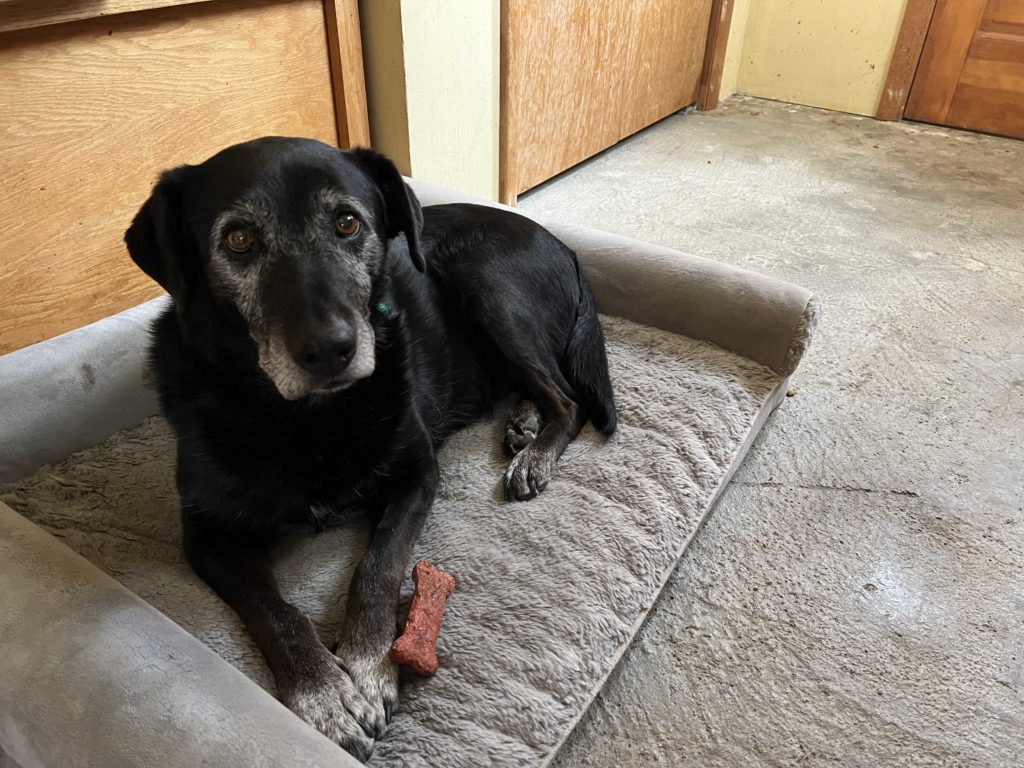
T-Bug had been with us for some time. About thirteen years ago she came to us by the loving arms our little granddaughter who arrived at our house with a present for Puppa. She thought her grandfather needed a special gift – a puppy. Every time one of our dogs died, Puppa determined he would never have another dog that would break his heart. But on that particular occasion, he looked at his little granddaughter who held a cute wiggling black mixed Lab puppy with warm brown eyes. How could Puppa refuse such a gift from a cute wiggling little girl with warm brown eyes? He named the puppy T-Bug for the little squirming girl who was sometimes called by the same name. That was convenient at times because if someone called, “T-Bug”, they both came running.
T-Bug certainly knew her master. She was an outside dog and if Puppa was outside, T-Bug was by his side. If she was left on her own and the neighbor’s dog was around, the two would sometimes run off together. I’m not sure which one was the instigator, but I have my suspicions. They could be gone for hours or overnight. When they returned, T-Bug was put in her pen and was only released for a short time only if Puppa was close by. She always redeemed herself and was allowed more freedom until the next time it happened again.
When we moved from the South to the great Northwest, T-Bug came with us. She adjusted quickly. There was one big difference – she became an inside dog. That was probably more of an adjustment for me. We soon had our routines in place – that is until she disappeared. We went through the neighborhood and posted a photo and plea on social media.
Six weeks from the time she left, Puppa got a phone call from our local dog care center. T-Bug had shown up at the neighbor’s house just that morning. Sure enough, when he stopped to inquire, a black haggard thirteen-year-old dog responded to her master’s voice and crawled out from her resting place. She sat in front of him and looked up at him with those warm brown eyes. He looked down at her, petted her and asked, “T-Bug, where have you been?” She didn’t answer but when he opened the door to the truck, she hopped right in.
All we can figure is that she came looking for us, got lost, and was making her way back home. Six weeks wandering across the prairie took its toll on her. She lost nine pounds and had an infection. It took a few days, but her restlessness and uncertainty soon began to fade. Her strength is returning but the evening wails of the coyotes and thundering storms still frighten her. I guess we’ll never know what she experienced those six weeks. Though she’s not talking, when I see her resting peacefully in her bed, I simply dismiss my fears and let sleeping dogs lie.
Years ago, a show aired on TV that featured an elderly man who had lost his wife years earlier. In many episodes when some drama took place, the man clutched his chest, looked upward and said to his deceased wife, “I’m coming to join you, Honey.” Of course, that never happened. He always managed to continue on and the next week, another episode played when he once again declared his intent to join his wife. That may seem a bit comical which was the intent of the writer and actors of the show, but it is also a scene I have seen played out in real life.
When Mama died, Daddy thought he had fulfilled his marriage vow and decided he was free to join his bride of 60 years. For almost twelve years after her death, I contended with his desire to go to her which was intensified during bouts of sickness. Each time, he tried to justify his declaration stating that he was no longer needed. That longing to go on to his heavenly home was ever present with him.
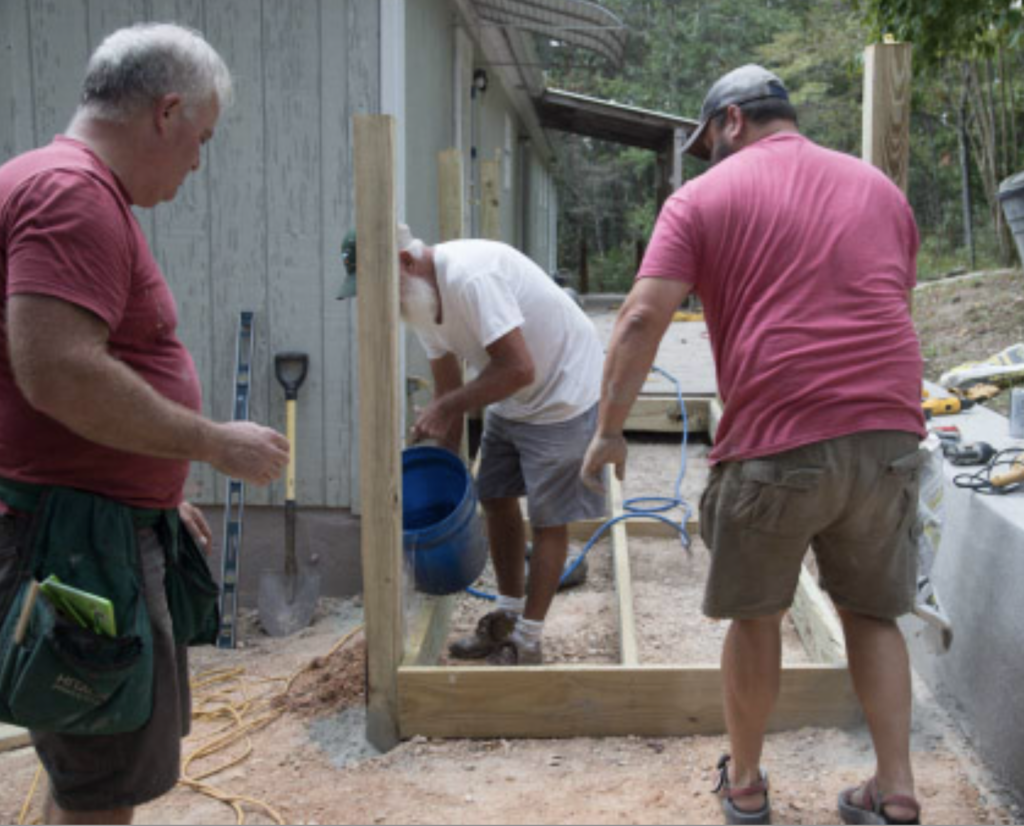
One day my son and a couple of his friends were at the house building a ramp. Daddy had gotten to the point where he had to use a walker and we knew there was a possibility we might have to transport him in a wheelchair, so we wanted to be prepared.
the guys building a ramp, Oct 2017
On that particular day, Daddy went out the front door to the porch. He took a few steps, teetered and tottered, and fell. Though he was a small man and because of the position in which he had fallen, I couldn’t get him up. My husband had just had shoulder surgery, so he wasn’t able to lift Daddy. We called our son who came running to pick up his granddad. He came up on the porch, walked behind the little man, reached down and hooked his arms under Daddy’s arm pits, and lifted him off the ground in one swift movement. The look on that little man’s face was priceless as he briefly hung in the air before his feet touched the ground. When my son set him down, Daddy stood the straightest I had ever seen him. He was stunned. It took a few seconds before he realized what had happened, and I dare say the look on his face turned to one of disappointment.
At first Daddy believed he was finally getting his wish. Later he confessed he thought an angel showed up that day and had picked him up to make a special delivery to the gates of heaven. As far as I was concerned, an angel did show up!
I think back on that day with a smile as I imagine the thoughts that must have raced through his mind. In that one brief moment I could almost hear him say, “I’m coming to join you, Honey,” and six months later he did just that.
Yep – I played second fiddle, or more specifically, second violin. One time I even held the first chair. Now, that doesn’t mean I picked up the chair and held on to it. No. It means I “tried out” for the position of sitting in the first chair of the second violin section. I have no idea how I beat the guy who was vying for the same chair, but nonetheless, I did.
Now, let me tell you that just because you play “second violin” (or second fiddle) doesn’t mean you have a lesser position. It means that you complement the first violins as well as the other strings and instruments in the orchestra. The first violins normally play the melody – kind of like sopranos in the choir. The second violins normally play harmony and add accompanying rhythm – kind of like altos in the choir. Violas are tuned lower and have a deeper, mellower sound – kind of like tenors. The strings wouldn’t be complete without the cello that offers those rich resonating tones that have the ability to soothe the soul – kind of like the bass section of the choir. The double basses add the lower notes that define the chord and set the foundational rhythm.
I remember thinking my part was of lesser importance until one day, I realized that the others could not complete their role without the other sections. Solos are fine and have their place,
but a transformation takes place when the tones and rhythms bring harmony and balance to create the masterpiece. And so is life. It takes all parts to bring completion. The ones taking the lead cannot fulfill the finished composition without those who offer their supporting, and often lesser noticed, roles.
So, just in case you’re wondering — sure, I can play now but it sounds more like a cat with its tail caught under the rockers of a chair. There is definitely no harmony in that!
Looking out the plane window I saw the shrouded city of ChongQing getting smaller and smaller. I said a quiet “goodbye” to the billions of people who called the city home. We had met new people, experienced life in the Mountain City and witnessed just a fraction of their culture. I hoped I would never forget the sights, sounds, tastes, and smells that were imbedded in my mind.
Arrangements had been made for us to stay at the ELIC (English Language Institute China) headquarters in Beijing. We were picked up at the airport by a driver the organization used on a regular basis. The accommodations were very nice. A balcony overlooked a courtyard with pretty flowers, a gazebo with the traditional architecturally curved roof, and a group of waving school children who were curious about the Americans. We order Papa John’s pizza for our evening meal, and they delivered! I slept well that night. There were no opened windows in our room, no sounds of jackhammers and people working through the night, and no bright lights.
Our driver picked us up the next morning. Our first stop of the day was Subway where we got sandwiches and drinks for a picnic lunch. On our way to the Great Wall, we visited the Ming Tombs, built from 1409-1644, which contain the mausoleums of thirteen emperors of the Ming Dynasty. The palace and tombs were quite impressive.
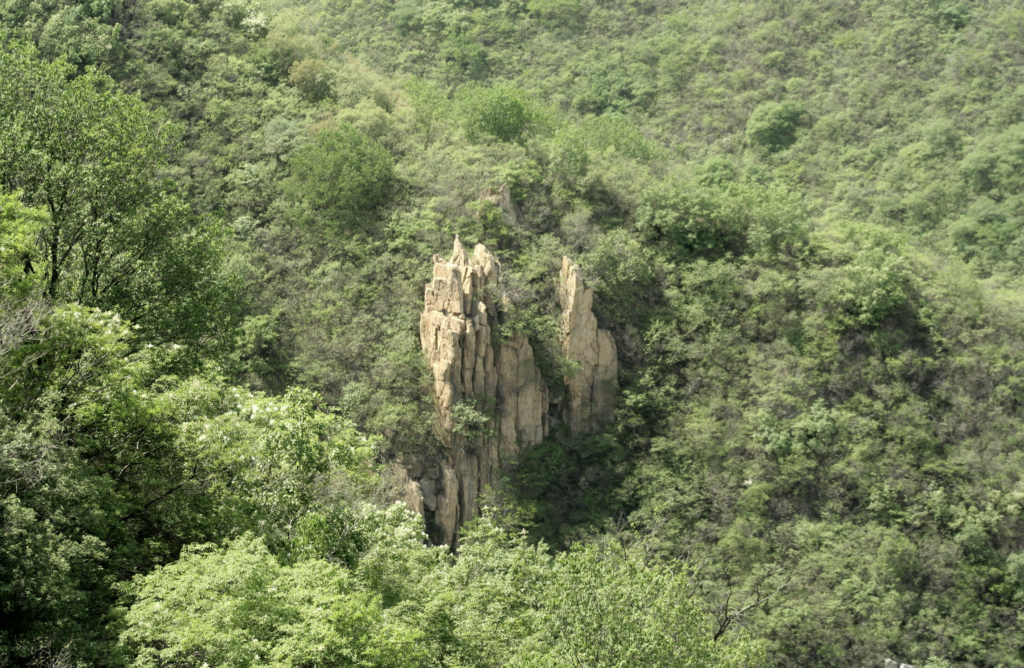
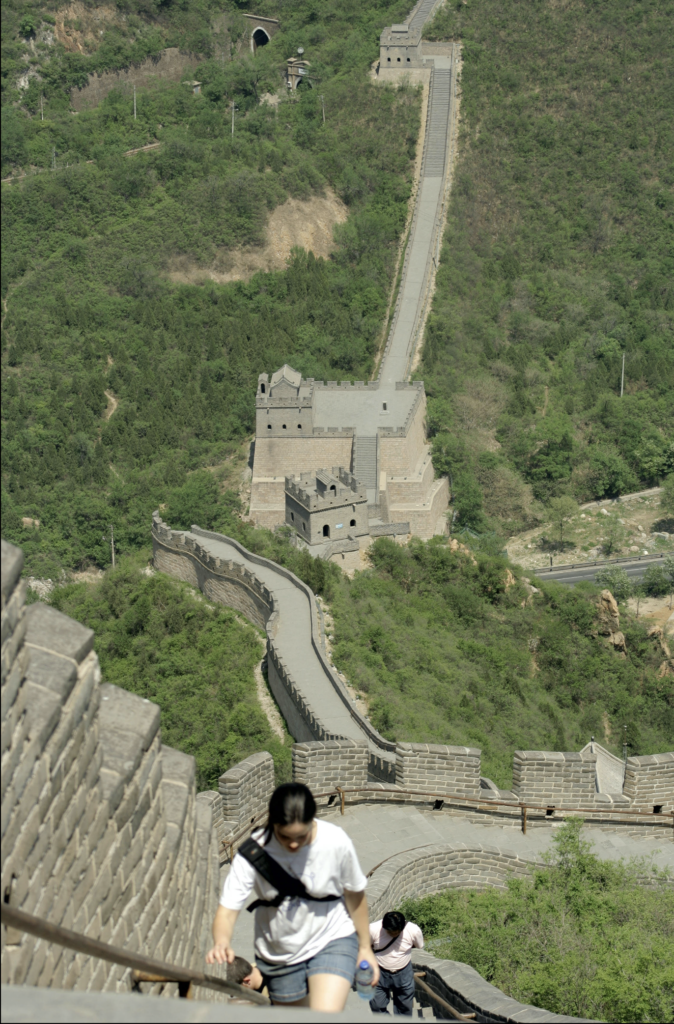
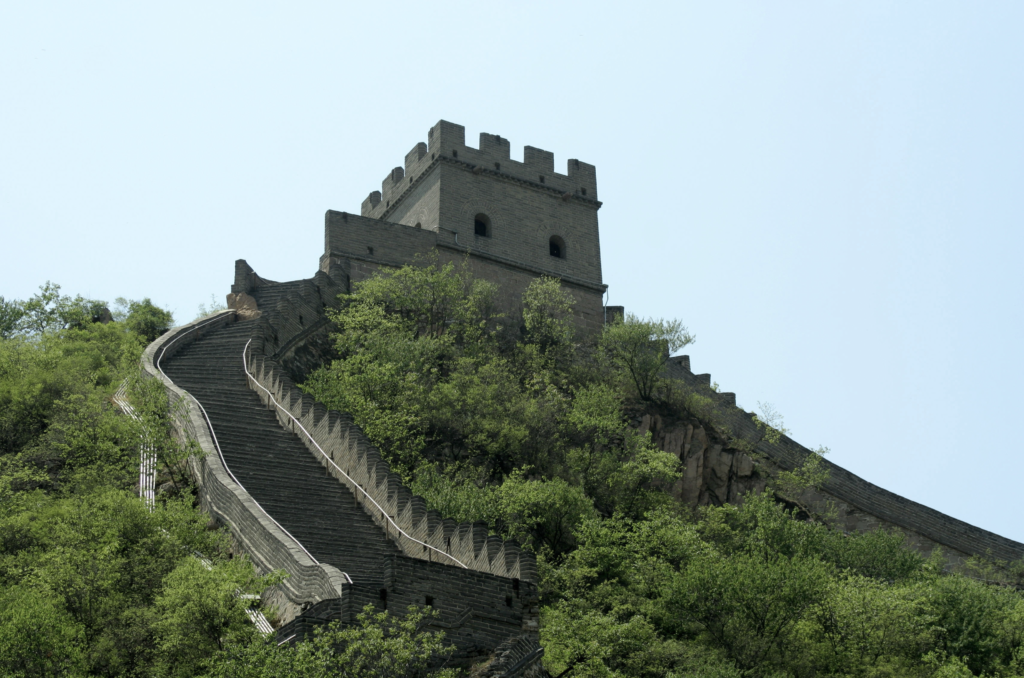
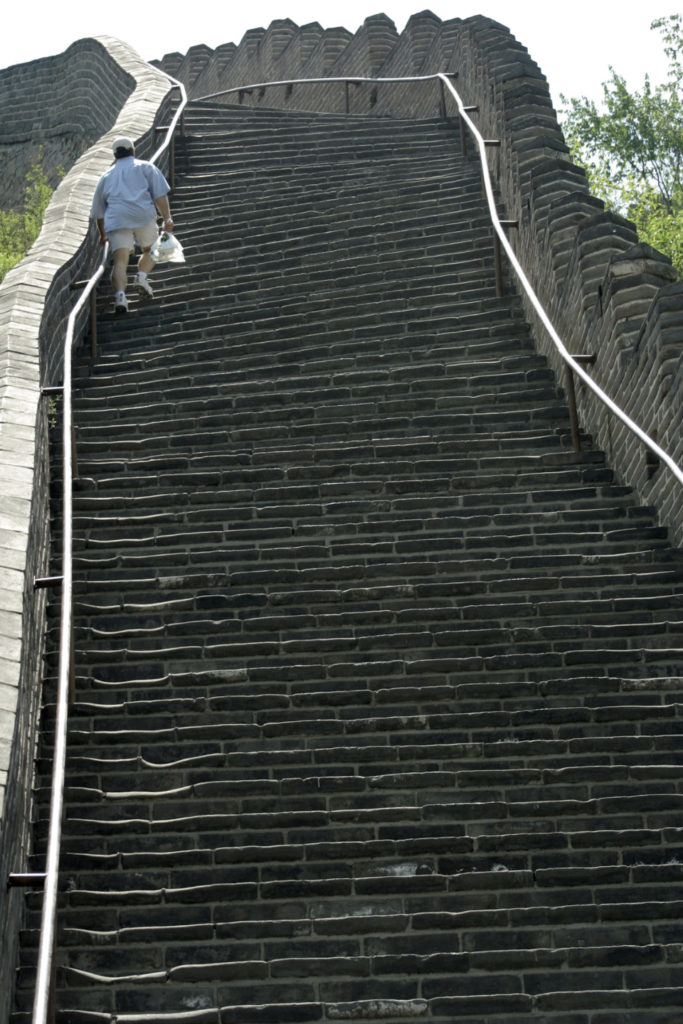
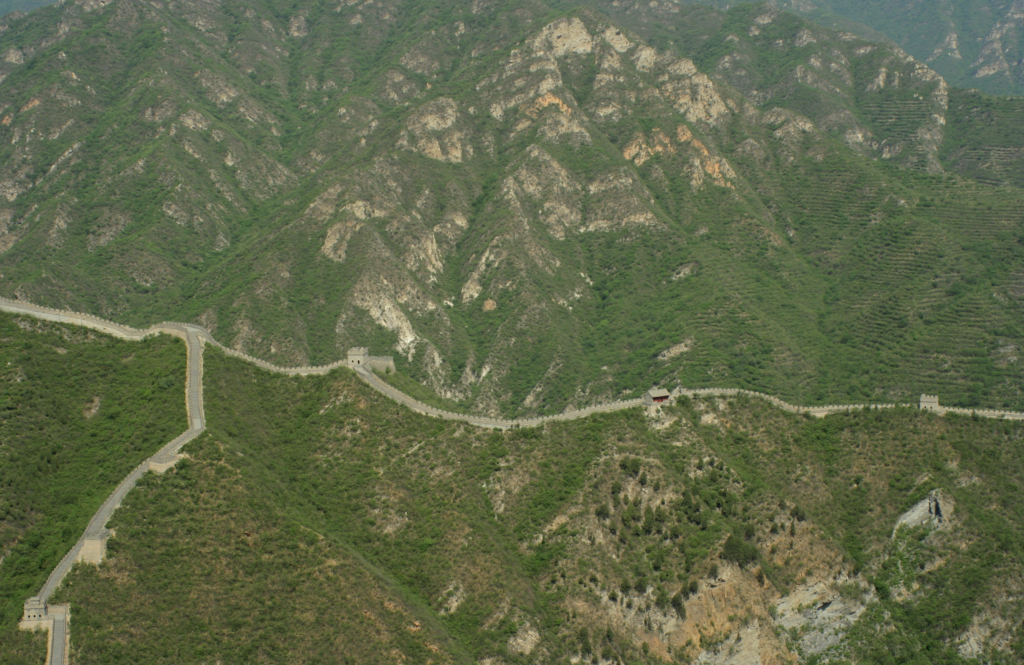
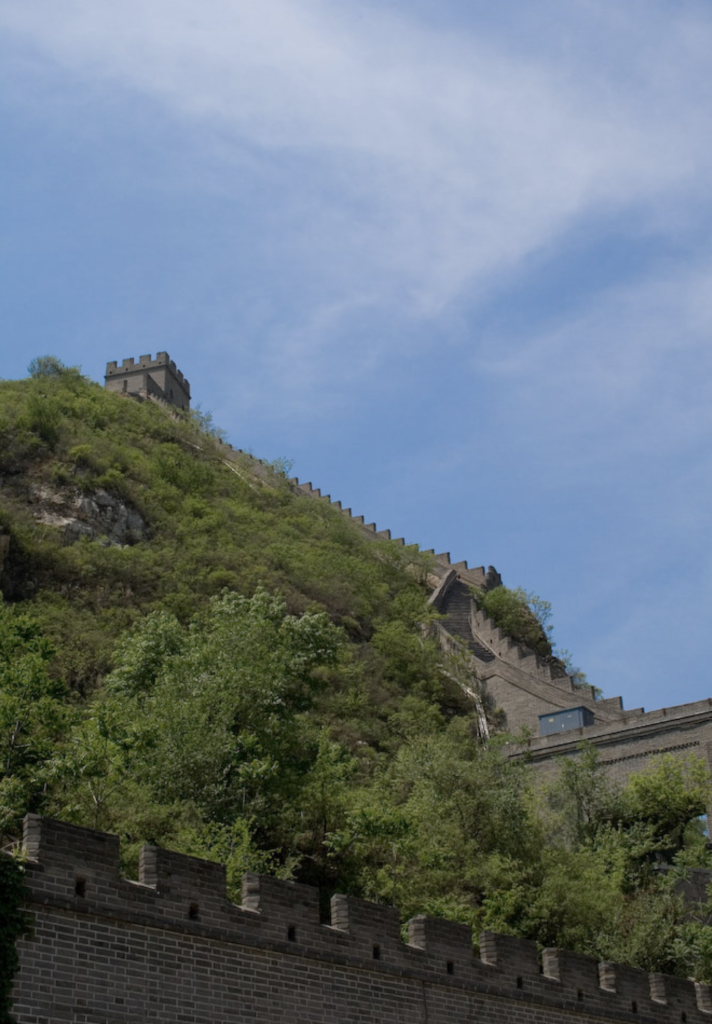
From there we went to a section of the Great Wall that is less commercialized. It was hard to fathom that for centuries, portions of the wall were built, rebuilt, and extended many times by China’s emperors to protect their territory from invaders from the North. The Great Wall is aptly named. It twists over mountains, plateaus, deserts, and plains for 13,170 miles. We climbed sections of steps to the top of the wall. The scene was breathtaking! Unique mountains thick with trees seemed to flow to the ends of the earth. Rocky jagged cliffs rose above the ocean of green like spikes along the back of a huge sleeping dragon ready to awaken and take flight from its secret lair.
The width of the wall averages from 13-16 feet wide, but the widest section is about 55 feet. There was ample room for weapons and soldiers to move strategically along the top of the walls to defend against enemy attacks. The walls were constructed of stone, earth, brick, lime, and wood. For a time, mortar for the bricks were made with sticky rice mixed with lime. As many as 400,000 men lost their lives building the wall, many of whose bones remain buried within.
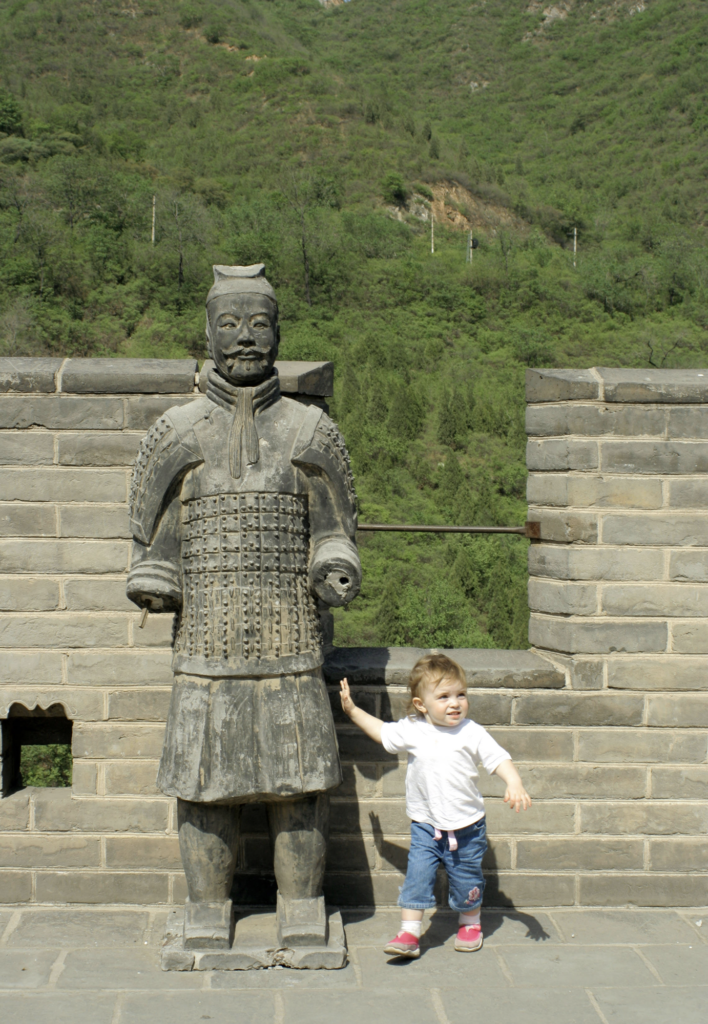
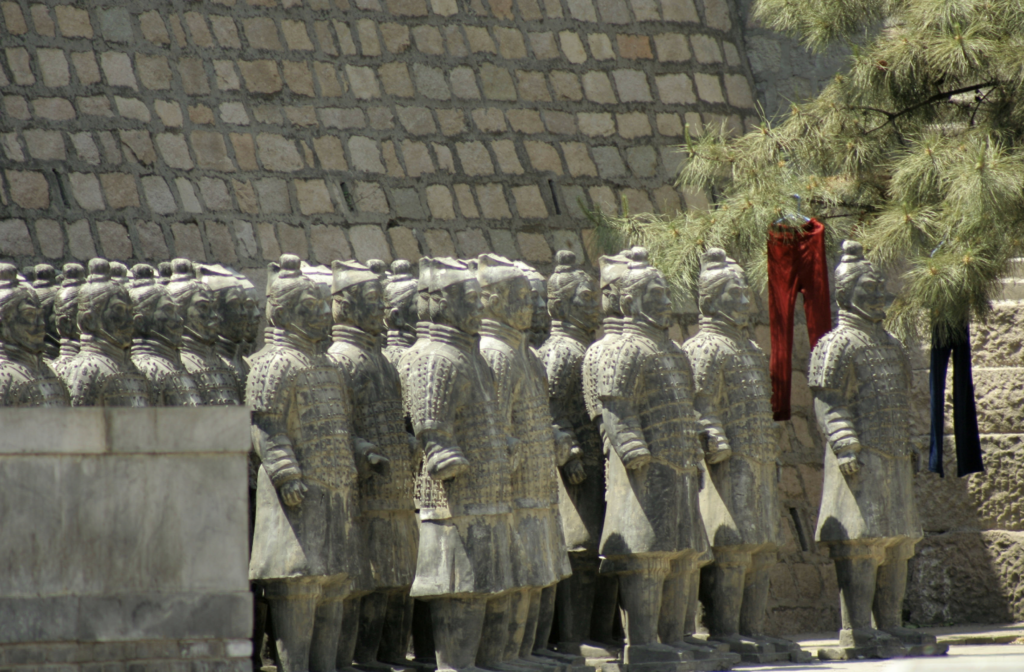
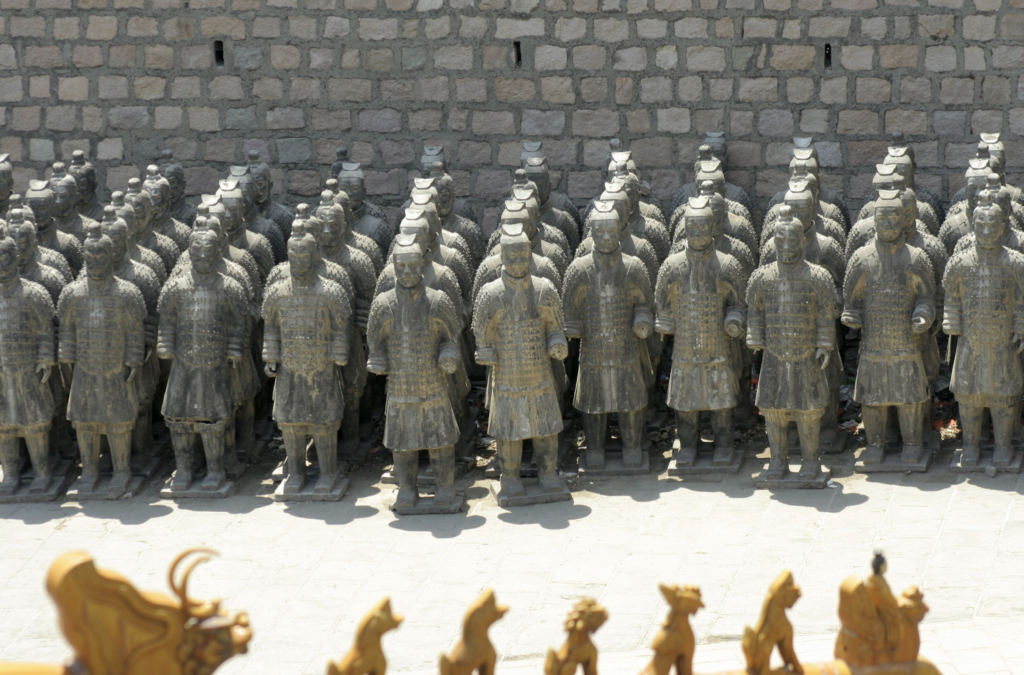
After all the walking we did in ChongQing, we were better prepared for the steep uneven steps. Along the wall were towers of different sizes at various places. Looking across the landscape, the wall seemed to go on forever as it wound up and down and around while terra cotta soldiers stood guard.
As we traveled back to the house where we were staying, we noticed a lot of construction going on. Facades were built and placed in front of dilapidated apartments and buildings as a means to cover the unsightly scenes. New bridges, street work, updated signs, and construction was underway in preparation for the Olympics and the influx of foreigners into the city of Beijing. There were more bicycles than in ChongQing and longer buses ran through Beijing’s streets. It was quite a difference from the chaotic streets of ChongQing where six lanes of traffic moving in all directions tangle through a four lane road.
Soon our time in China came to an end. We had a few more unforeseen travel adventures before we pulled into our driveway at home. It had been a memorable once-in-a-lifetime trip, one of which still stirs my memories from time to time.
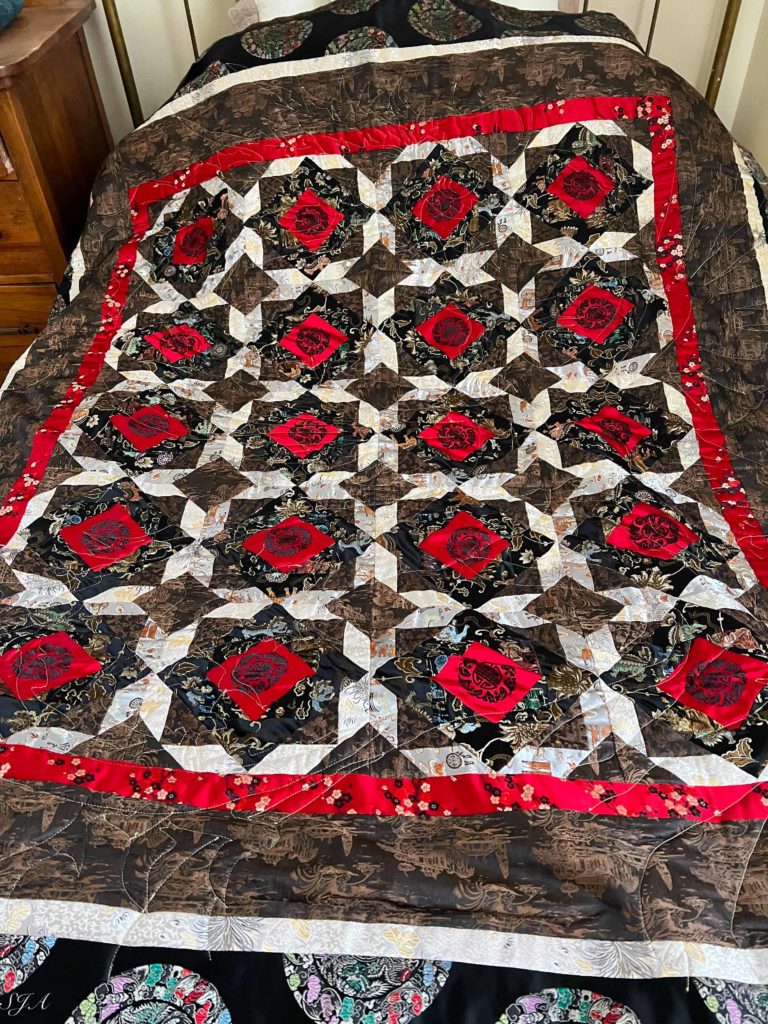
A trip to China would not be complete without a visit to the silk shop and the teahouse. One of my missions was to purchase Chinese silk for a quilt. That required a trip into the downtown business area of Chongqing.
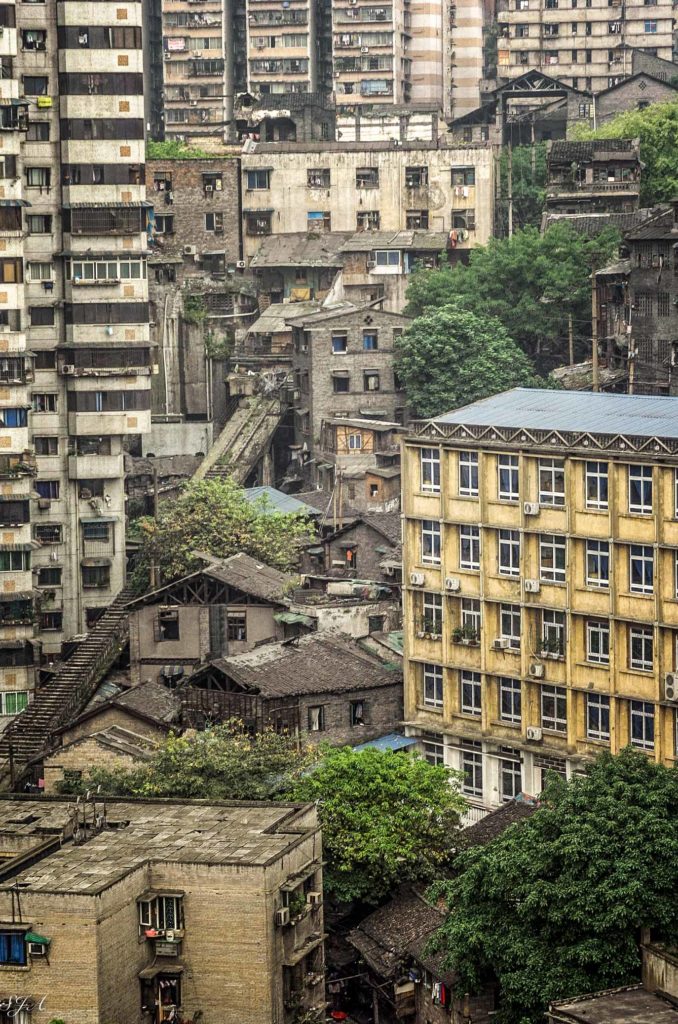
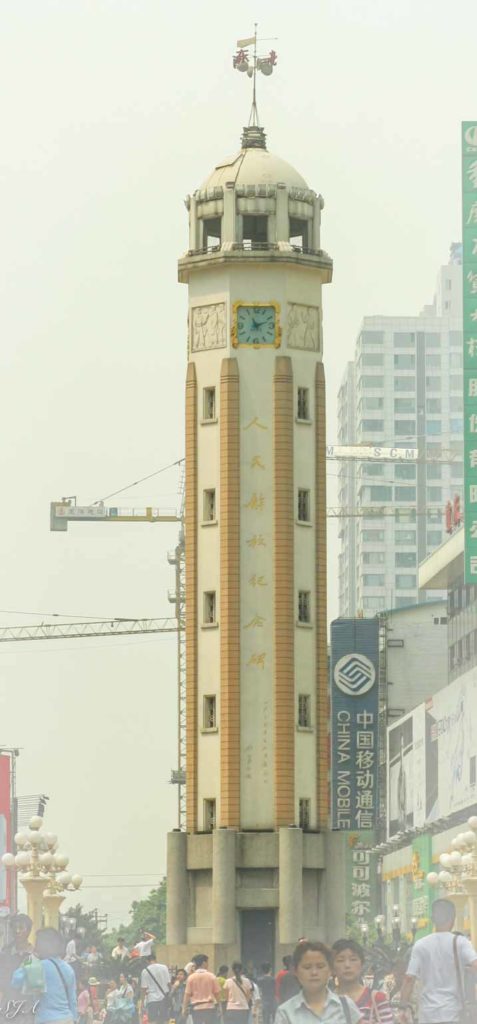
We met our friend at the Old Gate, took the bus to Nan Ping, walked to the cable car and took the flight over the Yangtze River. We saw tall apartment complexes with gardens on the rooftops. Our first stop was Chao Tian Nen, meaning “riverport shop”, where we purchased red Chinese lanterns. We proceeded to Jie Fang Bei, the downtown shopping area. A clock tower was the center of attention. At one time, it was the tallest building in Chongqing, but was quickly overshadowed as many downtown buildings rose to greater heights. There were many interesting little shops, one which had traditional clay teapots.
flying across the Yangtzerooftop gardensclock tower
As we continued down the street we saw a logo that caught our attention. We followed the two-tailed mermaid who led us to Starbucks. It was like stepping onto an island in the midst of a different world. After having our drinks, we went upstairs and went through a doorway into a store that looked much like an American mall. It was a stark contrast from the little side shops and vendors just outside the front door. To my surprise there was another familiar sight, golden arches. It was decided that we would go to McDonald’s to get hamburgers for lunch. A crowd of others had seen the golden arches, too, for the lobby was crowded. While standing in line with people cutting in front of us and pushing, a sweet looking lady coughed up a wad and spit on the floor. Such a public display was not an uncommon sight and was completely and culturally acceptable. I was sure to watch where I stepped. For some reason I wasn’t quite as hungry, and after our expensive “burgers”, I wasn’t sure what I ate was even beef. I thought I heard an elderly small lady say, “Where’s the beef?” But it could have just been my imagination.
There was one thing in McDonald’s I really appreciated – the restroom. While there were the traditional Chinese squat toilets, there were also “western” flush toilets to which I am accustomed. I knew how to use a squat toilet. After all, I had experience backpacking and camping, so I was very familiar with the process. The little kids wear split pants that allow them to squat without having to pull down their clothes. That makes potty training easier. I made several pair of split pants for our little one.
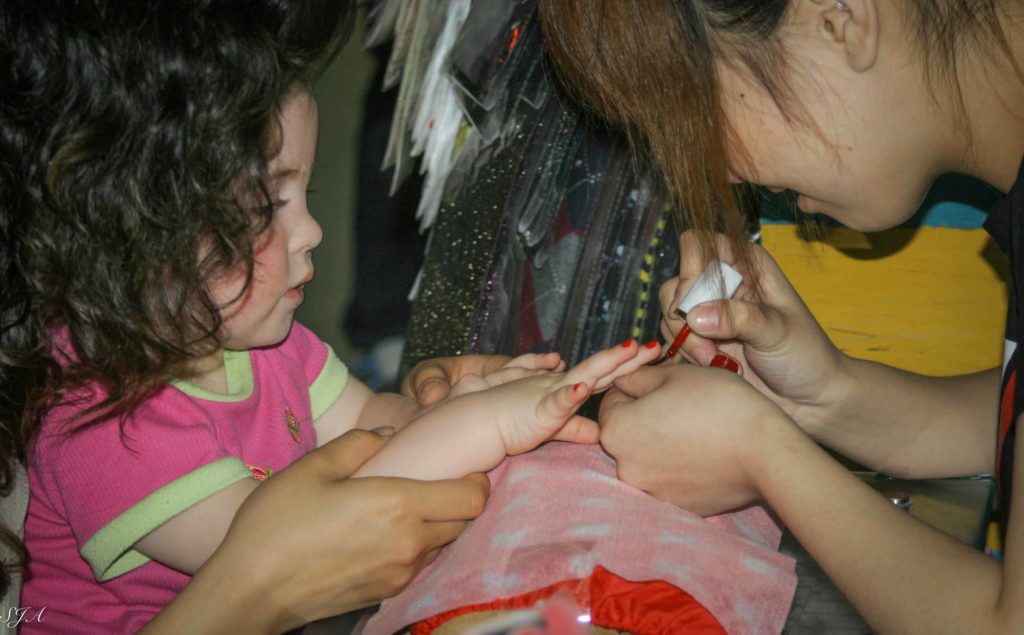
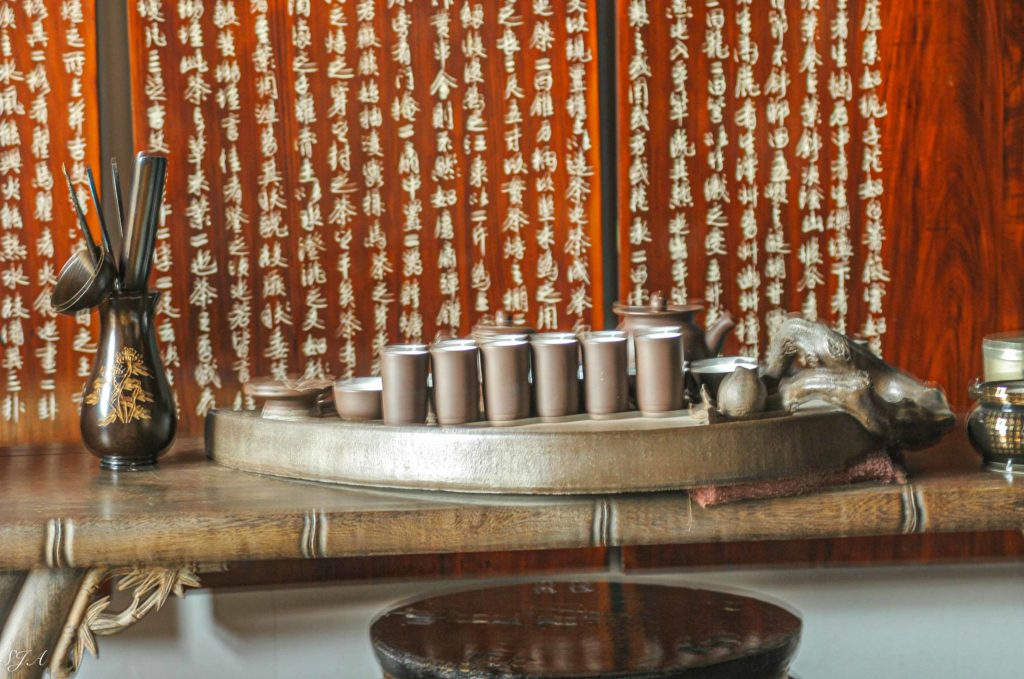
getting her nails polishedafternoon tea
We moved on from there to a marketplace where our Chinese friend led us girls to a manicurist booth where we got our nails trimmed and polished, for $2.40 US dollars each. Our next stop was the silk fabric shop. Oh my! How could I ever choose? Through the years I had watched my mother in fabric shops where she had to touch every piece of fabric as she passed bolt after bolt. That was me! It took some time to make my selections of the soft silk fabric. I chose a reversable thick red fabric and a piece with a black background, both of which had oriental designs that incorporated the history of China. Another red piece was of cherry blossoms which symbolize new beginnings and the circle of life. Red is also significant in that it represents prosperity, happiness, and success. A couple of fabrics I purchased depicted the Silk Road, a network of Eurasian trade routes used for centuries. One piece of silk was of ancient buildings with the Xieshan roof styles and soldiers on the march.
Legend has it that around 2696 BC, as the Yellow Emperor’s wife was having tea in the imperial gardens, a cocoon fell from a mulberry tree into her tea and unraveled. She noticed that it was a long, strong, soft strand. She combined silk fibers into a thread and created a loom to weave the silk into fabric. It has played an important role in their culture and economy for thousands of years. Somehow, I wanted to portray that culture and history into my silk China quilt.
The shopping process was exhausting but pleasantly so. One thing could take care of that – a visit to the teahouse. The name of the teahouse was Shi Bao Ti, meaning “Eighteen Steps”, though I didn’t count them. It was a great place to while away the afternoon and relax. They take their tea seriously. Not only do Chinese people drink tea with their meals, but also for medicinal purposes, for enjoyment and fellowship, to promote friendship, and to soothe the soul. As we drank from out little cups, it brought back many memories of time spent with my grandmother who loved to share a cup of tea with friends and family, and even snotty nosed little grandkids.
Traditionally, tea ceremonies are performed at weddings, family gatherings, and places like teahouses. Serving tea is a way for the younger generations to show respect for their elders. At the teahouse, we were served green tea and flower tea.
Though we didn’t have a silkworm cocoon fall into our tea, the combination of the silk and tea on the same afternoon somehow made the day complete. We were truly able to share two vital pieces of their culture that has survived for thousands of years.
Sometimes I drink tea poured from my Chinese clay teapot and remember our trip with fondness. That along with the silk quilt I made with fabric from a little silk shop in China are reminders of an ancient culture that still thrives in Asia – a rich history steeped in the tradition and culture of tea and silk.
Here is a picture of the completed silk quilt. The quilting design is of a dragon with flames rising as it battles with a phoenix. The stitching is done with gold silk thread.
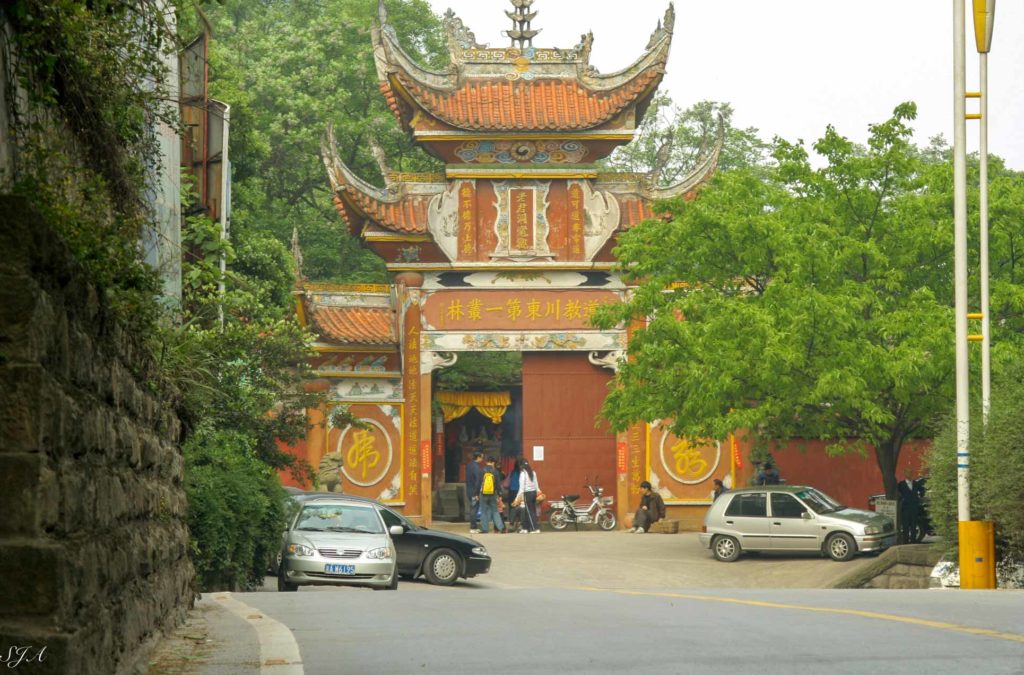
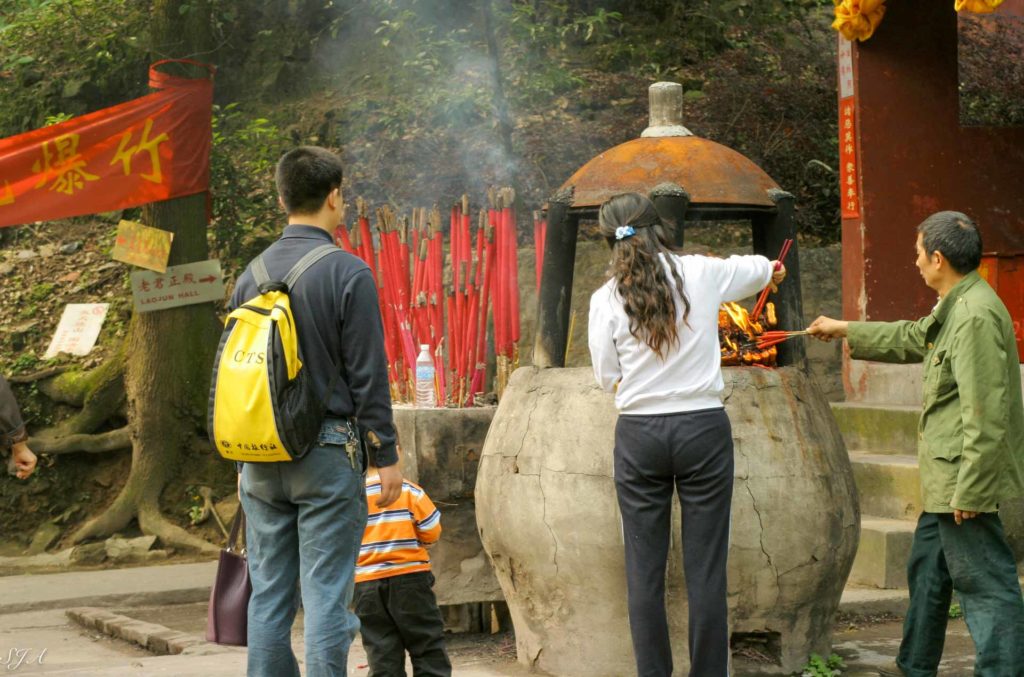
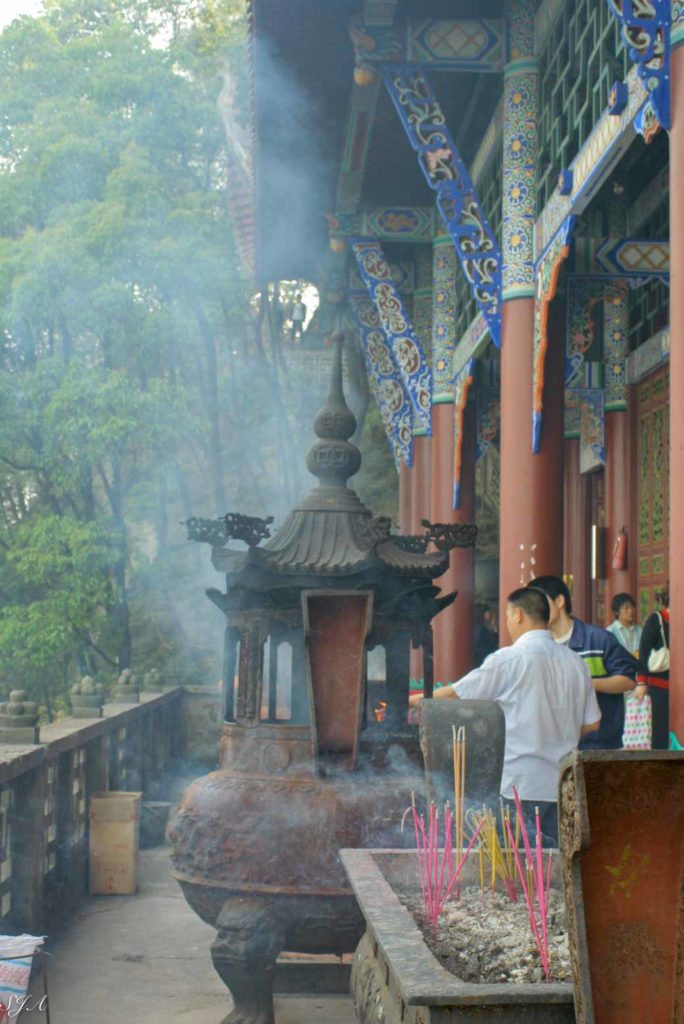
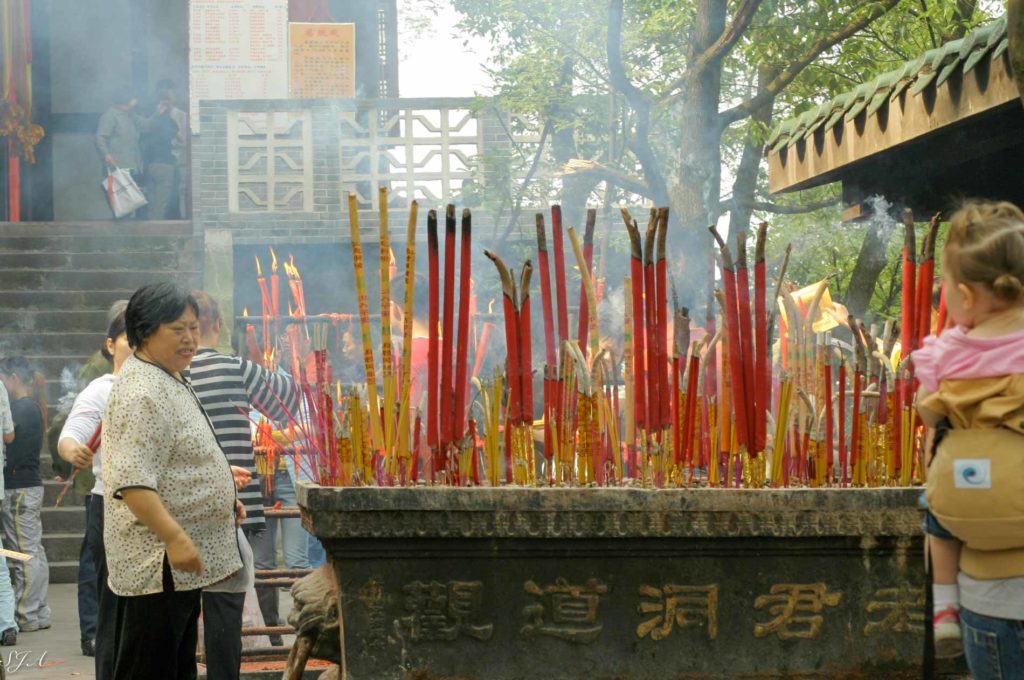
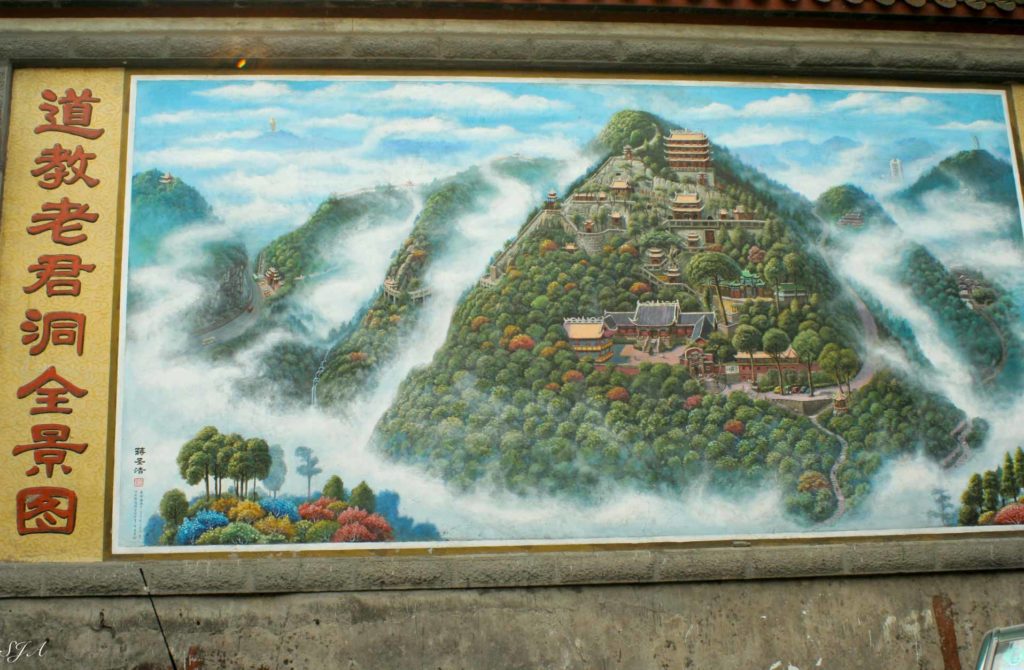
The busy streets were even more congested than usual because it was the May Holiday, Laodong Jie. We weaved in and out of the crowds as we walked along the road toward the Taoist temple. One of the University students accompanied us, and it looked as if all the extra people in the city came along, too. At the main gate of the temple complex we were silently greeted by a stone god in a little building. Vendors were nearby to sell candles and incense for visitors to present to the gods. We walked up concrete trails that wound through the trees thick with lush foliage and climbed multiple flights of steps that led to the temple. Through openings in the trees, we got glimpses of worshippers offering sacrifices to various idols that were scattered throughout the temple mount. Dragons perched on the ridgelines of roofs symbolized imperial power, wealth, good fortune, and power over the weather. It was believed the dragon brought rain for the crops and extinguished fires. There were big gods in the main temple area and smaller gods set along the walkways and outcroppings on the slopes that overlooked the city below. Big potbellied decorative iron cauldrons with xieshan roofs looked as if they were on fire. Some worshippers knelt before stone idols housed in booths where they offered food sacrifices. Others placed burning incense of varying sizes and candles in sandy troughs, hoping to please their god. Smoke rose to the stone nostrils of the statues.
incense near the gate
The foul odor of rotted fruit mingled with the smell of burning incense. Clouds of smoke hung heavy in the air as people bowed before cold lifeless images. Thick smoky haze filled the temple as well as the mountain valleys and peaks. The student who went with us told us some of the beliefs of the Taoists as well as other ancient religions. It was an interesting and new experience for me.
offering incenseincense anad candles
As the week came to a close the crowds lessened though it wasn’t very noticeable. On Sunday, we went to church. It was much different than when I was a kid. Mama would get us six kids clean, neatly dressed, ready to go, and to church on time. If we talked out of turn or wiggled or giggled in church, she would thump us on the head. That was not the way it was in the church we visited. No, on that particular day church was quite different.
To get to church, we walked. In fact, we walked almost everywhere in Chongqing, and it seemed everywhere we walked was up. The streets were busy as people were headed to who-knows-where. We dodged vehicles and people to even get to the street that led up the mountain to the church building. Up, up, up we went. The church came into view, but we still had a steep climb ahead of us. About halfway up, our noses were met with a horrible stench. Some kind of brown liquid poured out of a pipe from the side of the hill. It gushed into a ditch that flowed down the steep roadside giving no indication as to where it stopped. Apartments were on both sides of the road. It was hot and smothery. There was no escape and not one whiff of fresh air. The horrendous odor hung like lead in the air intensifying the smell even more. It was then we realized what gushed from the pipe was raw sewage. By the time we got to the church, some of us were about sick.
We entered the Three Self Church and climbed five more flights of stairs. One service was still in session, so we waited for the second service. We found our seats and after a greeting from the minister to the congregation, there was a time of praise and worship. Of course, I couldn’t understand what was being said. The only word I recognized was “hallelujah.” I guess that is universal. Even though the words of the songs were not familiar many of the tunes were. We were able to sing along to most of the songs in English which was a stark contrast to the Chinese words that were sung. The minister delivered his preapproved message to a somewhat distracted congregation. My mother would have had a heyday in there!
During the service a lady swept the floor, people talked on cell phones, ladies got up from their seats to see and touch our little girl, a dog wandered in, communion cups fell to the floor while at least a dozen people got up to see what was going on, a lady scolded a girl across the aisle for something, and the same lady visited at least three other women and chatted with them, and I watched – every bit of it. When the service was over, I decided that even though I didn’t understand the language, I understood as much as anyone else in the congregation. Yes, if my mother would have been there, boy oh boy, she would have had a good time!
After church, as we walked back through the busy streets to get lunch, I thought of all I had seen and experienced. One thing was for sure. The culture and beliefs of these people were evident in their day-to-day lives – their gardens and farms, the markets, the courtyards filled with dancers, the grandparents tending the children, their worship, and even those things considered inappropriate in our corner of the world. Yet, there were likenesses, one of which was taking time to worship.
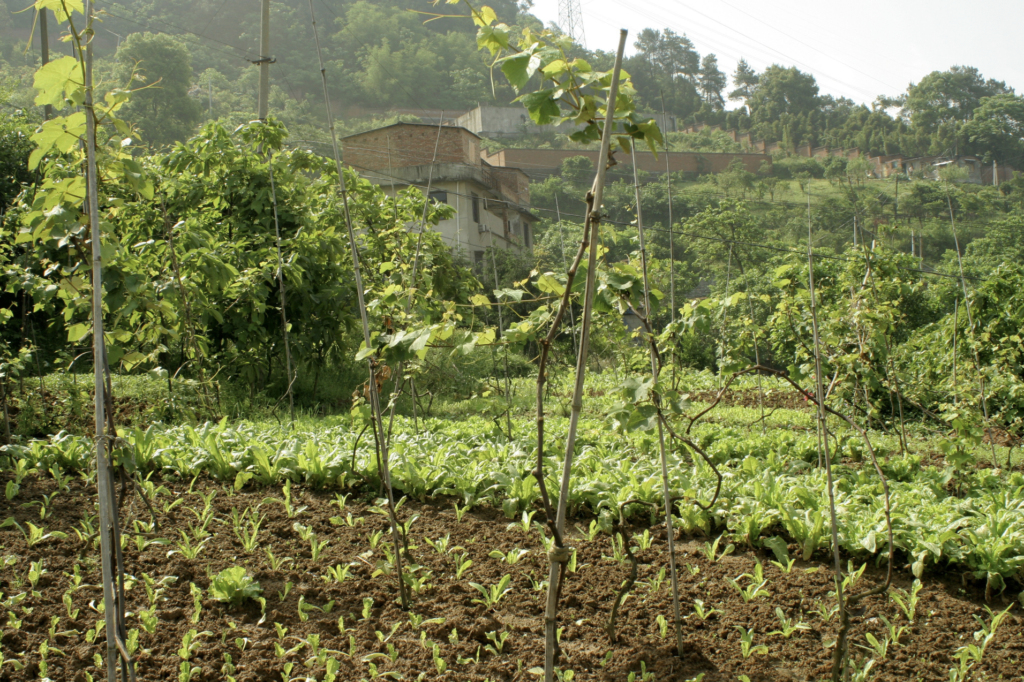
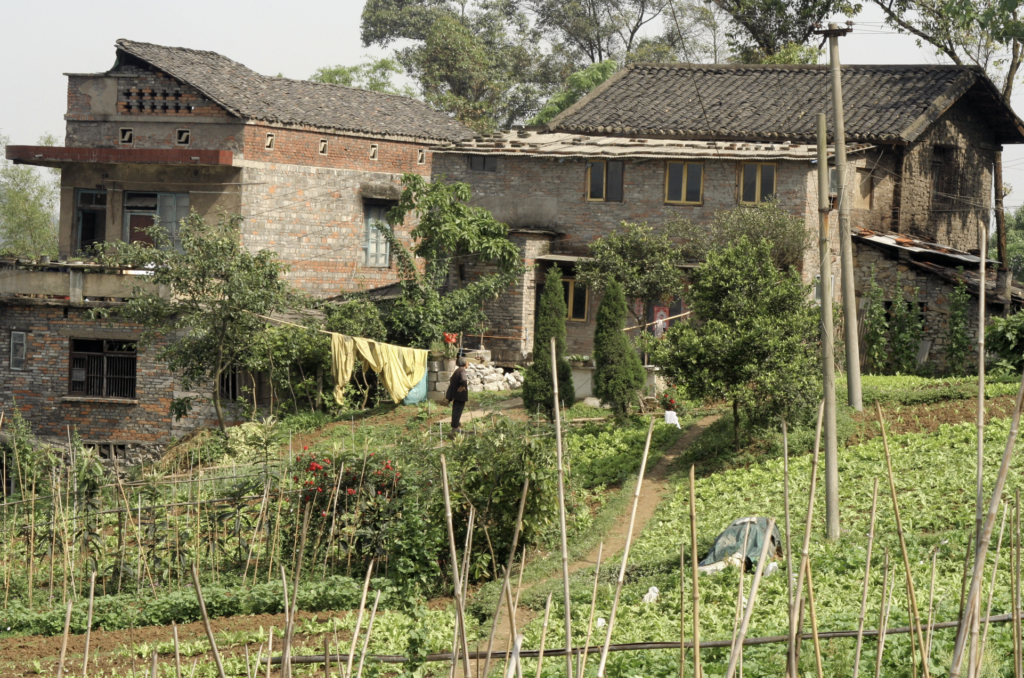
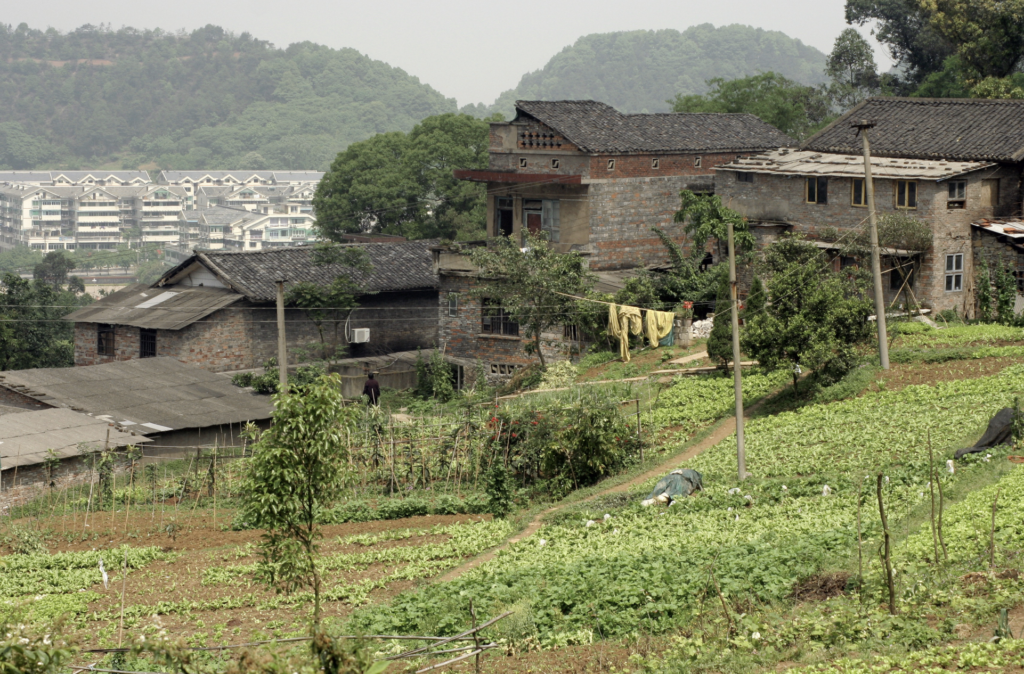
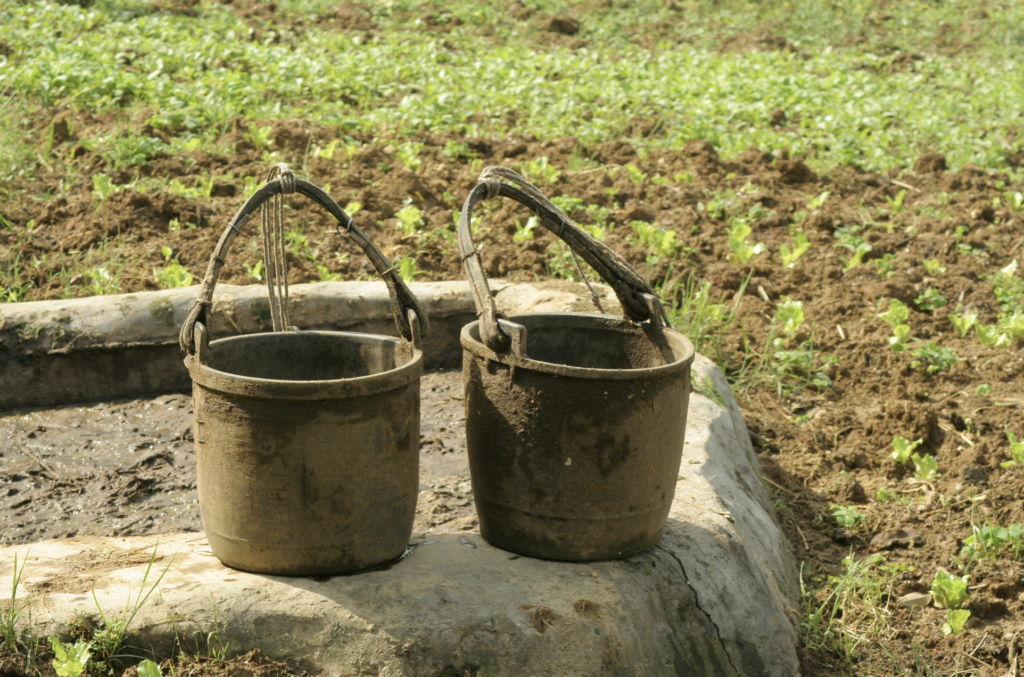
It was a steep trek up the mountainside. When I heard we were going hiking in the mountains, I was excited. I thought it would be nice to get away from the masses of people for a bit. We started out for our morning walk up the mountain behind the university campus. Chongqing has been referred to as “the city of stairs,” and I can attest to that truth. Steep paved trails and steps from all directions led up the slopes. As we climbed, we passed farms and gardens tucked in every valley, nook, and hollow. We saw women hoeing and tending the crops. Large round metal buckets held human refuse used for fertilizer. The stench was quite awful. Everything except for what was in the buckets was green. Just that morning as we left our hotel, we saw ladies from the mountain farms headed to market carrying their freshly picked produce that was still wet from their morning washing.
As we walked the trails, I wondered how they ever paved those walkways high in the hills. It must have been quite an undertaking. Looking back to the city below, we could see that every bit of land was used. Beyond the lush green gardens and farmhouses tucked away in the foliage and fences was the city of Chongqing shrouded in smoke and haze. The Yangtze River wandered through the valley like a huge mythical dragon slithering through the streets and winding around tall buildings. We saw the top of the Taoist temple above the trees on a ridge across the valley. The corners of the temple’s dual hip-and-gable xieshan roof swooped down and curved upward at the eaves to ward off evil spirits. Many people used the same roof style to prevent spirits from invading their homes. We saw roof ridges adorned with dragons and other mythical beasts that ancient Chinese believed would prevent fire and drive demons away.
Even on the mountain paths we saw many people. There were places beside the trail where worshipers had offered sacrifices to their gods. Ashes from incense, residue from rotted fruits and vegetables, and various trinkets remained on the sacred site that others dared not bother as they passed by.
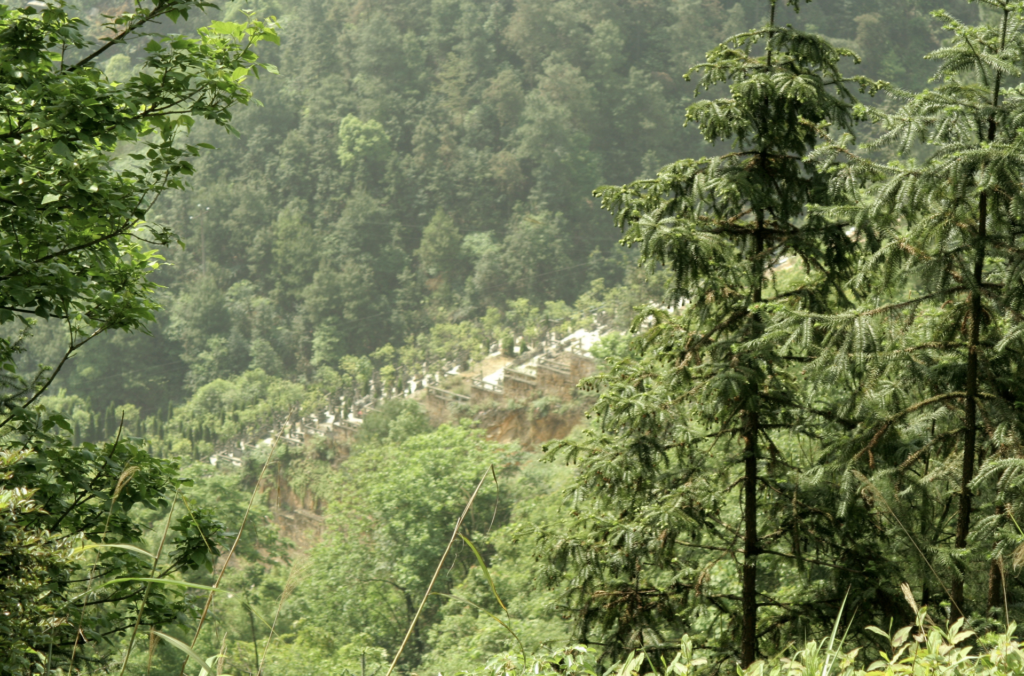
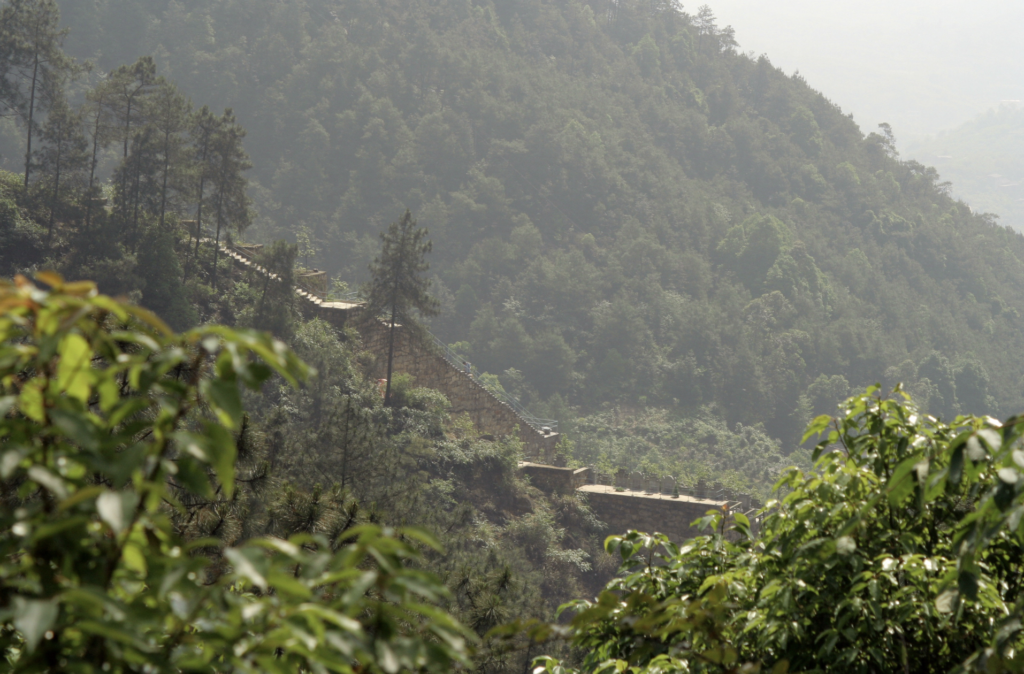
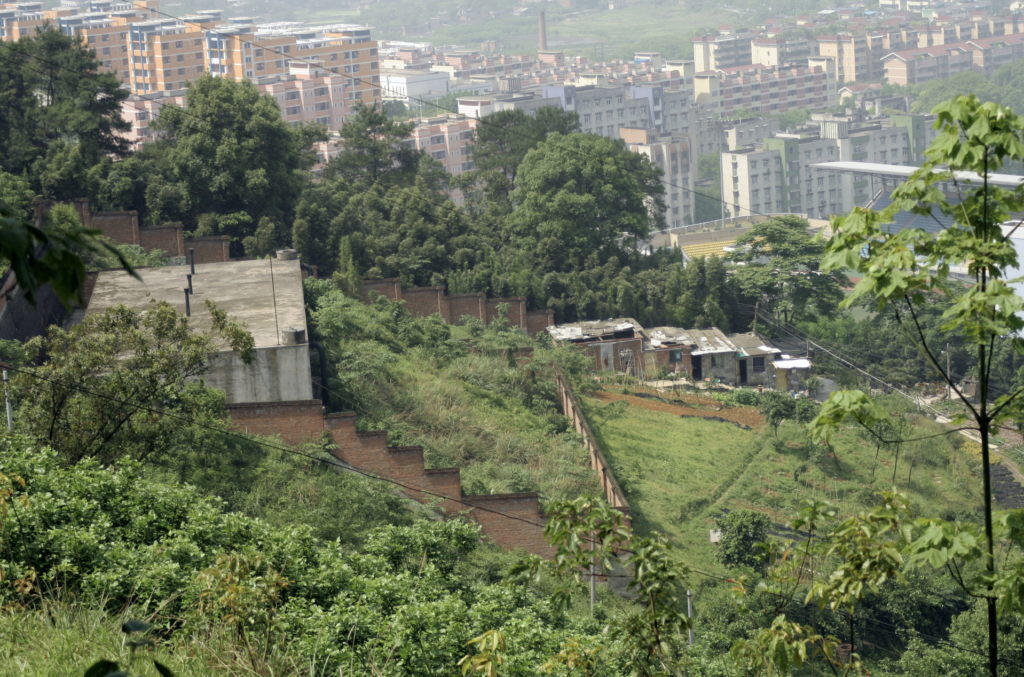
We came to a high ridge where we could see the valleys on both sides. One side revealed the city below. On the other side were miles and miles of hills and jagged ridges that looked like spikes and scales along the backbone of an ancient serpent. A graveyard stepped down the slopes with what appeared to be mausoleums and tombs resting on steep tiers that descended into the gorge. Through the haze and thick growth of vegetation, we saw walls that meandered up and down the rises and dips of the hills. The tops of the walls that seemed to be a lesser version of the Great Wall were pathways complete with more steps.
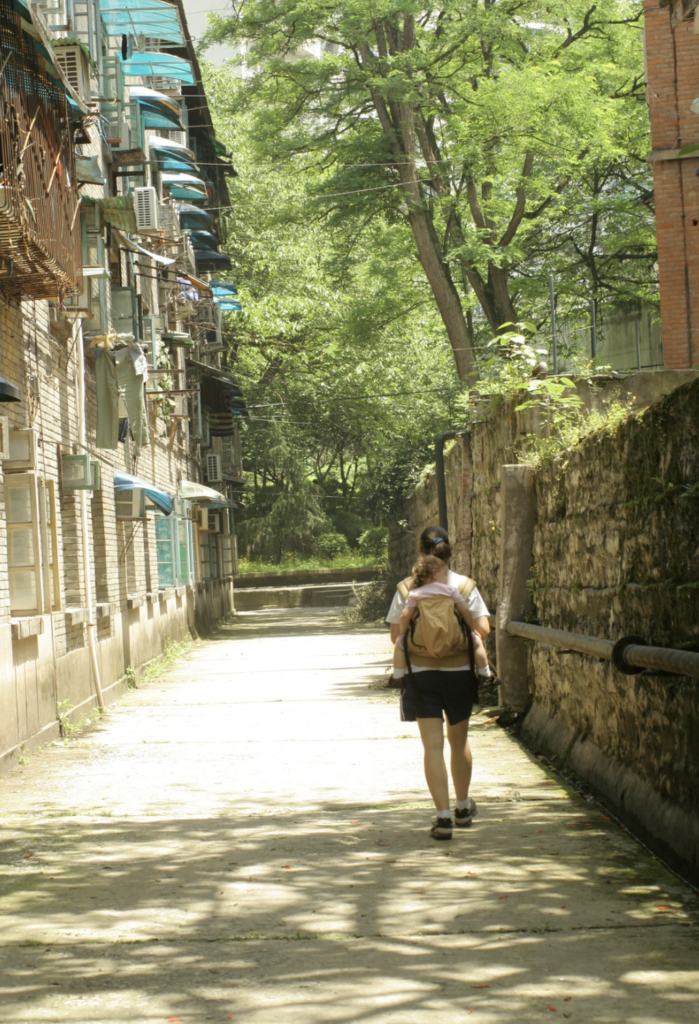
The heavy humid air intensified the somber silence as we took in the scene before us. The quiet moment was a reprieve from the noisy streets that was short lived as we continued our journey. We followed the trail into some thick foliage but when we emerged, we were surprised to see we weren’t alone. It looked like a group of people were having a party on the top of the ridge. Chinese ladies were decked out in bright clothing and high heels. They wore hats and carried umbrellas to protect themselves from the sun. A couple of the ladies wore head coverings made out of bushes, one of which still had flowers on it. When they saw us, they swarmed around the cute fair skinned, green eyed, blonde curly headed little girl who rode on her mama’s back. The ladies all wanted to touch her and tried to shade her from the sun. To them, fair skin was preferred to their olive color, a belief that goes back to ancient China. Farmers and laborers had darker tanned skin. The elite, those of wealth, had paler skin because they spent days inside. White skin represented prestige and was the most desirable. When my daughter was expecting her “China Doll”, the Chinese women catered to her. They insisted she eat lots of tomatoes because they believed that would give her child lighter colored skin. As we turned back to the trail, I wondered how those women made the climb up the mountain paths in those high heels. Nonetheless, we left them to continue our walk.
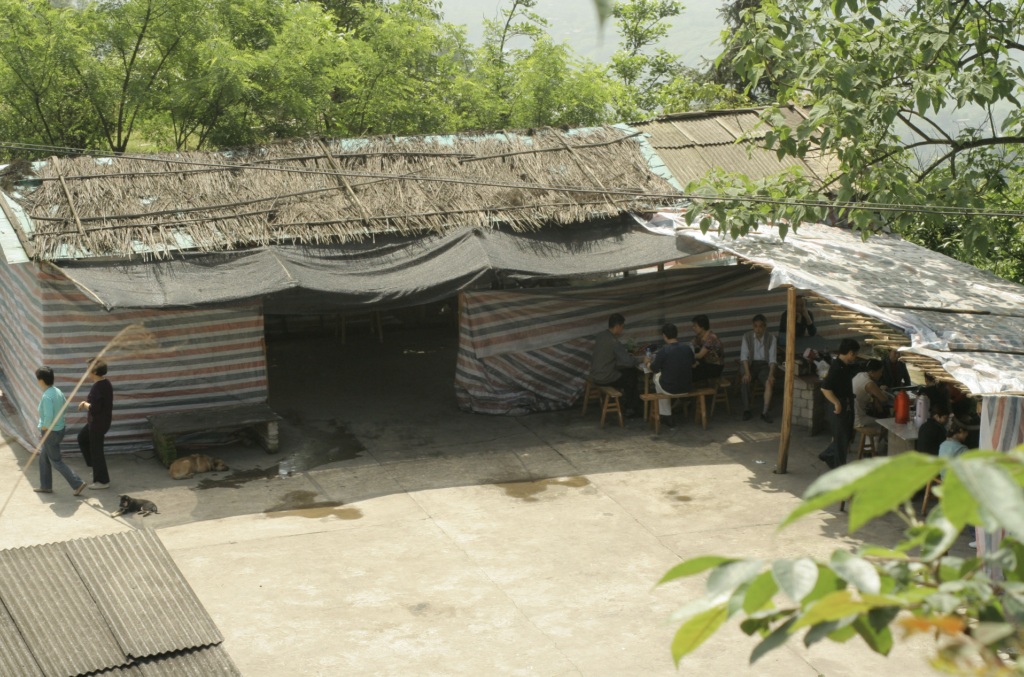
Once again there was solitude. Then we heard voices and music and followed the sounds. There, below us in an opening through the trees was a restaurant. The walls of the building and lean-to were made of plastic or something similar. Their dining room was a few small tables and benches tucked in close to the building. The roof was made of pieces of tin, plastic, and bamboo. Another building across the concrete yard may have been a home. I had to smile as I thought that even here on the mountainside were more people. The hustle and bustle of the city streets below made its way up the mountain.
It had been a good day discovering more of the lifestyle and culture of these intriguing people. We headed back down the mountain, tired but satisfied from our adventure. The streets teemed with life. I turned to look back at the mountain that appeared serene and quiet, but I knew that, yes, even the hills were alive.
The streets were crazy! There were cars, mostly cabs and private drivers, horns honking, and lots, I mean lots, of people. I immediately saw that pedestrians did not have the right of way. Street vendors scattered along the sidewalks sold their wares and food. A unit of uniformed soldiers marched in formation. I stood back and watched all that was happening around me. My initiation into this new culture was eye opening. All the sounds, sights, and smells combined to create the atmosphere that gave the city its unique character.
The walk to the market that day was relatively short since we were only getting bottled water. Our little China Doll rode on her mama’s back. She held out her hand to me and said, “hand.” My heart simply melted. With her little hand in mine, I knew the twenty-four hours it took to get to Chongqing had already been worth it. As a bonus, she held my hand all the way back from the store, too.
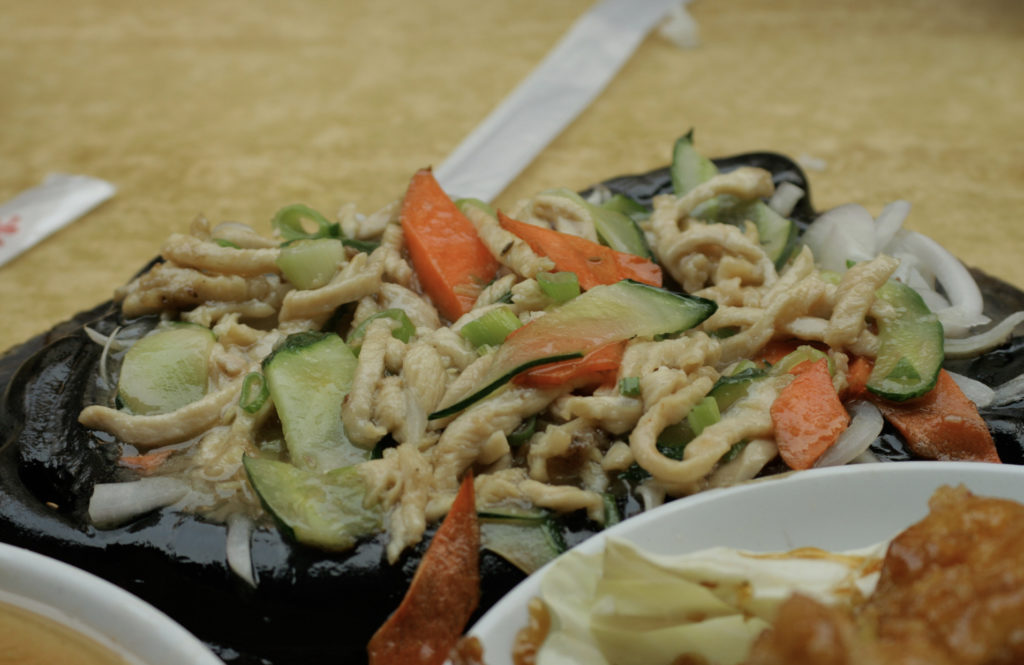
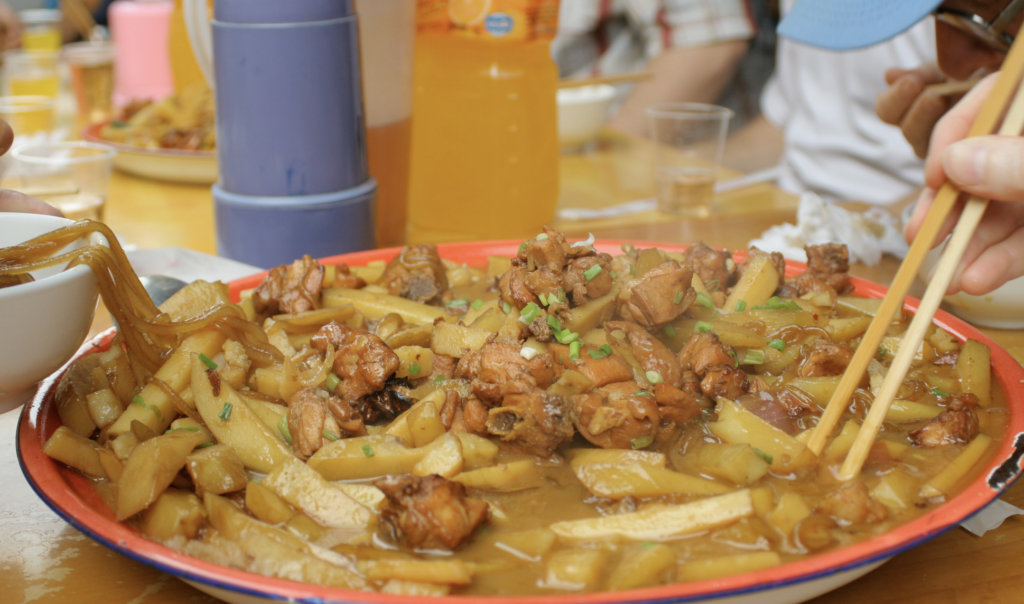
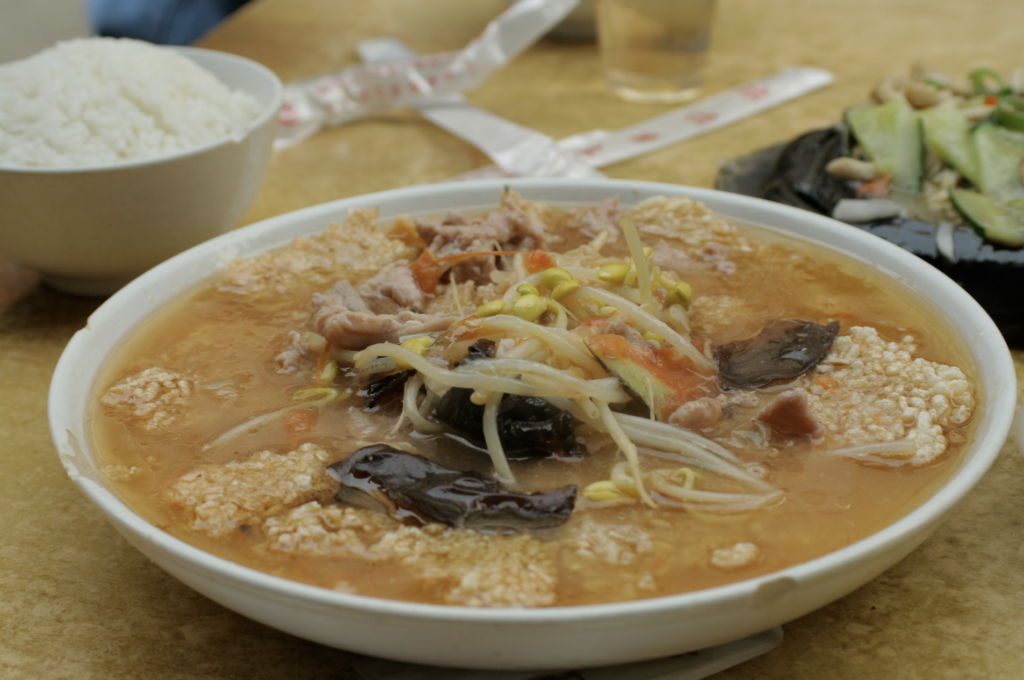
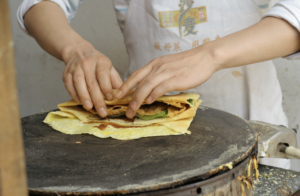
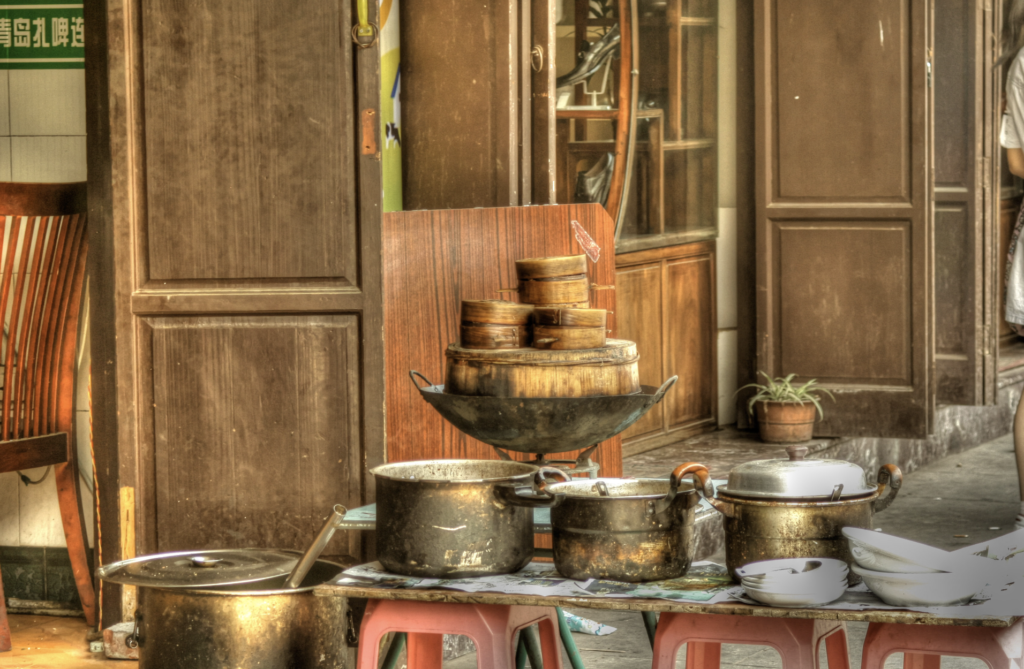
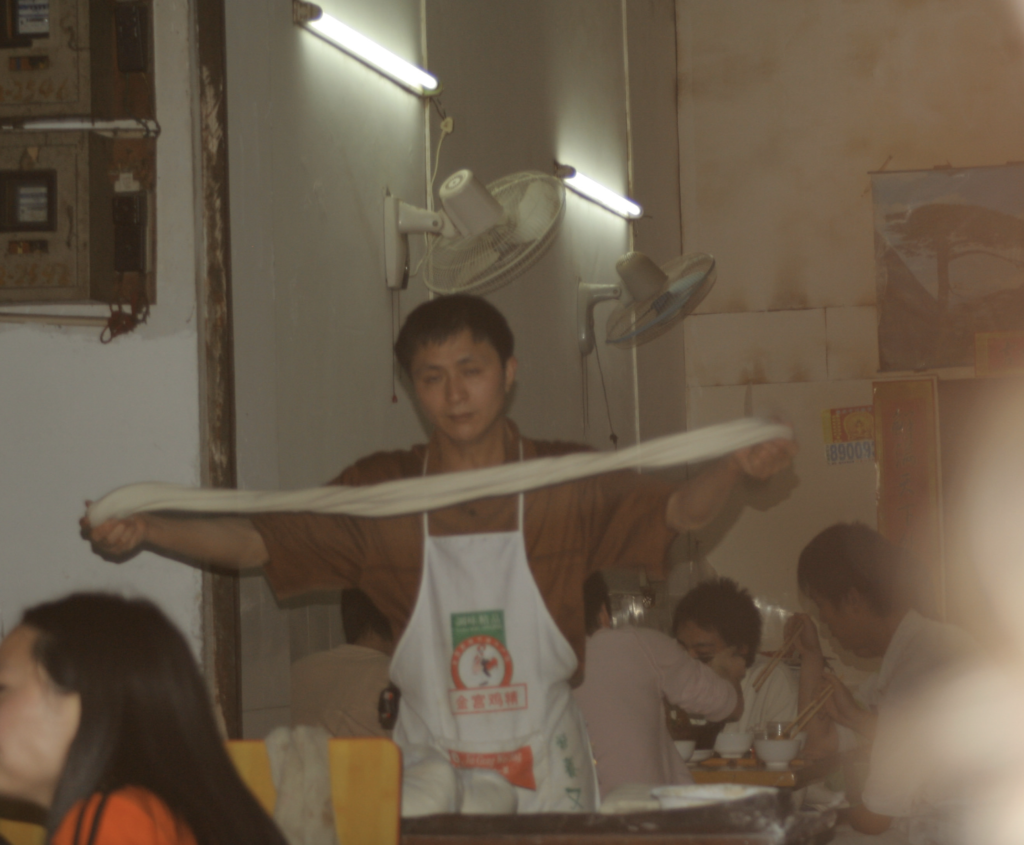
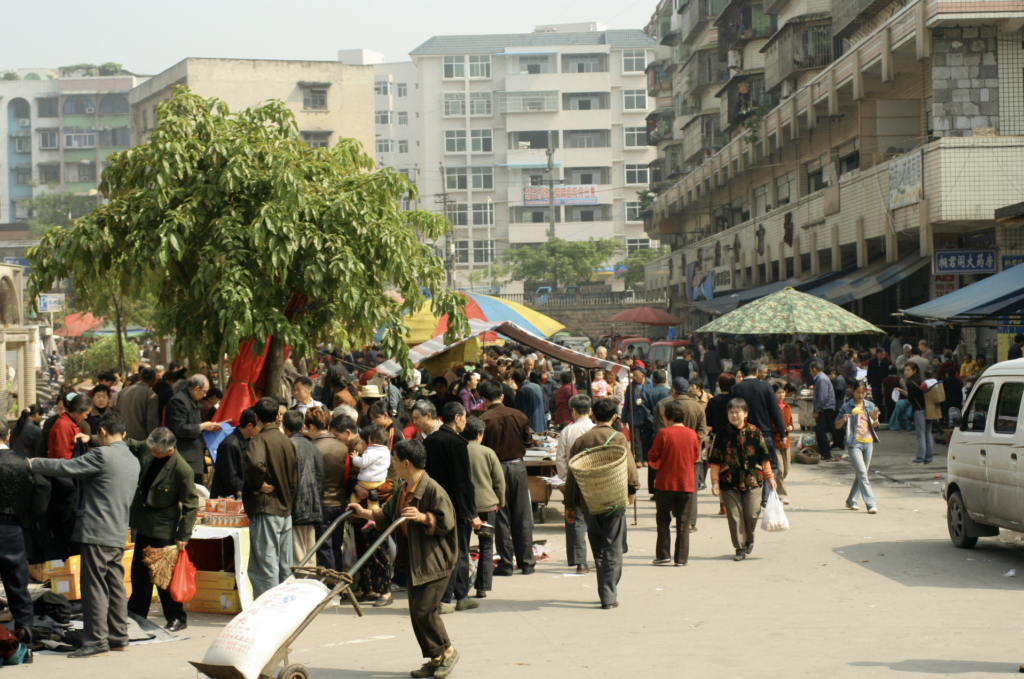
Going to market was an everyday occurrence for many of the people in Chongqing. During our short stay, it was for us, too. Beyond the street we crossed the previous day was the marketplace. We passed various shops and walked down an alleyway that led to other vendors and open-air restaurants. It was fascinating. We stopped to watch the noodle man. I stood still, mesmerized by his fluid movements as he worked the dough. He held a big ball of dough and stretched it in the air, working it back and forth in musical rhythms – kind of like pulling taffy when I was a kid. Another vendor made dumplings, JaoXi, dough stuffed with pork or other meat, onions, spices, etc. The dumplings were placed in bamboo steamers that were stacked on top of one another. We sat in front of the one of the restaurants and shared a meal with several of the English students my son-in-law taught at the university. Our meal consisted of rice (mi fan), chicken carrot dish (tie ban ji si), eggplant potato pepper dish (di san xian); Sichuan dry fried string beans (gan bian si ji dou) – this was my husband’s favorite food, potato pancake (tu dou bing) and Chinese tea. It is customary for everyone to eat out of the same pot, but I still dipped some out of the community pot and put on my own plate.
ti ban ji siDa pan ji
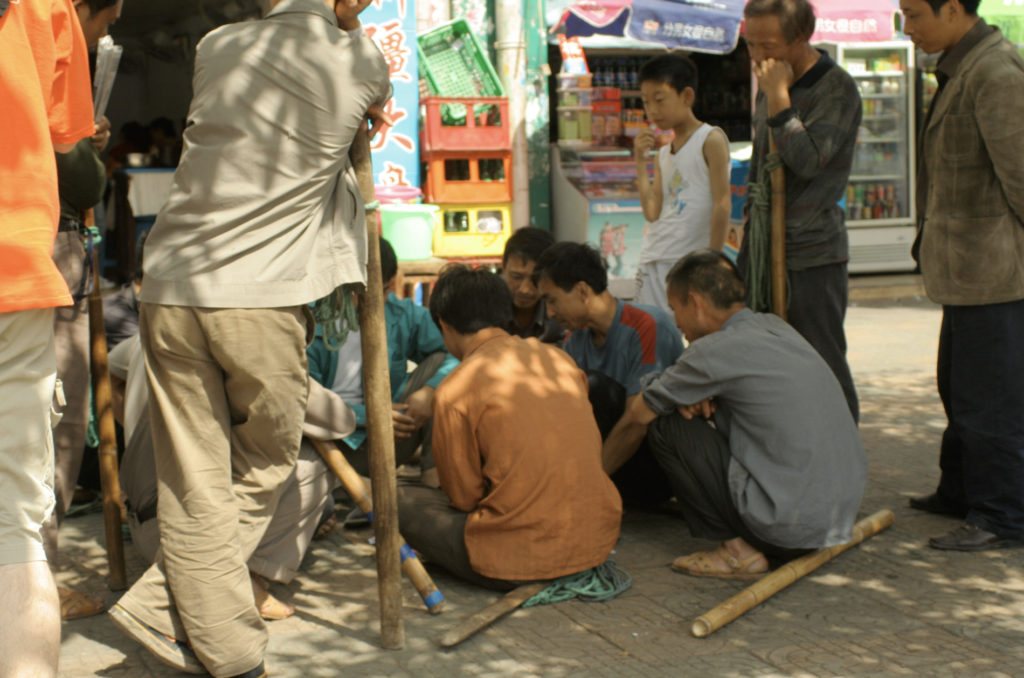
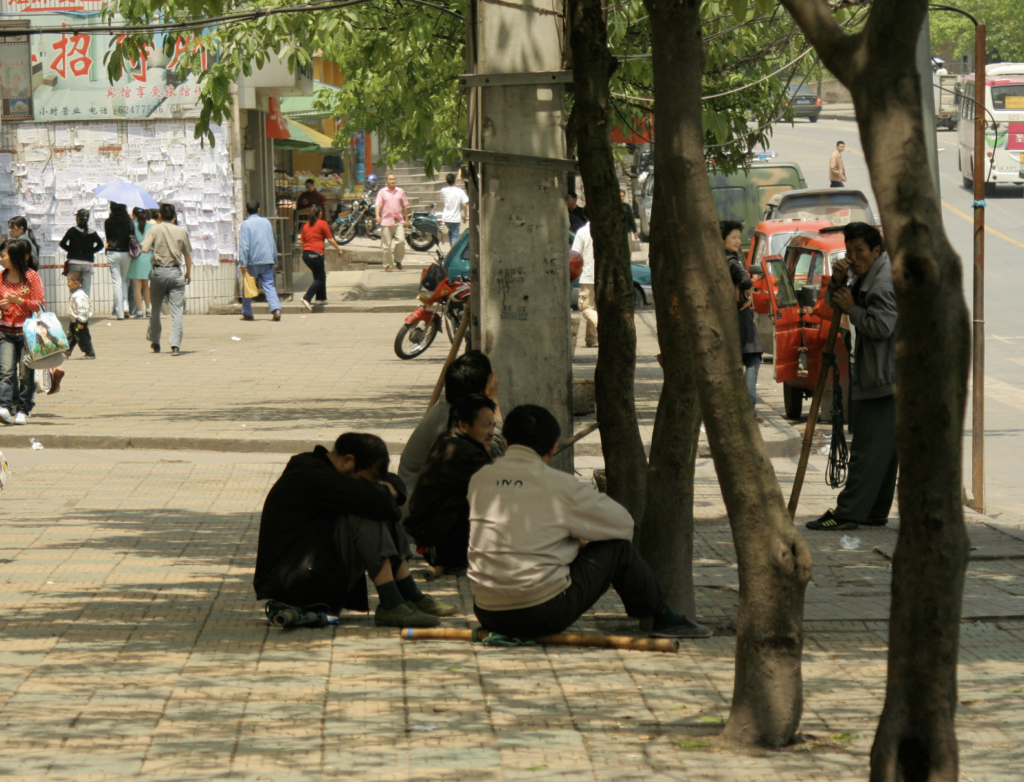
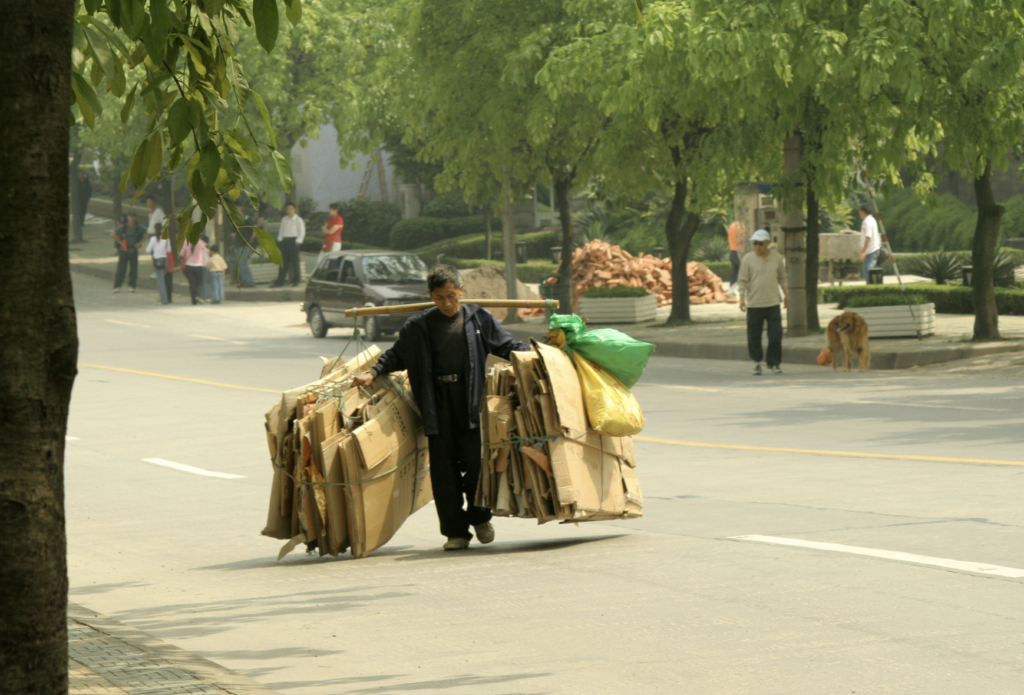
Gathering along the streets were bangbang men with their bamboo poles (bangzi) waiting for someone to hire them to carry goods – from produce, personal items, appliances, or whatever. Other men brought tools of their trade, laid them out on the sidewalk, and waited. Employers would drive up and choose workers for the day. As men sat on their bangzi and waited, some played games, some took a nap, and some just visited. We saw bangbang men carrying items that hung precariously, one even carried a TV.
bangbang men playing gameswaiting on their bangzi for work
Most days, one or more of the English students went with us on our adventures. They loved being with us and wanted to know all about our way of life. They asked about movie stars (of which I knew nothing), wanted to experience our food, talked of fashions, news, homes, and even architecture. In return, they shared their culture. One of our daughter’s close friends taught me how to knit like the Chinese women. This friend went with us one day when we crossed the city to visit some historical places and a couple more markets. I stepped into a little shop and when I came out, I didn’t know where the others had gone. There was a crowd gathered just across the street. Immediately I knew that our China Doll had drawn a crowd again. Sure enough, the rest of the crew was there with her. On that day, our friend came to my rescue when a store owner tried to charge me extra for souvenirs because I was American. She scolded him for treating me that way, spoke sternly to him, and said we would take our business elsewhere. As we left the shop, she stood at the top of the steps and told all the people in the shopping area not to do business with him.
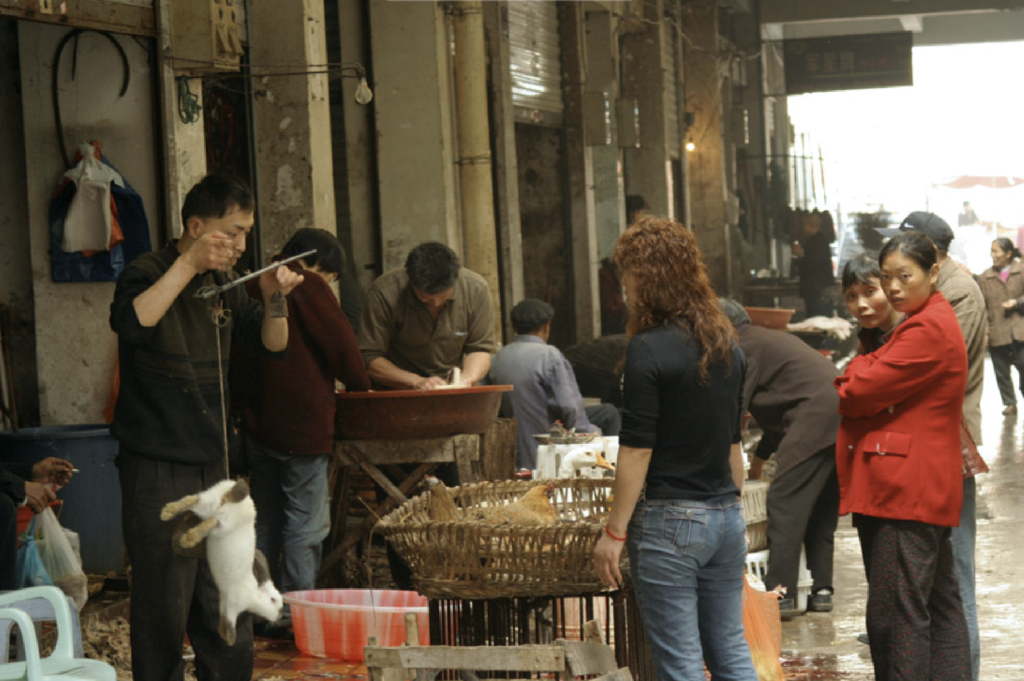
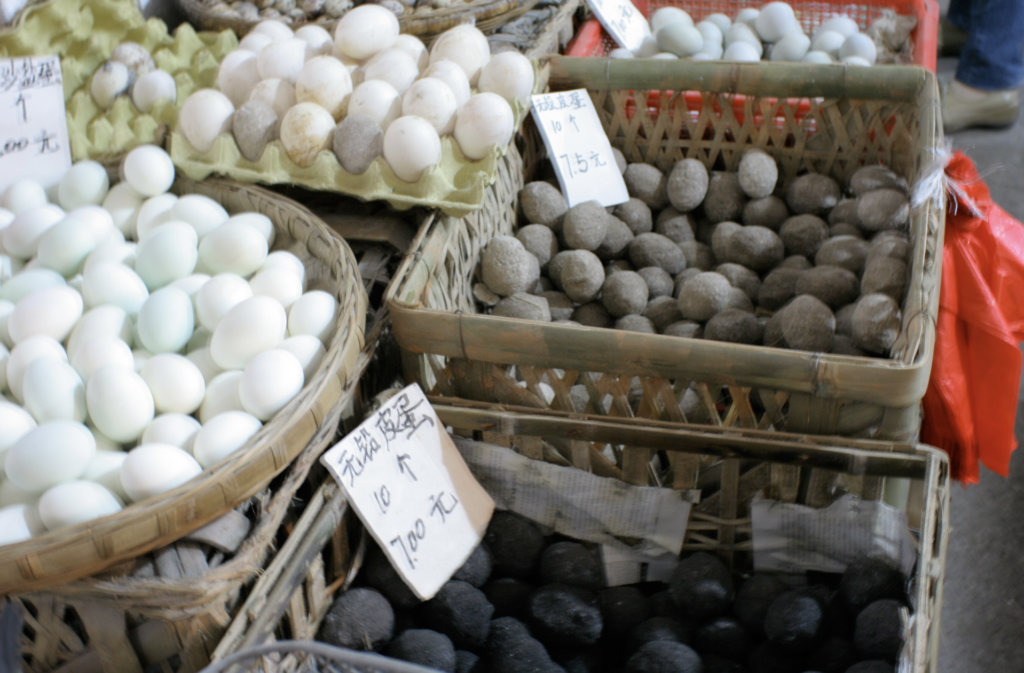
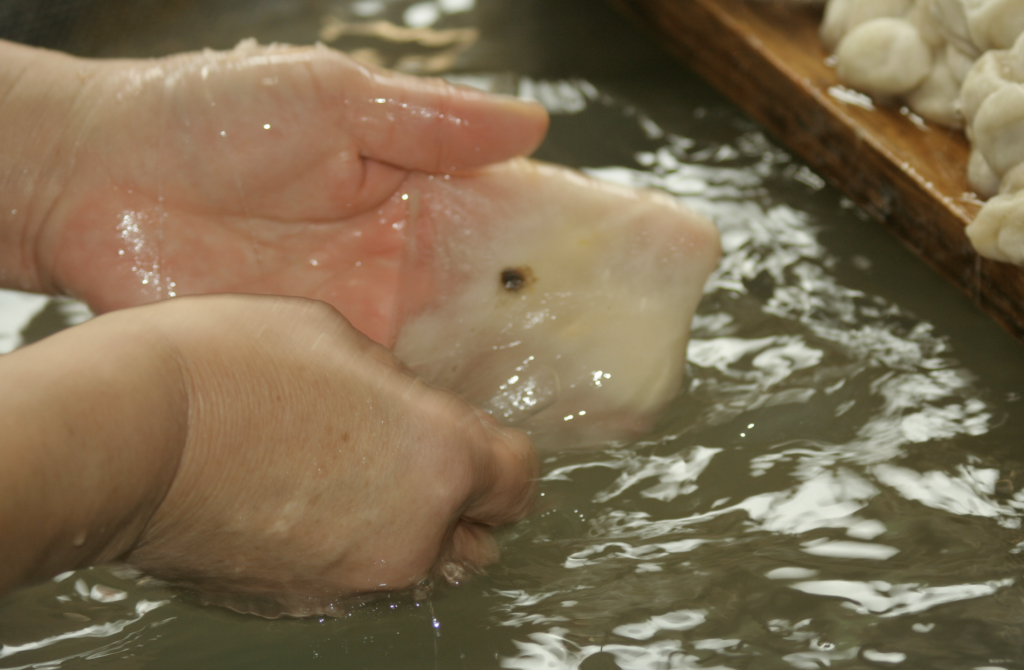
One thing I wanted to experience in the marketplace was the meat market. Big slabs of raw meat (complete with flies) hung from hooks. Who knows how long they may have been hanging there! Intestines, stomach, tongue, pig snout, and other animal body parts were also available. Cages held live small animals, such as rabbits and chickens. There were containers with snakes and other things not too appetizing. Live animals were weighed on scales. Aquariums held fish and other water creatures. Further into the market were big bins of eggs – white eggs, brown eggs, bird eggs, eggs that had been buried in mud and fermented for a long time. Those fermented the longest were considered to be the best. Those eggs were transparent. I didn’t try any of those! We watched a lady pull silk worms out of spun silk. One man made sugared strawberries and created spun sugar art on a stick.
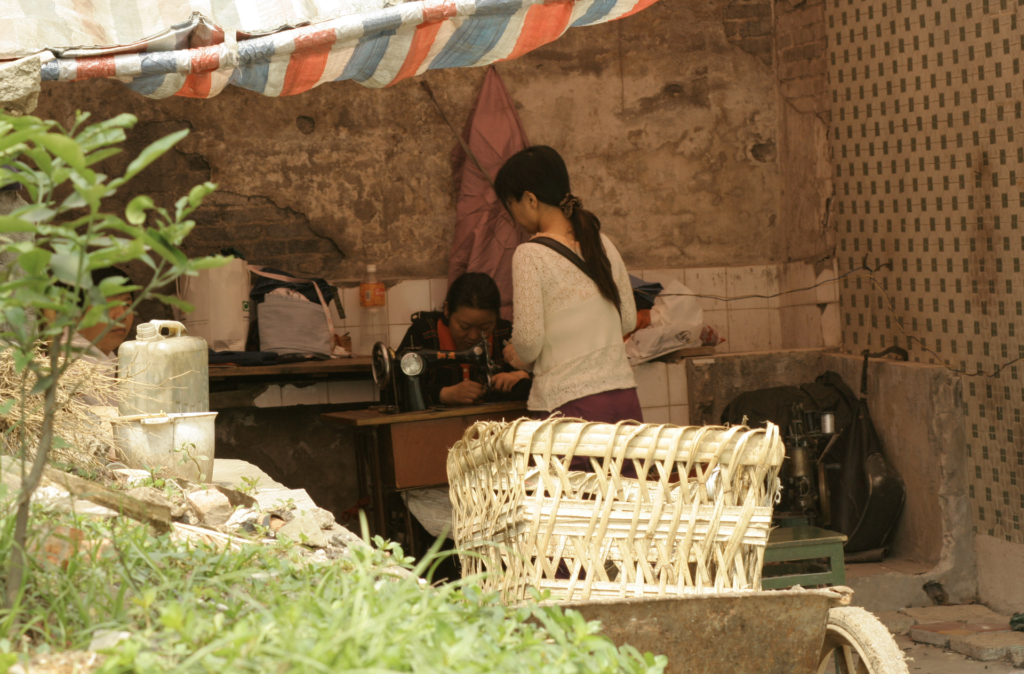
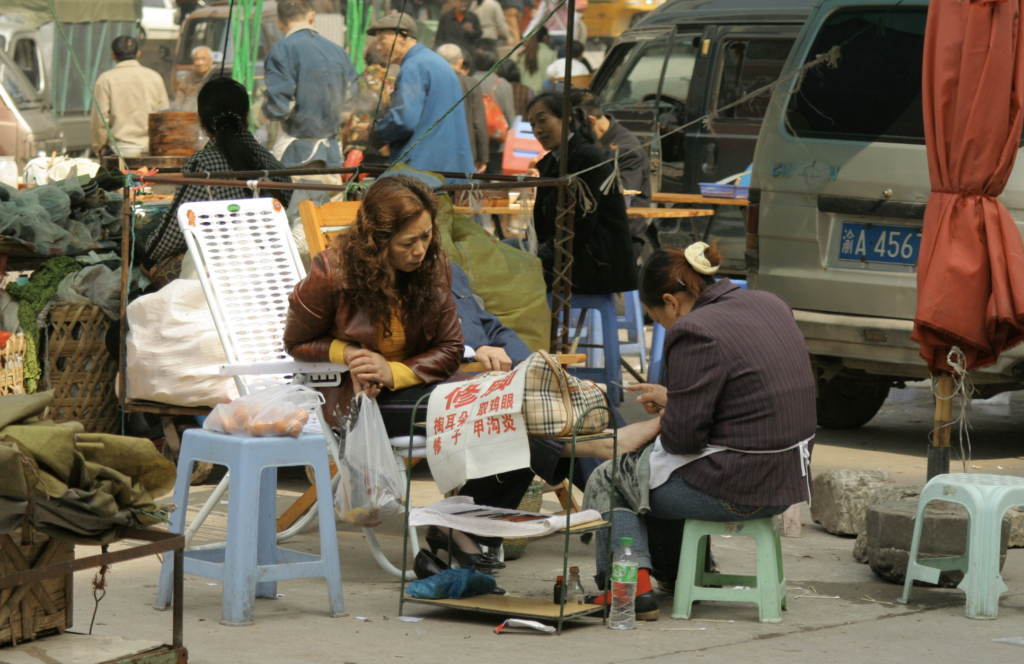
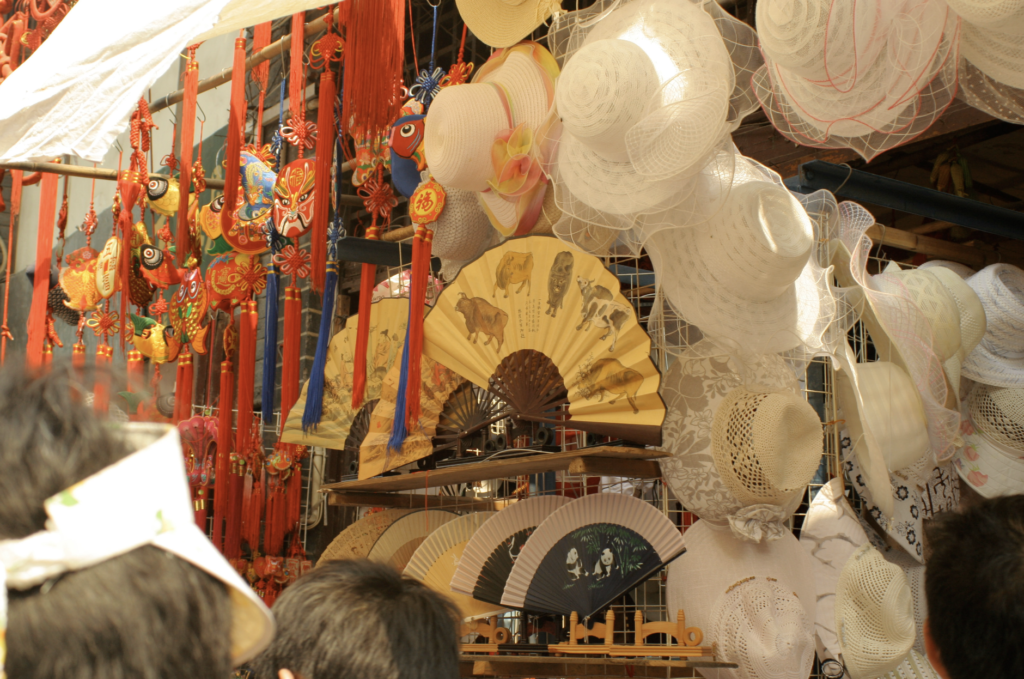
noodle manin the meat marketeggslady remove silkworms from the silka streetside seamstressneed a pedicure?the open-air marketthe women love fans, hat, and bright colors
There was an odor in the air I could not distinguish and couldn’t figure out where it was coming from. My son-in-law said it was from one of the food vendors. How could anyone eat something that smelled like that? It was fried tofu and the smell was horrendous – and indescribable. I wanted to experience the smells – and I certainly did!
Everyone was busy at something, none were idle. Well, we did see one lady at her open-air shop who was taking a nap as we passed by. Vendors sold all kinds of wares and services. There was even a streetside seamstress, and a pedicurist.
Once again, I was enthralled at these industrious people. This would not be our last visit to the market!