A Glimpse of the Mountain City

Despite the time difference and jet lag, we were up early. There was little sleep to be had anyway because of the noise from the jackhammers, construction workers, and comings and goings of people outside during the night. I wondered, “Do they ever sleep?” At least it had warmed up a bit in the room. The first thing I did when we got there was close the windows. The locals believed if there was a window, it was meant to be opened.

Daylight filtered through the curtains. I pulled one back and peered out. The street was already coming to life as birds sang their songs to the coming day. I was dressed in no time at all. My request was to experience the sights, sounds, tastes, smells, and culture of Chongqing, China, and I was ready for the day’s adventures.

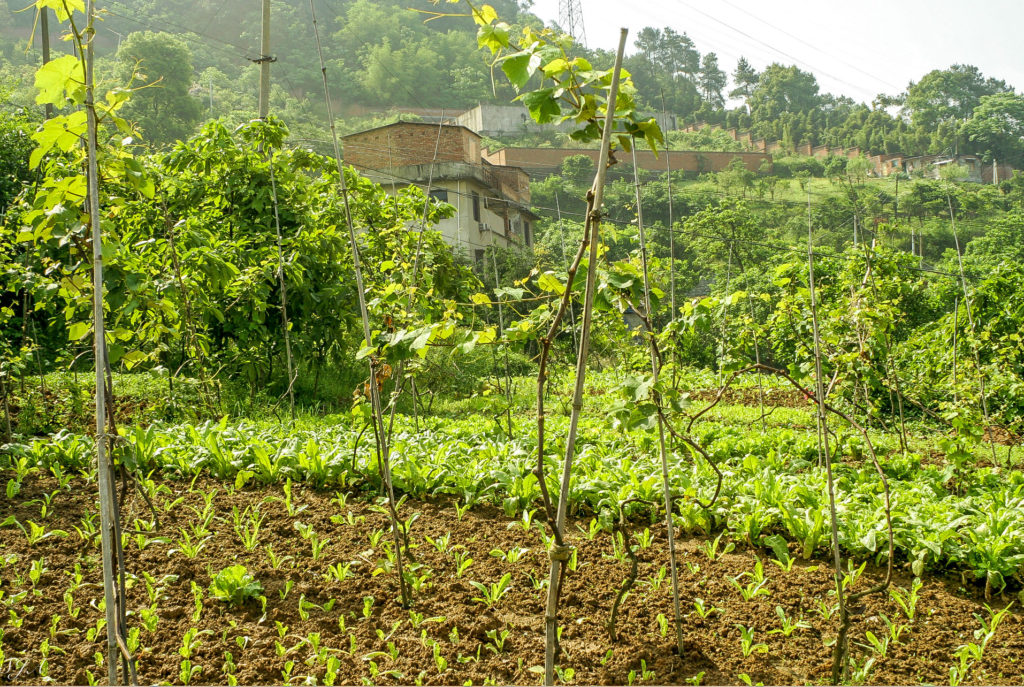
We went down the hotel steps and started the short walk along the street lined with trees toward our daughter’s apartment. As we started up the street, we saw two ladies each carrying baskets of fresh produce that hung from the bamboo pole (called bangzi) across their shoulders. Other vendors joined those who made their way down from hillside farms and gardens to sell their produce in the open market.
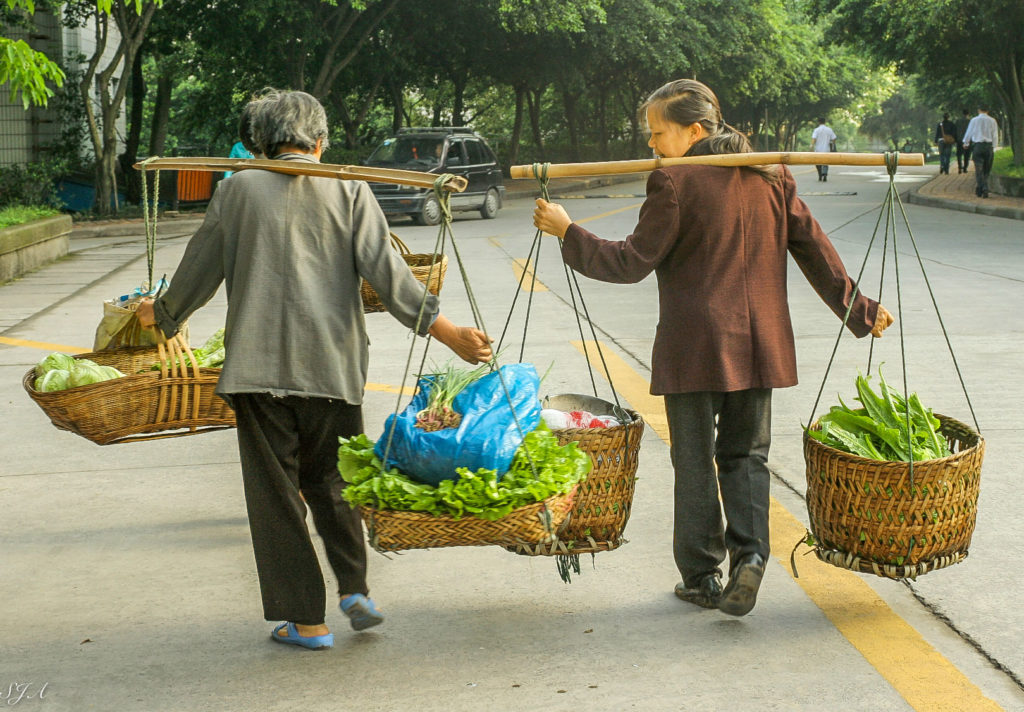
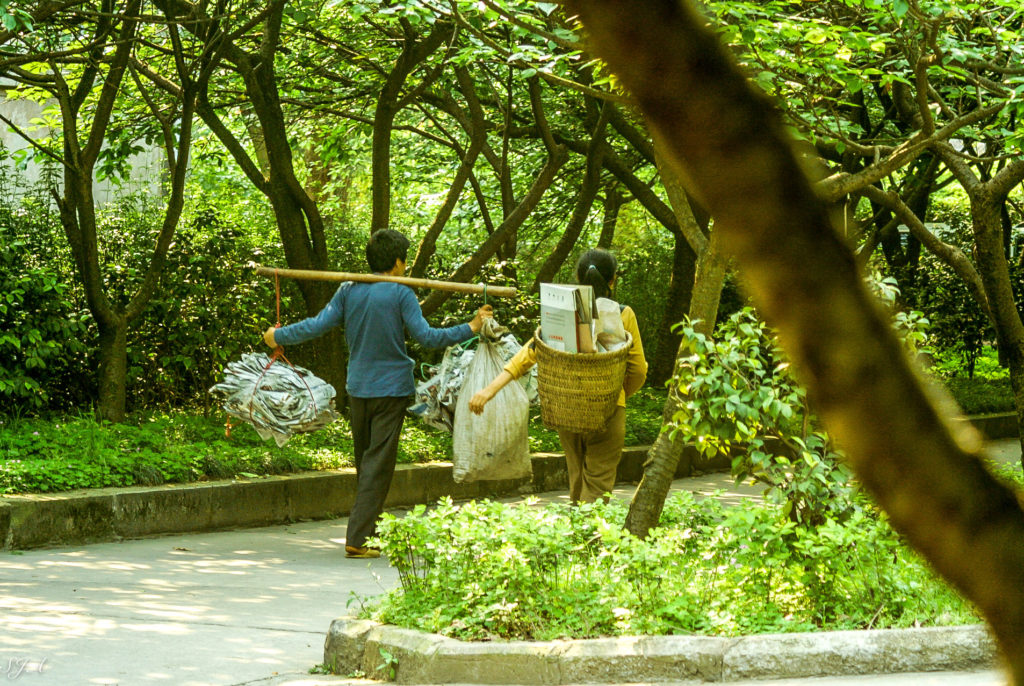
Chongqing, known as the “Mountain City,” was our home for a short time. People walk almost everywhere. The hills are so steep, it is impractical for bicycles. Because of the terrain, bangbang (pronounced bahng bahng) men (and women) carry the weight of the city on their shoulders, literally, as they haul goods hung from the ends of their bamboo poles. Bangbang men for hire is a fascinating part of the Chongqing culture which is now quickly disappearing. https://social.shorthand.com/chengwei_wang/j2ulvBo0cmf/chongqing-bangbang-man

I was immediately amazed at these people who lived day to day, simply. Doors opened as women and some of the men headed to the market to gather what they needed for the day’s meals. The next day, they would do the same. Soon, the streets, gardens, and small parks were swarming with people scurrying around like an army of ants on the move.

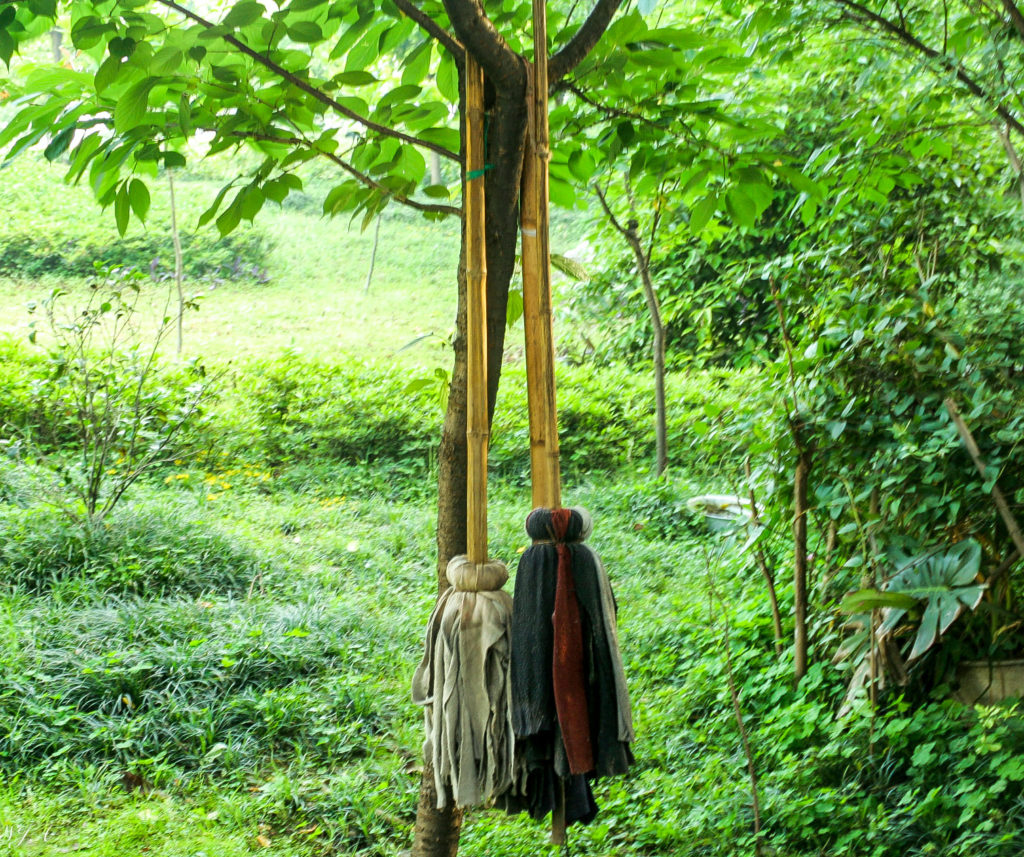
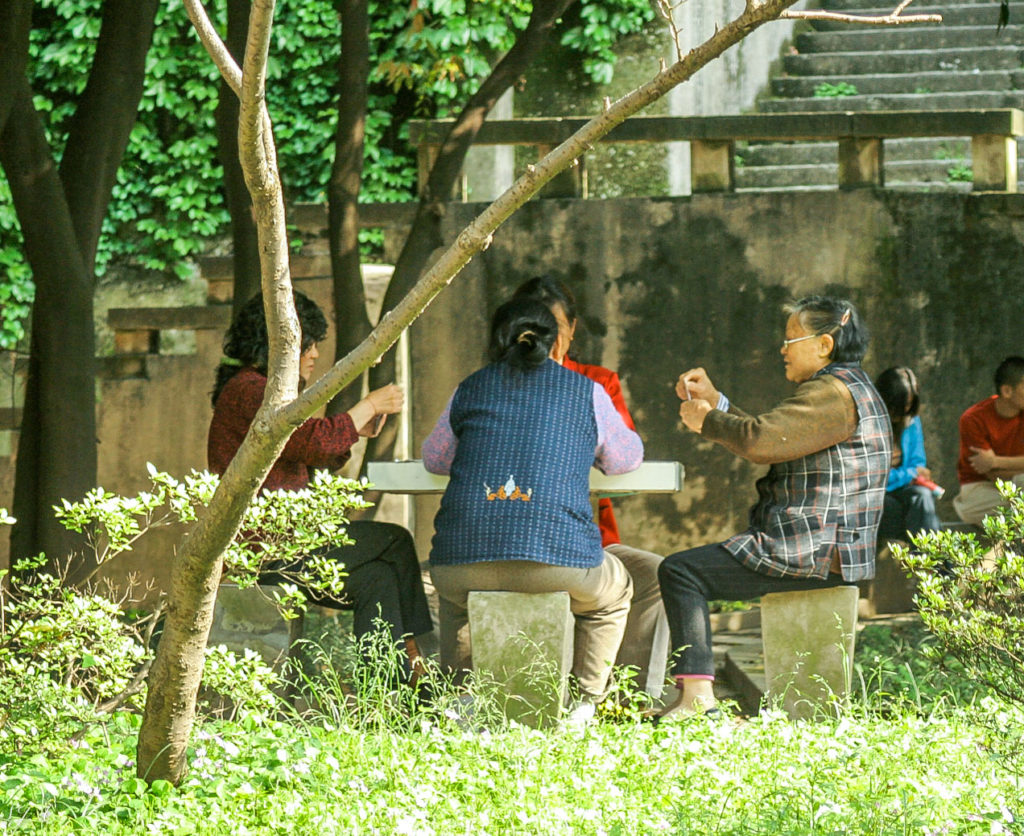
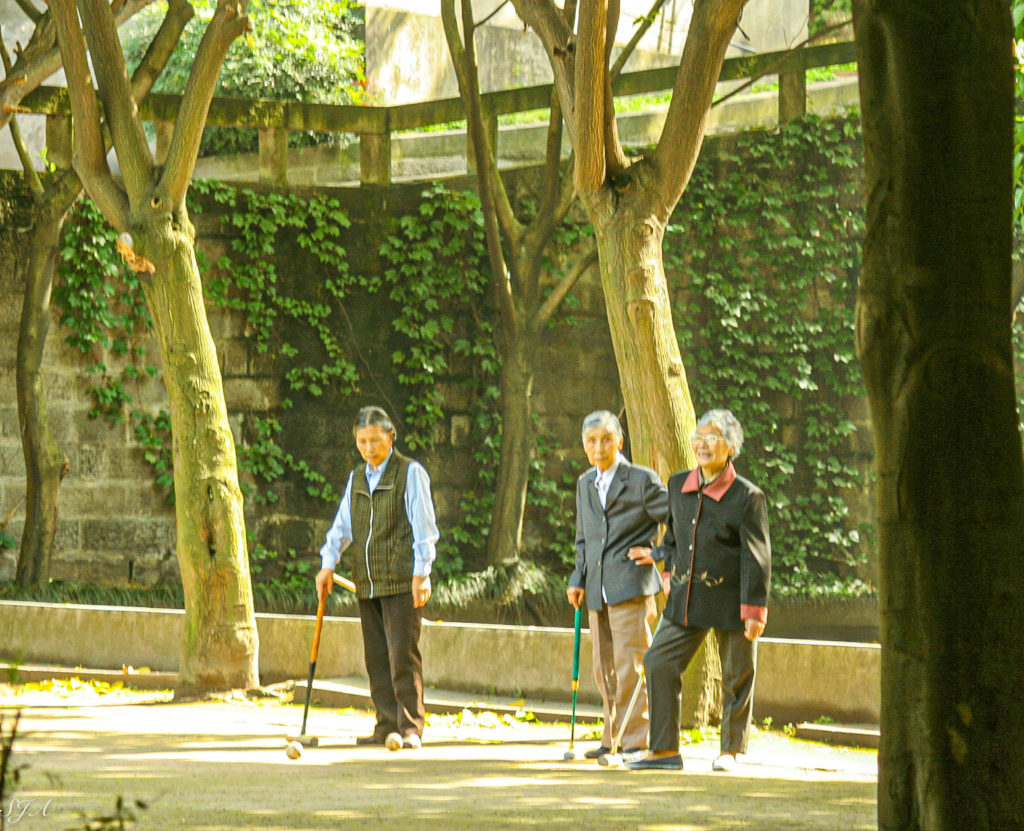
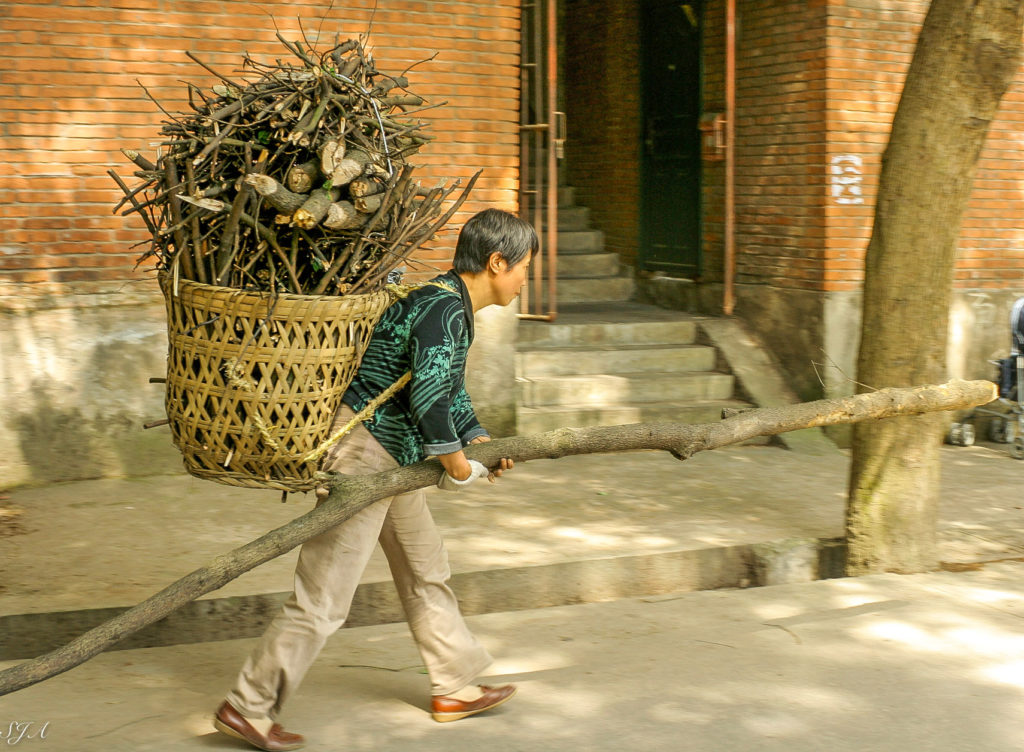
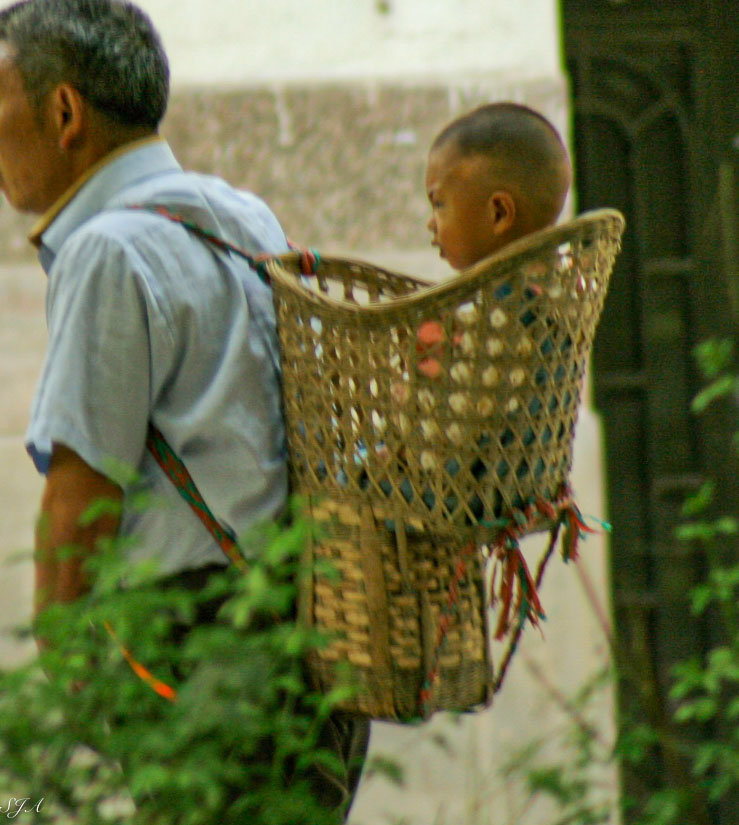
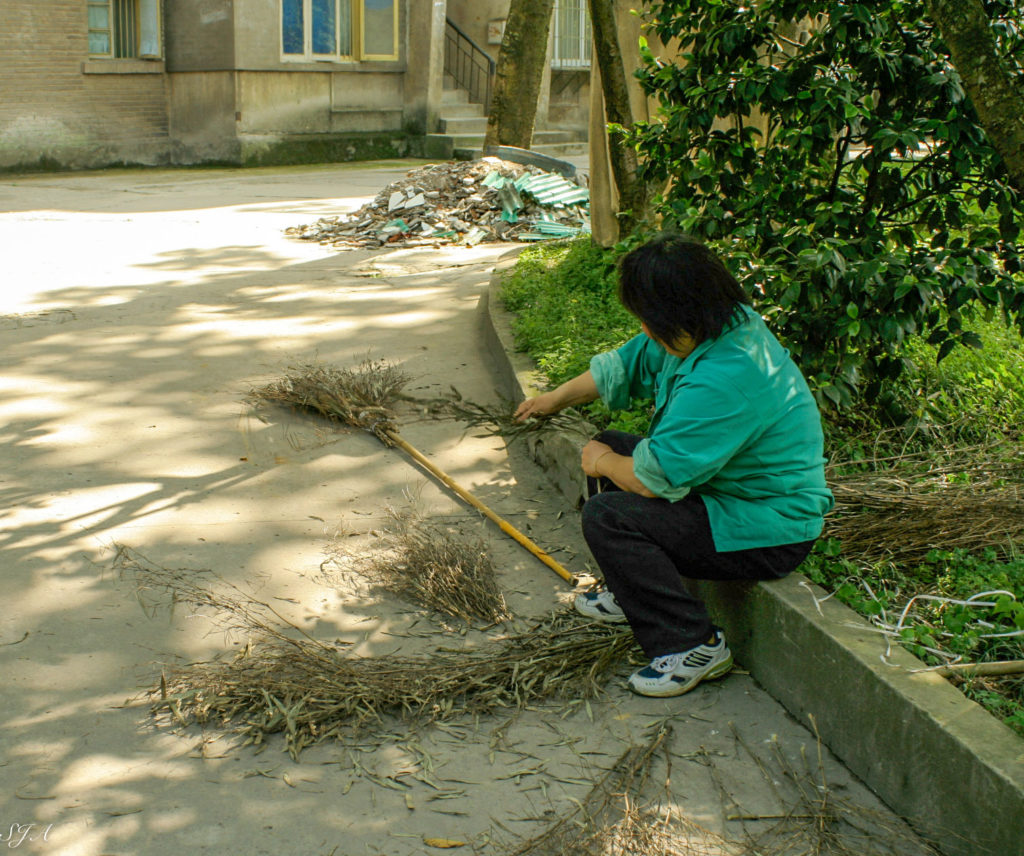
It is tradition for grandparents to care for the grandchildren while the parents work. We saw grandfathers and grandmothers alike who carried a basket on their back with their little grandchild tucked away inside. Older women sat alongside the street making brooms and mops. Men and women sat at small tables playing cards and other games or gathered to play croquet. On the balconies of the apartment buildings, women tended their gardens, reeled in clotheslines laden with laundry, or knitted. Some ladies even knitted as they walked down the street. Other people carried baskets of sticks they gathered along the many trails for their cooking fires. One lady even carried a huge limb to be chopped up for wood. No one was idle.
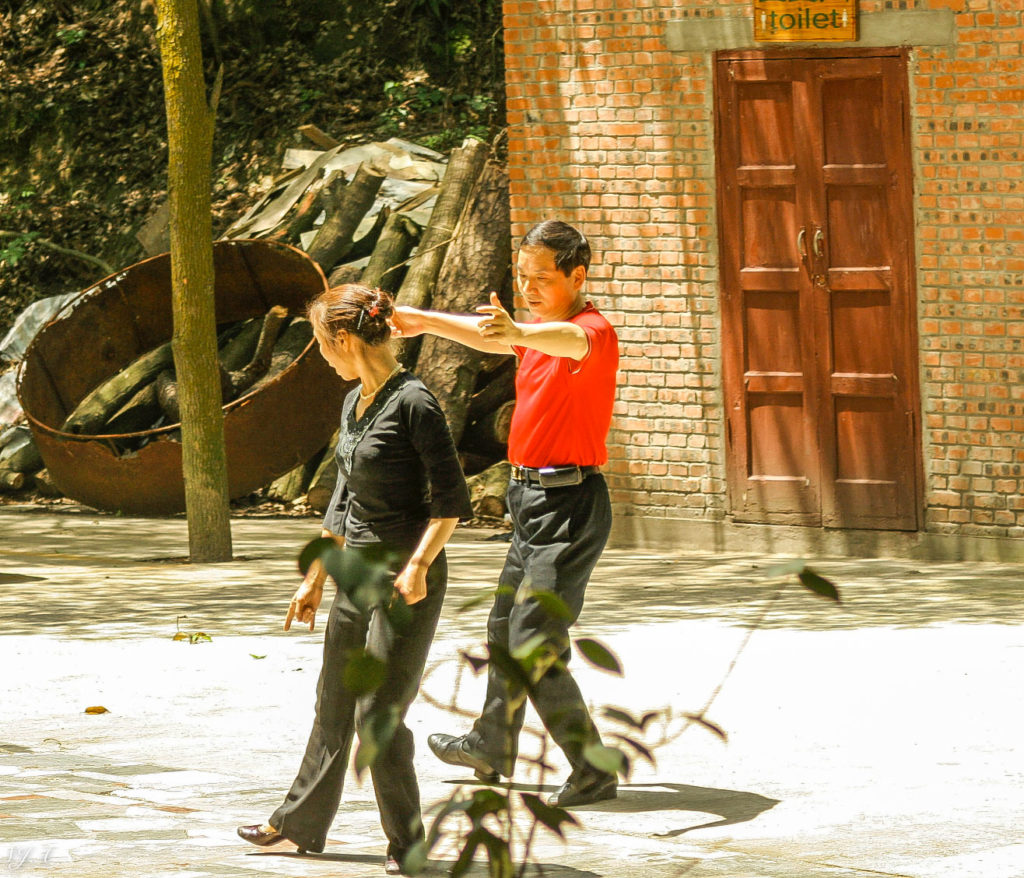
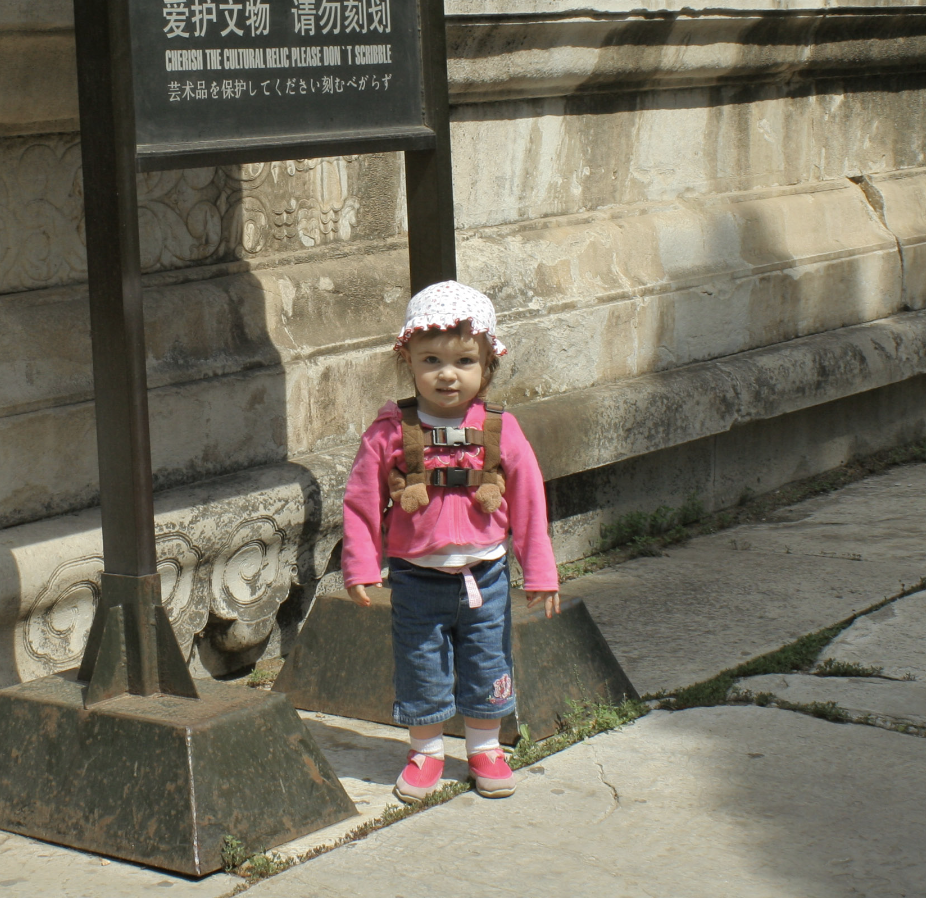
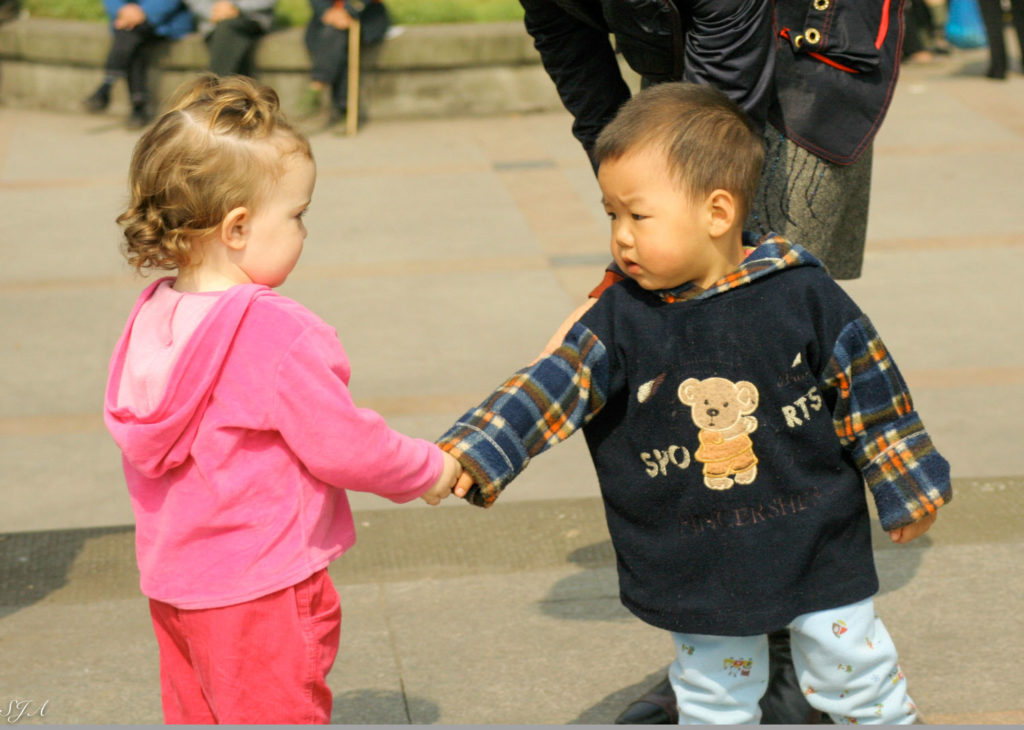
Later, we walked to a park where grandparents took the kids to play. There was no language barrier with the youngsters! They quickly came up to our green eyed, blonde headed, fair skinned little girl to play. She always drew a crowd. People would try to give her gifts, usually in the form of food. Our daughter didn’t encourage that, but sometimes they found surprises tucked away in the baby carrier when they got home.  At a nearby courtyard, music played, and people danced. Laughter filled the air, and smiles lit up the faces of those who seemed to enjoy life to its fullest. 
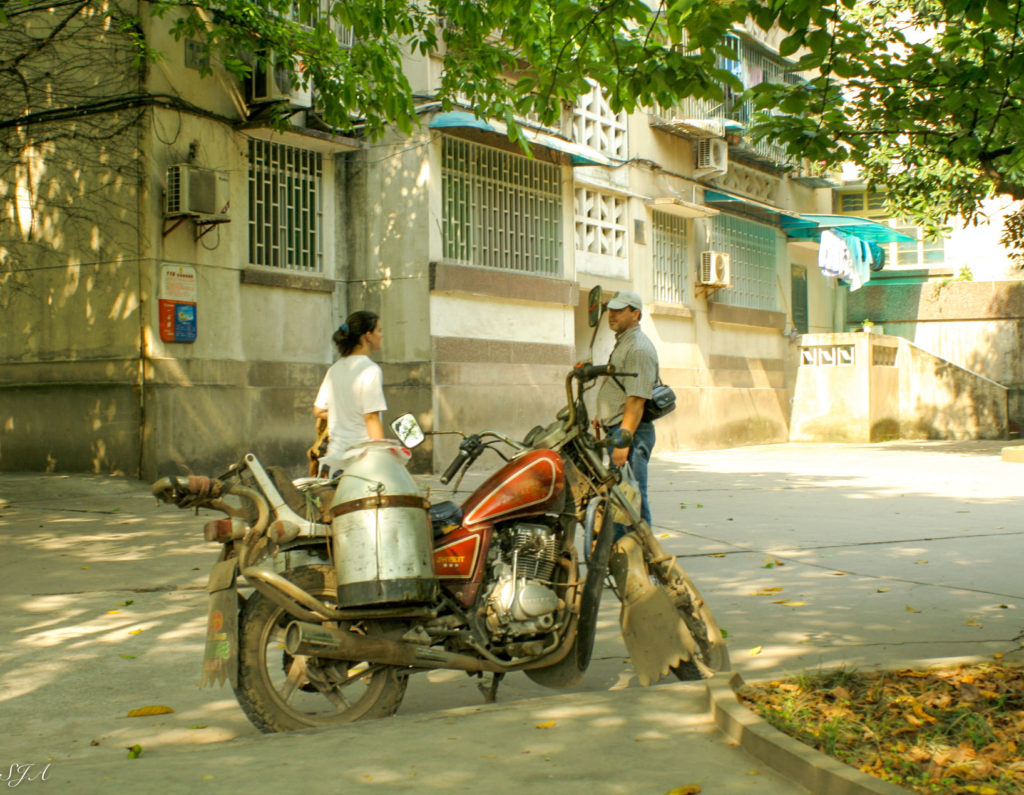
The milkman rode down the street with a milk can strapped to his motorcycle, stopping to make his deliveries. A woman came down the street with her bangzi across her shoulders, going door to door to collect recyclable items. She stuffed them in the bags that hung from the bamboo pole.

Yes, these things were what I wanted to experience in China – to see the people as they lived – to appreciate their day to day lives – to witness their love for family. Already I had seen many sights, heard many sounds, and had a whiff of smells, some of which I recognized, some I had not yet figured out, some I didn’t want to know. The culture I had witnessed so far fascinated me. This was just the beginning, my first impression of a world new to me. I couldn’t wait to go to the marketplaces, eat street food, and experience more sights, sounds (and smells), in the coming days.
China Doll

Touch down! Though the long flight had been fairly comfortable, since we both had three seats so we could stretch out, it was good to be on land. We scrambled off the plane and tried to follow the few signs we saw. The first order of business was to go through customs and then exchange our crisp new $100 dollar bills for Chinese currency. Now, if we could just find where to catch our next flight for the last leg of our journey, we would be all set!

Long hallways leading to and from various terminals shot off in all directions. The signs were poor at best. I know we looked completely lost. Our eyes darted back and forth as we tried to figure out where to go and what to do. A Chinese man dressed in what appeared to be an official airport employee uniform approached. No doubt he smelled fear oozing through our sweaty pores. He spoke to us in very broken, no, shattered, English. I’m sure in reality he was saying, “You look like a couple of suckers. Let me see your tickets and I can profit from this situation and, by the way, get you to your gate.” We gladly complied, the big X on our foreheads pulsating along with the beat of our hearts. He pushed his way forward, said some magic words to a Chinese airport employee, and led us to the front of the line. We quickly went through the crowd. As he left us at the gate, he held out his hand. How much should we tip? I had no idea. I wasn’t sure the value of the currency I had stuffed in my purse and pockets. I gave him what I thought might be a good tip and asked if it was enough. Only then did he grin and indicate that it was. Later we found out that we had given him the equivalent (plus some) of a month’s wages. Well, if it got us where we wanted to go, it was worth it. My imagination had already dreamed up several scenarios of us being lost in China amid myriads of people, horrible drivers, and not knowing what they were shouting at us. 

I wouldn’t feel satisfied until we got off our next flight. We sat there a while anxiously waiting to hear an announcement to board our flight. There was no such announcement – at least in a language I understood. An airport agent approached an American couple seated several rows from us who was traveling to the same destination. The couple grabbed their bags, headed through the door and down the hallway. We sat there a few minutes more and then decided we had better follow.

Entering the corridor, we were consumed by a sea of people. I wondered if that was how cattle felt being pushed through a chute into a trailer to be hauled off to the slaughter. We slithered through the crowd until we got beside the American couple. They told us we had to take a bus to where our small plane waited on the tarmac. We packed like sardines onto the bus and quickly jumped off when we neared our plane. It was evident they were waiting – impatiently – I might add. The flight attendants looked really perturbed, but we made it on, to our seats, and squeezed in past the passenger who glared at us as he sat back down in the aisle seat next to us. Whew! That was an ordeal! Now, if we could just relax a bit before we landed in Chongqing!

It wasn’t long before a flight attendant came around to take our order for food. I had already looked at the menu online, so I quickly placed my order. My husband? That’s a different story. He tried to play 20 questions, asking her the various selections. On the first flight, we had Chinese food and he said he had already had enough, so he was very curious about the ingredients that were in whatever she was offering. She was already “put out” with us because we were late, so this didn’t help. I told him, “Just take something.” The guy sitting next to us was clearly not happy. He finally spoke to the attendant and basically said, “Don’t ask him what he wants, just give the guy something!” There may have been a few expletives inserted as well. She quickly handed him whatever she had in her hand. He may have eaten one bite.

We were sure glad when the flight was over. All we had to do was to find our son-in-law. When we walked out, there he was! “Now,” I thought, “I can relax.” We hopped in the taxi and off we went. Our son-in-law turned our direction and chatted away. I stiffened, clinched my teeth, and held on for dear life. You haven’t lived until you’ve ridden in China traffic in a taxi going supersonic speeds, horn volume on high, busses whizzing by within a half inch of you, on a four-lane road crammed with eight lanes of traffic, cars, buses, and motorcycles weaving in and out, none in a straight line. Getting through the airport to the next flight had been a breeze in comparison!

I wasn’t sure we would survive until the taxi came to a stop in front of our hotel. There to meet us was our daughter and our small granddaughter, our China Doll. When that little girl with big sparkling green eyes, blonde bouncy curls, and a sweet smile on her face ran and put her little arms around me and said, “Maga” (pronounced Mah Gah), I melted. The trip was already worth it!

Jimmy Hicks

My Guest Author, my dad, said, “both scars and joys were imbedded in my childhood memories.” He often told this story a “stray kid in the early thirties when folks were too poor to nourish lice.”

Father was delivering a load of lumber when he saw a hitchhiker beside the country road.  The hiker was about half grown, but his hands, feet, and nose were fully grown.  His sunburned neck climbed out of a ragged shirt and his Adam’s apple made a small shelf more sunburned that the rest of him.  The young man said that he had left home in Wyoming because his widowed mother didn’t have enough money to feed her family.  For a week he had been hitching across the prairies of eastern Montana.  Then somebody told him he might get a job on one of the mountain ranches west of Melville.  That’s where Father picked him up.

Maybe it was because of the boy’s story.  Maybe it was because his oldest son was confined to bed and needed company.  Maybe it was because Bud Ward was that kind of a man.  Whatever the reason, Father brought the hitchhiker home.  He introduced him as “Jimmy Hicks”.  This wasn’t his real name.  It was a name born out of depression times.  It symbolized a wandering youth in search of a place to stay and a place to work.

That night Alan Storm threw his spare shirt and blue jeans on a bed in the bunkhouse.  He came into the kitchen with the hired men and sat down to a square meal.  His sunburned Adam’s apple bobbed up and down.  For a skinny kid, he sure knew what do with food.

When it came to work the new hired hand wasn’t very experienced.  He chopped into rocks, fastened chains to logs the wrong way, got lost on the mountain and broke his ax handle.  When he carried in an arm load of stove wood, he stumped his toe and scattered sticks all over the floor.

After the first month, Ernest Parker summed up the situation.  “By the Great Horn Spoon,” he said, “that kid will never make a lumberjack.”

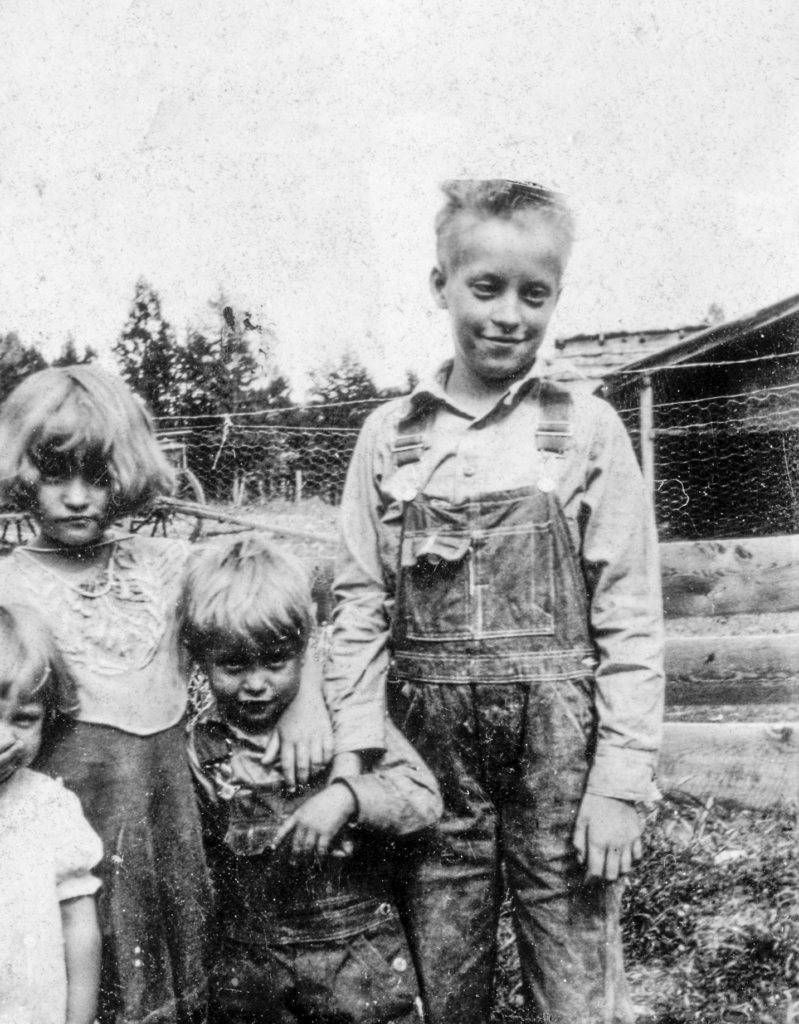
Some of the neighbors wondered how long the Hicks kid would keep his job.  But two and three months went by and still Jimmy Hicks stayed on.  His body was filling out, but he continued to dull his ax and get lost.  However, Jimmy had jobs that the neighbors did not know about.  In the evening, after work, he would get on his hands and knees on the lawn and I’d sit astraddle of his back and use him for a bucking horse.  When he was bucked out, even Sister Barbara could ride him without pulling leather.  After supper, Jimmy would sit in the middle room and talk to my brother.  There was about two years difference in their ages.

Brother Jack had lost the use of his legs and paralysis was creeping up his body.  He had received more x-ray treatments in Billings.  His hair had fallen out again, and the doctors said that nothing could be done to stop the growth of the tumor in his brain.  But in the evenings after supper, laughter resounded from the couch in the middle room.

Just like I’d find out in later years, giants and angels come in all sizes, and when you entertained one, you didn’t know what would happen.  There would be good things to remember.  In the next decade there would be sad things too, for a battlefield at Salerno Beach in Italy would cut short any more memories about a stray kid we knew as Jimmy.

Discovering Treasures in Nature

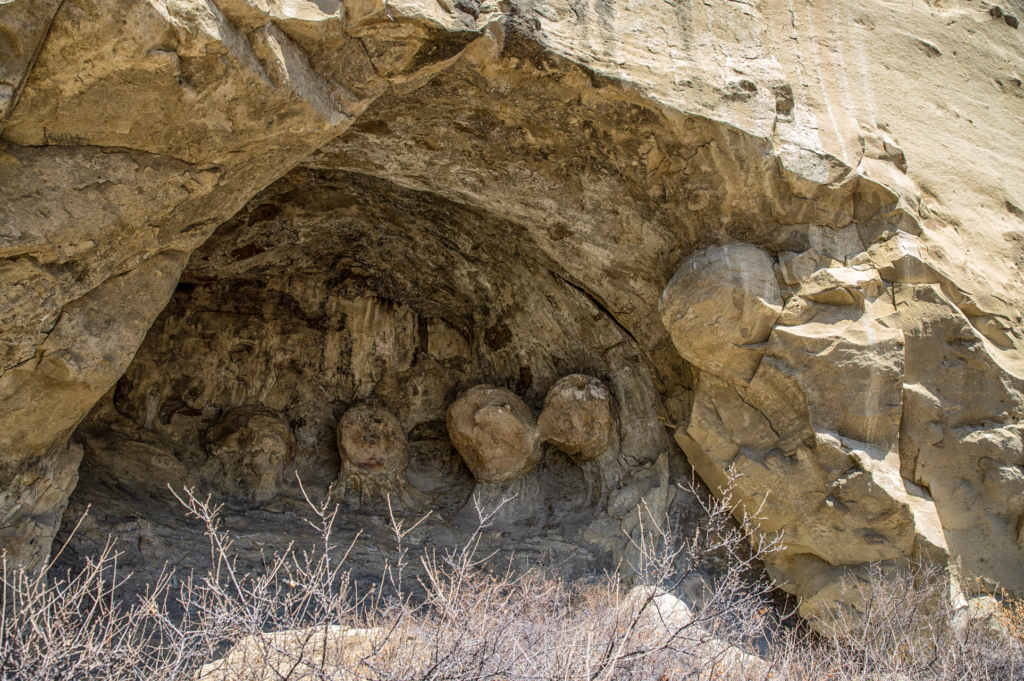
I stood in amazement as I studied the formations in the cave. Big round boulders hung as if suspended from the ceiling and walls of the hollow cavity carved into the high cliffs. It looked as if the huge stones were put into a mold, secured by concrete, and set in place. I had never seen anything like it. I stepped back into the sunlight and looked around me. There were more of those same large shapes on the sides of cliffs along the skyline. My mind raced. What were those geological dome shaped figures imbedded in stone, and what caused them to form as they did?

Upon further investigation, I had a name for those fascinating wonders of nature. They were “concretions”, masses of mineral matter embedded in layers of rock, one of those minerals being a component of concrete. Hidden deep in the core of the rock was a bone, fossil, pebble, shell, or other object that served as the nucleus around which the concretion was formed.

It reminded me of another act of nature, that of a little oyster and a grain of sand trapped in its shell. The oyster releases a secretion to buffer the pain of the irritant resulting in a prized gem, a pearl.

As I pondered these things, a thought came to mind. Aren’t we like those “concretions”? Haven’t our lives been shaped around the experiences, and the trials that come our way?

I just finished reading the story of a family who endured horrific circumstances and defied all odds of survival. They were tested as if refined by fire and emerged as survivors of the atrocities they saw and experienced. All those events acted as secretions that wrapped their lives in stone and precious pearl to shape them into the people they became. A friend who suffered through many of life’s tests once said, “You have a choice – to emerge bitter or better.” 

We tend to base our opinions or beliefs in that which we see, not on what is hidden at the core. Our lives have been formed around events and obstacles that made us who we are today. Within each life is a story, and who knows what treasure you may discover!

Foot Washing

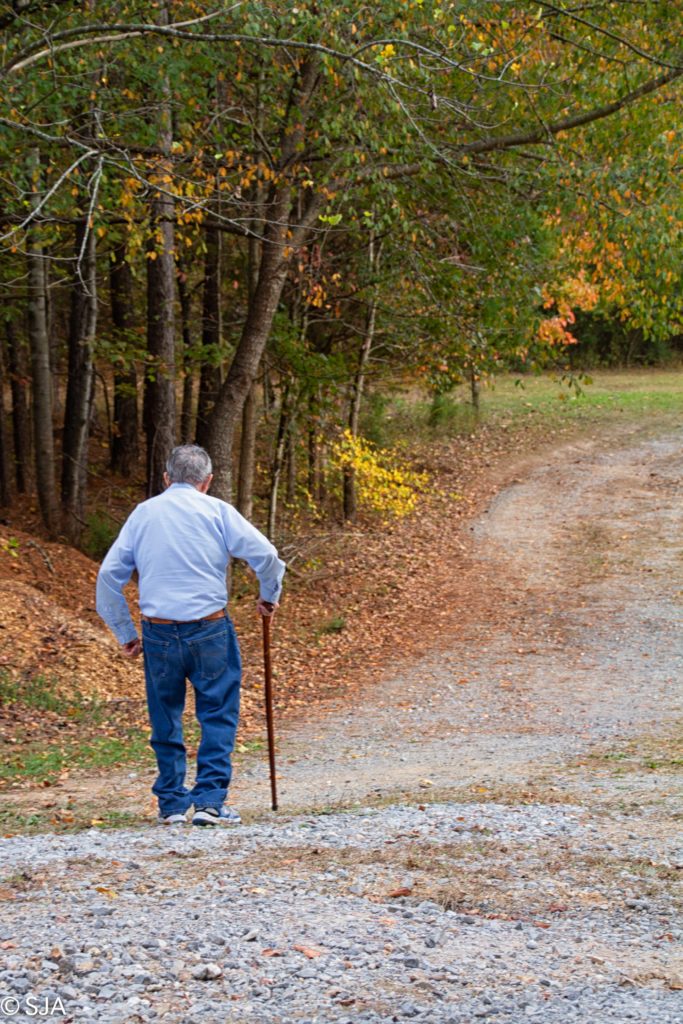
The little man wore holey socks. His long bird-like talons cut the toe of the socks until a hole wore through. He then switched feet for the socks so there was a matching hole on the other side. Sometimes holes even showed up on the underside of the socks. If you happened to see those claw nails escape the socks, you would surely gasp at the atrocity. 

One job I said I would not do was cut the little man’s toenails. They were horrendous. Though I would have done it if there was no other choice, I declared emphatically, “I won’t cut his toenails! I’ll cook for him; I’ll clean up any messes he makes; I’ll shower him; I’ll toilet him; I’ll get up in the middle of the night and change his sheets; I’ll take him to his appointments. I’ll even administer his suppositories, but I won’t cut his toenails!”

I thought about calling a farrier, but then my tall daughter came to the rescue, “I’ll cut his nails.” I was relieved. Not only was she performing a job I didn’t want to do, but she was also getting training to cut my nails that look just like my dad’s. 

Oh, if you could have seen that little man when she came to the house with her clippers! She bought a massage soaking tub for his feet. Gently, she massaged his feet as she rubbed ointment on them, placing each in the tub to soak and soften those ghastly sharp misshaped weapons. She sang songs as she lovingly washed his feet and trimmed his nails. You would have thought he had been given the best of gifts. His eyes danced and a broad smile covered his face. The smile on my face was almost as big because I didn’t have to do that task. 

What I saw as a thankless terrible chore, she saw as an act of love, selfless service, and respect for the little man she held dear to her heart – foot washing.

By the way, “thanks Daddy for passing on your feet to me.” At least I know who can cut my nails! I, too, served a little man with respect and love even when I said, “Now bend over!”

Winter

by my Guest Author, my dad – the man of the mountains

The people down in Big Timber and Melville thought we were crazy to live that far back in the Crazies in the wintertime. They were almost right. 

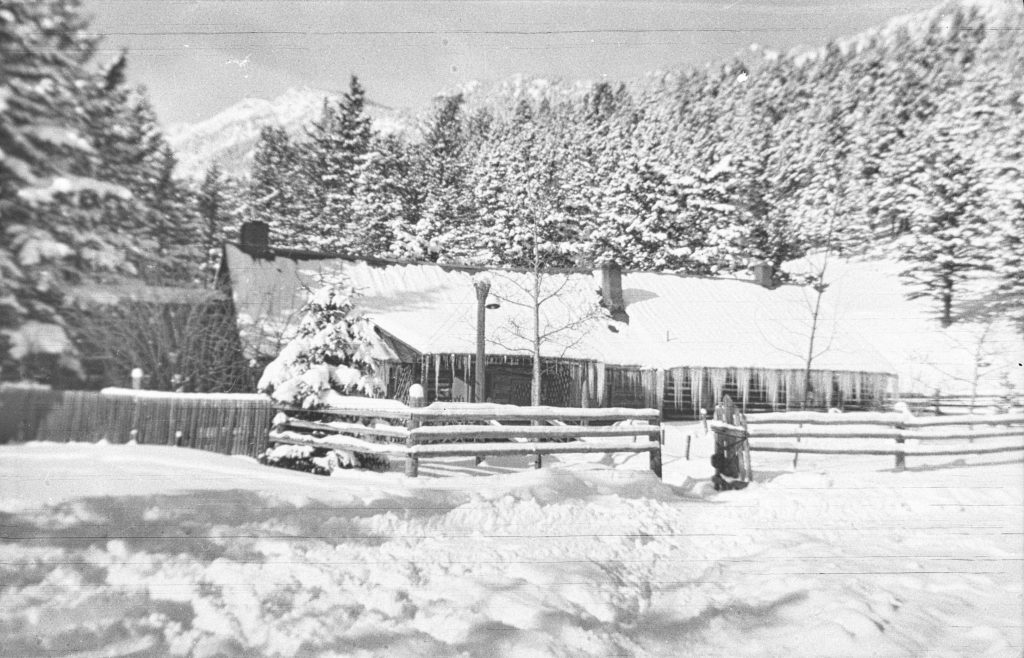
Winter was a son of a gun. For four months of the year we put chains on our car at the Olson Field Bridge four miles away.  We carried a snow shovel and even then, sometimes, we walked and left our automobile off the road or in a snow drift.  

Some winters the Cletrac tractor was the only thing that could manage the road between our house and the herd of cattle four miles down country. My father would wrap up snug and lay down on the sled that I pulled down the road and back.  And driving the caterpillar tractor was cold with a capital K. At times I tied twine to the brake rods and walked behind it guiding it with lines like it was a team of horses.    

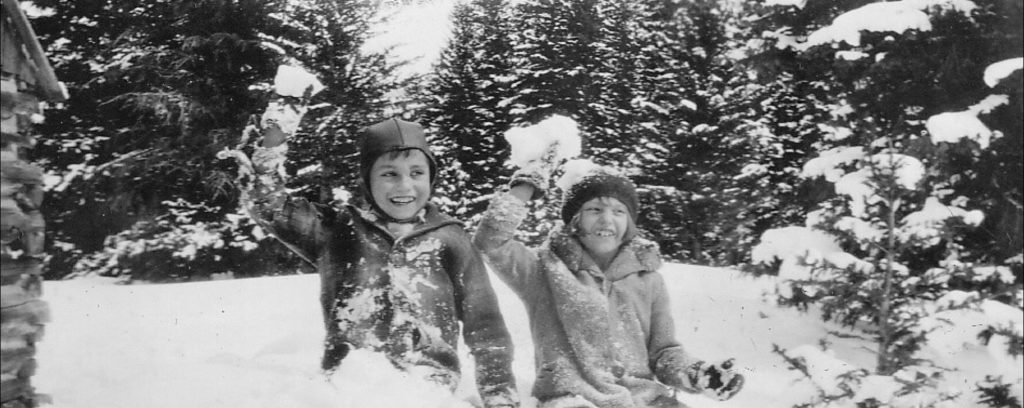
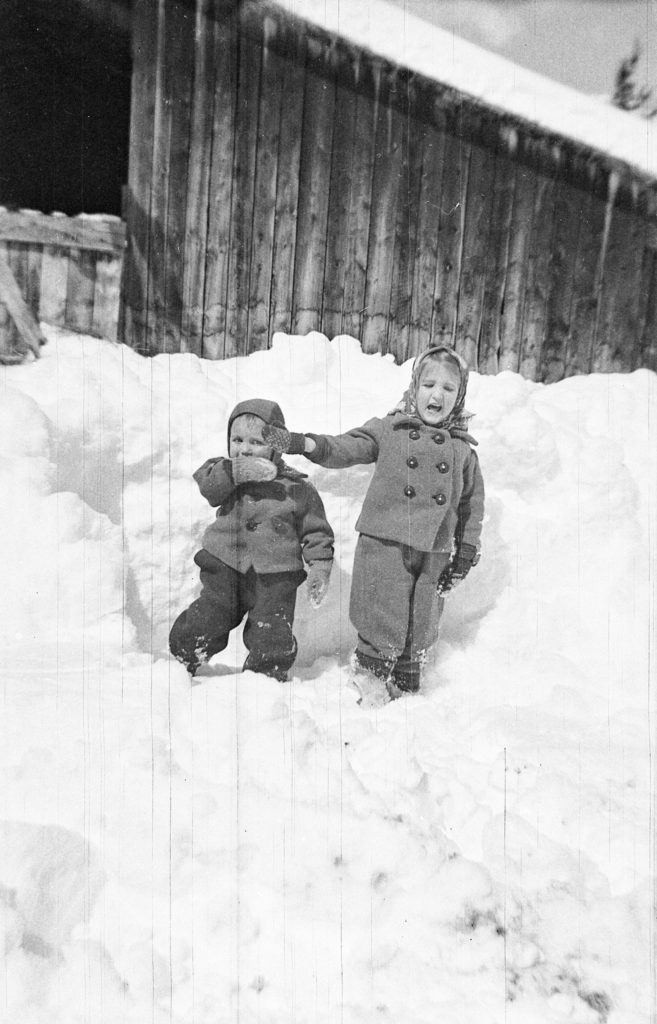
Anyone who lived that far back in the mountain wilderness got acquainted with the curse of winter. The book writer in the family might say, “Winter is a bitch.” But there were also blessings. Just come with me and find a special place and enjoy our land of snowdrifts. Winter gave us a wonderland for hand sleds, skis and red nosed children. When we came home from school, we’d grab our sleds and head for the sled race tracks on the drifted hillsides.

On one sled race that I especially remember, Sister Barbara run-started her sled, sped down the hill, crossed a swale, and landed on the limbs of a fallen tree. She jumped up with blood flowing from a tree limb gash and shouted. “I won!” 

A part of the winning was having had a warm house to get into.  The west wind could be is driving snow across thehouse roof pouring off the eaves like a waterfall with the snow drift on the front side of the house so deep we had to shovelsnow away  to see out the  window – on days like that it’s nice to be hugged by a warm house. 

 Icicles could hang from eaves to the ground, the thermometer could read twenty degrees below zero, but who cared, if there was  a glowing fire place or a wood heater with red cheeks. 

The uncles had a super large house with a massive rock fireplace accented with a mantel covered with interesting Indian relics and the mounted head and antlers of large bull elk. That fireplace burned lots of wood and sent the heat up the chimney. The fireplace was more show than heat. It would warm the back of your legs if you stood in front of it. One of our home improvements was a stone fireplace that showed the head and antlers of a buck deer. The fireplace also housed a Heatilator that would consume any wood that would burn and throw out lots of heat.  Before that we had a heater stove that was made out of a fifty-gallon barrel. It had a draft vent that was borrowed from a manufactured stove. It might go “Put, put, put.” What it lacked in looks it made up by output. That stove would really put out the heat.  We liked to watch its red cheeks when it got really hot.

REAL WINTER COMFORT

J. Frost rides the wind tonight.
He shakes the window screen.
He whispers through the key hole,
“Let me in.”

The fire’s aglow inside,
The hearth log sends its flame
higher up the chimney,
When it hears Jack Frost’s name.

At every heart grown cold,
And every demon, dread, and doubt,
Light faith’s hearth log yet again
And coldness will flee out.

Prairie Rose

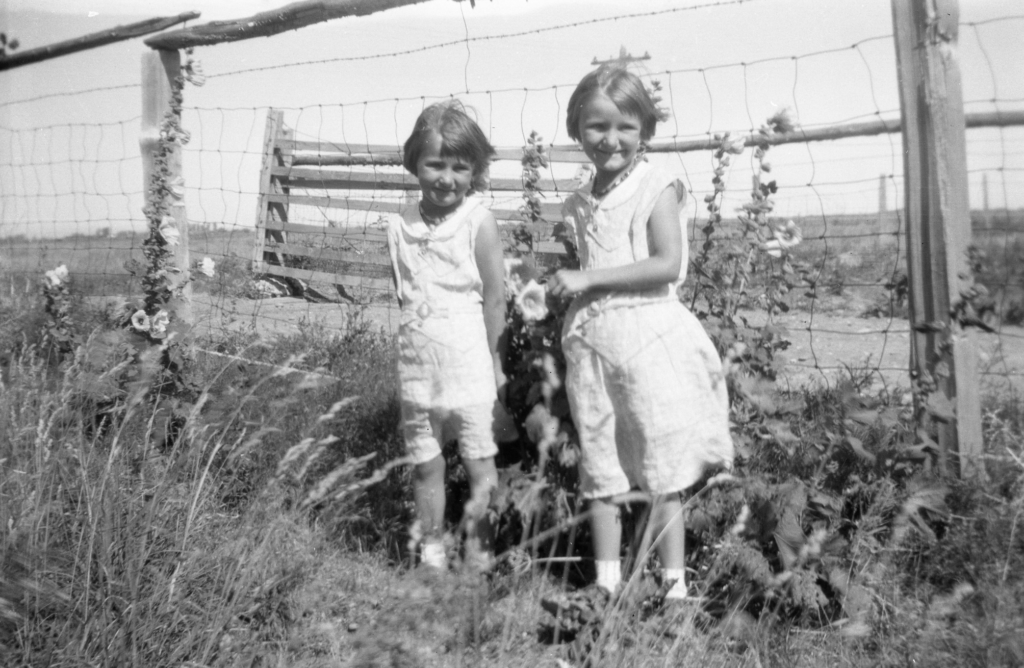
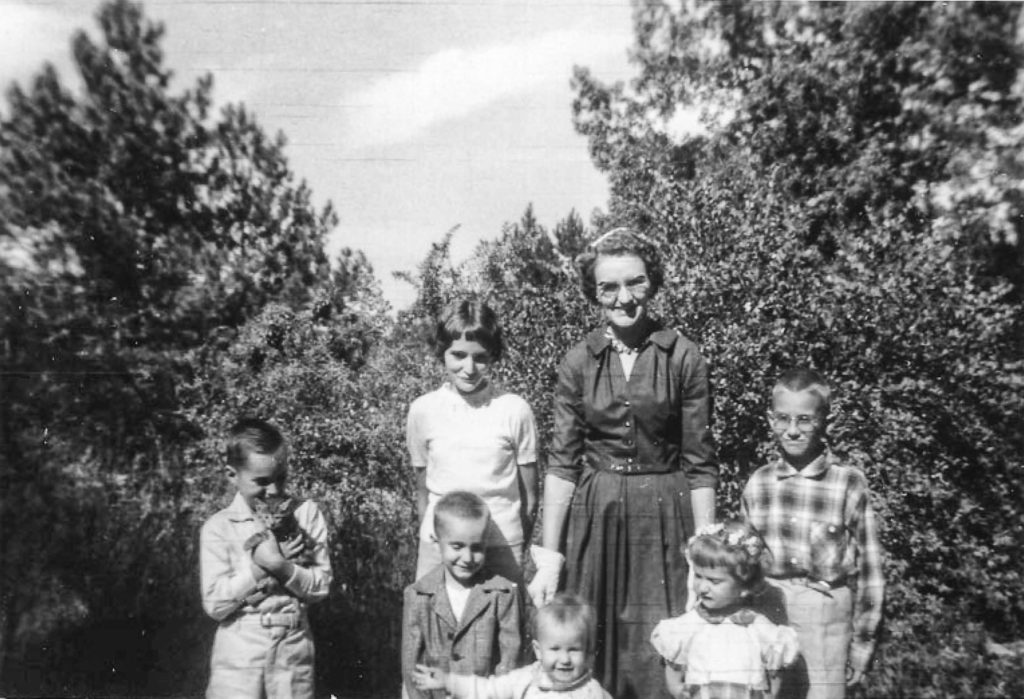
Rummaging through an old bookshelf, I found a tattered and torn book hidden away. A cloud of dust burst into the air as I picked up the book and wiped the jacket to reveal the title, “Prairie Rose.” Slowly, I opened the book. On the first page was the photo of a small girl and just beneath it was a picture of a mother with six children. Who was this little girl who grew into a woman? Would I like the girl, the teenager, the woman, whose stories rested between the pages?

As I began to read, it felt as if I was bound by a vortex of time that passed through the years of this girl’s life. The first scene that came into view was a cabin on the prairie in which a baby girl had just been born on a warm summer evening as green hail clouds cast balls of ice downward and the winds blew against the house. Even as a small child she held a fierce determination that could not easily be swayed. It wasn’t long before another girl joined the family. The two became fast friends and were inseparable. They were like prairie tumbleweeds, not staying in one place for long. One of the great joys of the youngsters was seeing a circus for the first time. 

The hands of time reached out and pulled back the flap of a covered wagon. Two little girls peered out from the bed of the wagon in awe of everything they saw as the family traveled from Montana to Idaho to escape the drought. In just a few short years, the family made the trek back to Montana. From time to time as the pages turned, I stopped to ponder the stage set before my eyes. It was hard to imagine the mother in the photo ever being a child or a teenager, much less a wife and mother.

A soft wind tugged at the leaves of the book. New scenes flashed before me as time slowly moved forward. The family moved again, and a son joined the family. It was then I saw the 

small figure of a little girl walking to school alone bundled against the cold. The winter wind taunted her and pelted her with blowing snow. The neighbors rescued her from the storm and kept her safe until her dad came and scooped her up in his arms.

Time picked up speed as the girl transformed into a teenager and became a young lady in love. A new chapter emerged. Within the moments, hours, days and years spoken of within the sheets of paper, the girl became the woman, wife, and mother seen in the picture. She was studious with a strong sense of righteousness. She stood up for those ridiculed by others. Her work ethics were commendable, her friendships unbreakable. This woman sacrificed to support her husband and children. Time and again, just like the prairie tumbleweed, she rolled on to another place.

“Prairie Rose” was calm as a warm sunny day, cold as the blowing snow, fresh and pretty as a prairie flower, sharp as a prickly pear, fierce as the heavy green storm clouds, determined as the blazing sun, curious as the rabbits that watched from the tall spring grass, relentless as the sticky gumbo that bogged down the tires of the cars and soles of her shoes. Yes, she was all those things, the prairie grass in the gently breeze, the cracked parched earth thirsting for a drink of water, the deep blue sky, and dark moving shadows of fluffy white clouds. 

I turned the last page to the final words.

“The End. Love, Mom.”

No, that wasn’t right, that wasn’t the end! 

I gently placed the book back on the shelf. The edges were still frayed, but inside I had found new, fresh stories, and treasures this lady left behind. I saw her now through different eyes. As I caressed the cover one more time, I turned with a tear and a smile. Yes, I had found more within the pages of her life, for I found a friend.

Through those years, she forged lasting friendships and strengthened the bonds of family. How could my heart not be drawn to this prairie school teacher who could ride a horse bareback across the prairie blown by the wind; who stood fearless to sweep rattlesnakes from the porch; who could calm a crying baby; who could sing a song and whistle a tune; who had spunk; who was not shaped by status; who was a perfectionist, yet never felt good enough, smart enough, or pretty enough; who was a prairie tumbleweed? Yes, I could like a girl like that, but would she have liked me?

Tumbleweeds

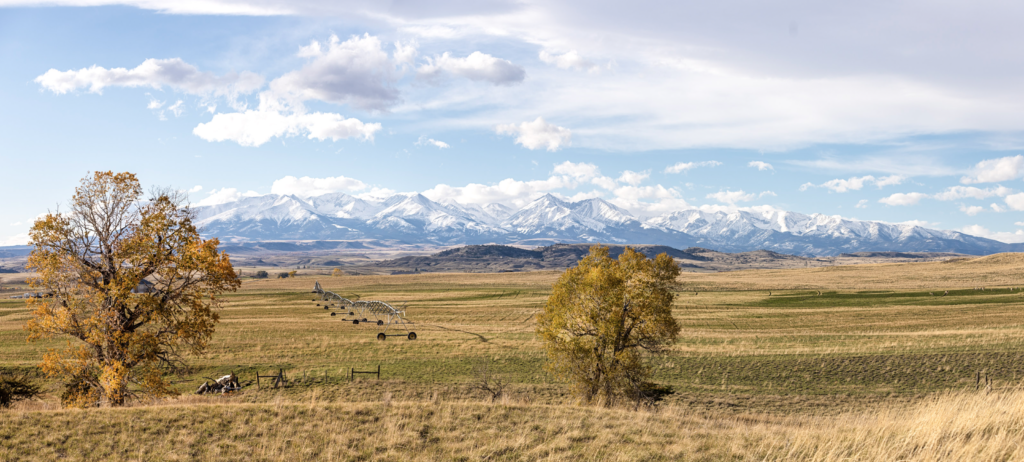
I sat on a big rock and looked out across the foothills toward the snowcapped mountains that rose from the prairie floor. It looked as if I could reach out and touch the tops of the peaks though they were miles away. I was always in awe of the mountains even on the days they were distant and dared anyone to approach. 

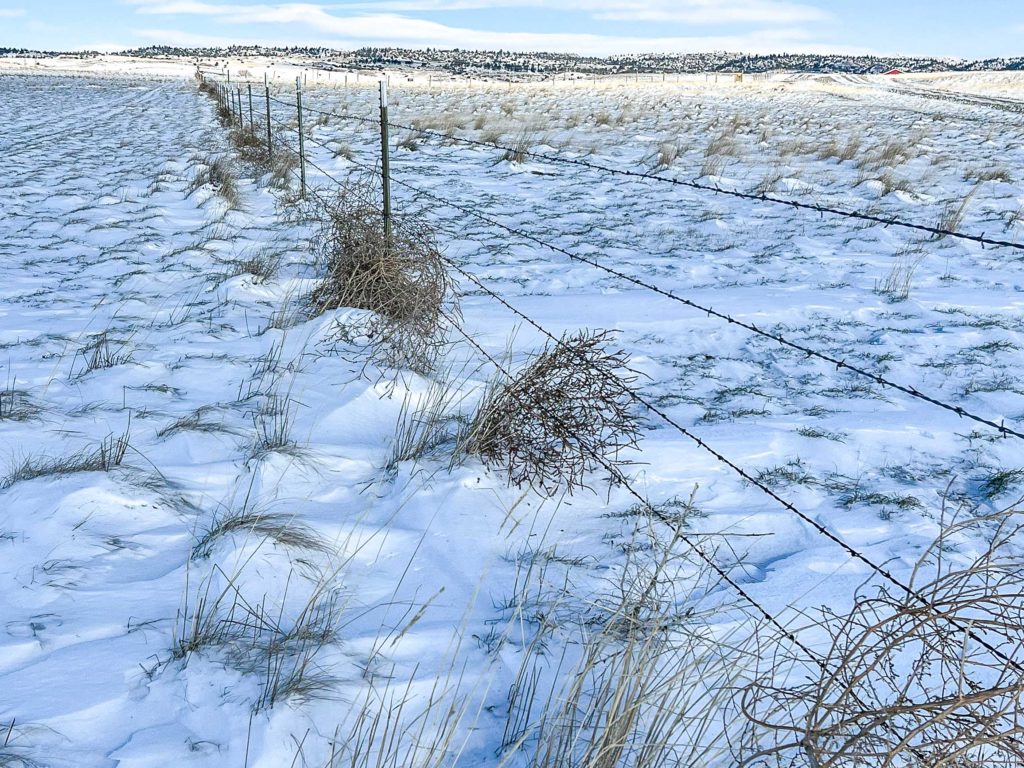
A breeze tugged at my hair and awakened me from my trance as the wind blew across the wide-open countryside, tossing tumbleweeds that jumped over clumps of sagebrush. Just beyond, uprooted grasses and weeds of various kinds clung to the barbs of a fence.  As the tumbleweeds reached the barbed wire, they finally found a resting place. As I took in the whole scene, I felt kind of like one of those tumbleweeds that rolled across the prairie.

During my growing up years, we moved from place to place. Living in parsonages with cast off furnishings of members of the congregation was not really a place to call home. However, there was one constant – the town where my grandmother lived. She spent most of her life in the mountains and even after she moved to town, they remained in view and gently spoke her name. It was there in the mountains where my father was born. When he married the girl from the prairies, she went to live with him in his mountain home and it was there that five of their six children were born. Those were their roots, their place to call home. 

I came along later. Though I was small the first time I saw the mountains, it was as if they whispered my name. After each visit, the silent call became louder. I heard it in the wind that whistled through the trees and in the gusts that blew through the valleys. Others before me heard the call, too, and many answered. My great grandmother found refuge there in the mountains that spoke to her. Native Americans heard the call and climbed the mountain peaks in search of wisdom through visions to lead their people. Even now, many who visit there find solace and can feel the sacred reverence.

When I married, we almost moved to the mountains. Instead, we made a vow that one day we would move to the place where the mountains lifted from the prairie floor, the place held sacred to those who had walked among the valleys and peaks and lived in its shadow. 

Yes, there were many places I called home, where we raised our children and spent time with grandchildren. Yet I still heard the voice calling. After many years, the dream I had as a child was within my grasp and now, I see the mountains every day. When my siblings see pictures of the roads that lead into the mountains, they say it looks like the road home. 

Just as those tumbleweeds that found a place of rest in view of the mountains that speak, it is here we found the place we will call home and rest for a time.

“The mountains are calling, and I must go…”    John Muir

Strawberry Roan

“Margaret, sing Strawberry Roan.”

She continued crocheting and said, “I don’t want to sing Strawberry Roan.”

The man continued to slap his leather gloves into his left palm and gently grasped them as he pulled them through time and again. He wore a faint grin, and after a bit said, “Margaret, why don’t you sing some of Strawberry Roan?” 

She looked up then, her annoyance clearly showing by the scowl on her face and her curt response, “I don’t want to sing Strawberry Roan. I don’t remember all the words.”

There was silence except for the slap of the gloves of the man that sat in his easy chair. He tilted his head slightly, amusement on his face and a twinkle in his dancing blue eyes as he said, “Margaret, sing some Strawberry Roan.”

She gave a quick retort, but after a pause she sang a few lines of Strawberry Roan.

I watched from the other room and thought, “That sweet little man is not quite as innocent as he seems. What an instigator!”

In my grandmother’s younger years, she played the guitar and sang. I never heard her play. One day I asked her to write down some of the old songs. Strawberry Roan was one of those. Here’s a stanza:

He’s about the worst bucker I’ve seen on the range
He’ll turn on a nickel and give you some change
He hits on all fours and goes up on high
Leaves me a spinnin’ up there in the sky
I turns over twice and I comes back to earth
I lights in a cussin’ the day of his birth
I know there are ponies that I cannot ride
There’s some of them left, they haven’t all died

I’ll bet all my money, the man ain’t alive
That’ll stay with old strawberry
When he makes his high dive

Born on the Fourth of July

A Tribute to Aunt Ellen aka “Sister Ellen”

Fourth of July celebrations began early that day in 1923. A seven-pound firecracker baby girl was born and that was cause to celebrate. Every year after, fireworks exploded into bright cascading waterfalls and thousands of whirling, spinning, sparkling lights that dissipated into the air. We always knew the fanfare was in honor of Sister Ellen’s birthday. She wasn’t Sister Ellen to us kids, she was Aunt Ellen, and we knew her personality well suited the fireworks that added to the celebration of her birthday.

We heard many stories of the lives and adventures of much of the family, but I believe the ones we heard most were of Sister Ellen. She was even in Daddy’s sermons, you know – the gospel according to Sister Ellen. There were many hidden spiritual truths in all the Sister Ellen illustrations we heard from the pulpit. 

Sister Ellen was a kid, and then a woman of many facets. She was called Soup by her dad, Sookie by Grandfather Ward, Sister Ellen or just Sister by Brother Buck, Toby by Cousin Anna, Potatuses, and Nellie. During her lifetime, she had many roles including that of a writer, warrior, ambassador, and sometimes even a conniver. Sister Ellen was also a bus driver. Yes, she sat in the saddle on old Spider and held the reins while Brother Buck sat behind prodding Old Spider whose belly moaned and complained all the way to the mountain one-room schoolhouse. 

She took up arms against her English Grandfather Ward. It didn’t take much for him to set her off like a rocket ready to launch. When he broke his leg, she took advantage of his convalescence as he rested in his bed. It seems she always had someone do her bidding, that “someone” being her little brother Buck. She had to have someone to blame! Her scheme worked when she persuaded the younger brother to push sawdust through the knothole into the face of Grandfather Ward.

When she wanted a new doll, she buried her old one in the sawdust pile and had a funeral for it, appointing Brother Buck to be the presiding minister. That may have been his first call into the ministry. When she conveniently couldn’t find the doll again, she asked for a new one – a prettier one – for Christmas, which she got. There were many other incidents and tales including Effie Bowlegs, the outhouse, Nimmy Not and the bear, other confrontations with Grandfather Ward, shenanigans with cousins, and pushing her sweet little brother.

Aunt Ellen had the gift of words – spoken and written – and there were many. She was Valedictorian of the rural schools, worked for The Sweet Grass News, and wrote for The Big Timber Pioneer. After High School, she took a business course in Helena, Montana and accepted a stenographic position in the State Legislature. Later, she was secretary to the City Manager in Santa Barbara, California. She got to know visiting dignitaries from other municipalities and foreign countries, one being an Assistant City Manager of Jerusalem.

When Sister Ellen went on a tour of the Holy Land with Brother Buck and some of their cousins, the dignitary she knew from Jerusalem gave them a private tour of the city. When they traveled to another country, she came to the rescue of a fellow traveler who had an unacceptable passport. She was fearless, marched into the American Embassy, took care of the matter and somehow managed to receive a special tour of an ancient Roman City. When Daddy returned home, he laughed when he told that Sister Ellen ordered strange things to eat while on their trip. Her philosophy was, “Well, I wouldn’t eat that at home.” Brother Buck followed suit, ordered strange things, and embraced that philosophy for himself, and I am a witness to that!

Brother Buck and Sister Ellen exchanged many letters over the years. She would send him a story she had written and then say, “Now you write…” He completed his assignment and sent it to her with a challenge to write something else and reach for even great achievements. Often, they read the same book and then discussed the contents in great lengths. They spurred one another on just as when they were kids with Ellen holding the reins and Brother Buck spurring Old Spider on with a kick in the flanks. 

During those years, the trail before them sometimes may have been covered with trees or with grass growing between the ruts. There were curves in the road and bumps here and there. Yet they continued to travel together, exhorting, encouraging, challenging, and praising one another. As their lives neared an end, she pushed him forward to lead the way. He complied and went on without her. At the age of 99, she joined him. Fireworks lit up the sky to signal the coming of a new year, or maybe, just maybe it was celebration of her entrance through the gates of heaven as she left this earth on New Year’s Eve. Little did she know that within just a few hours, they would welcome a favorite cousin who was proclaimed to be “another sister.”

Looking back now, the path seems clear. Their bonds of friendship and devotion to family opened the way for those who travel in their footsteps. I like to think that even now they walk side by side, but they just might be too busy talking.

Brother Buck once summed up the life of Sister Ellen,

You are the work of mystery,
You carry the seeds of majesty,
You are the works for miracle,
You carry the breath of eternity.